Why Can't My Partner Just Love Me for Me? (Without the Labels, the Therapy Homework, and the Pressure to Be "Fixed")
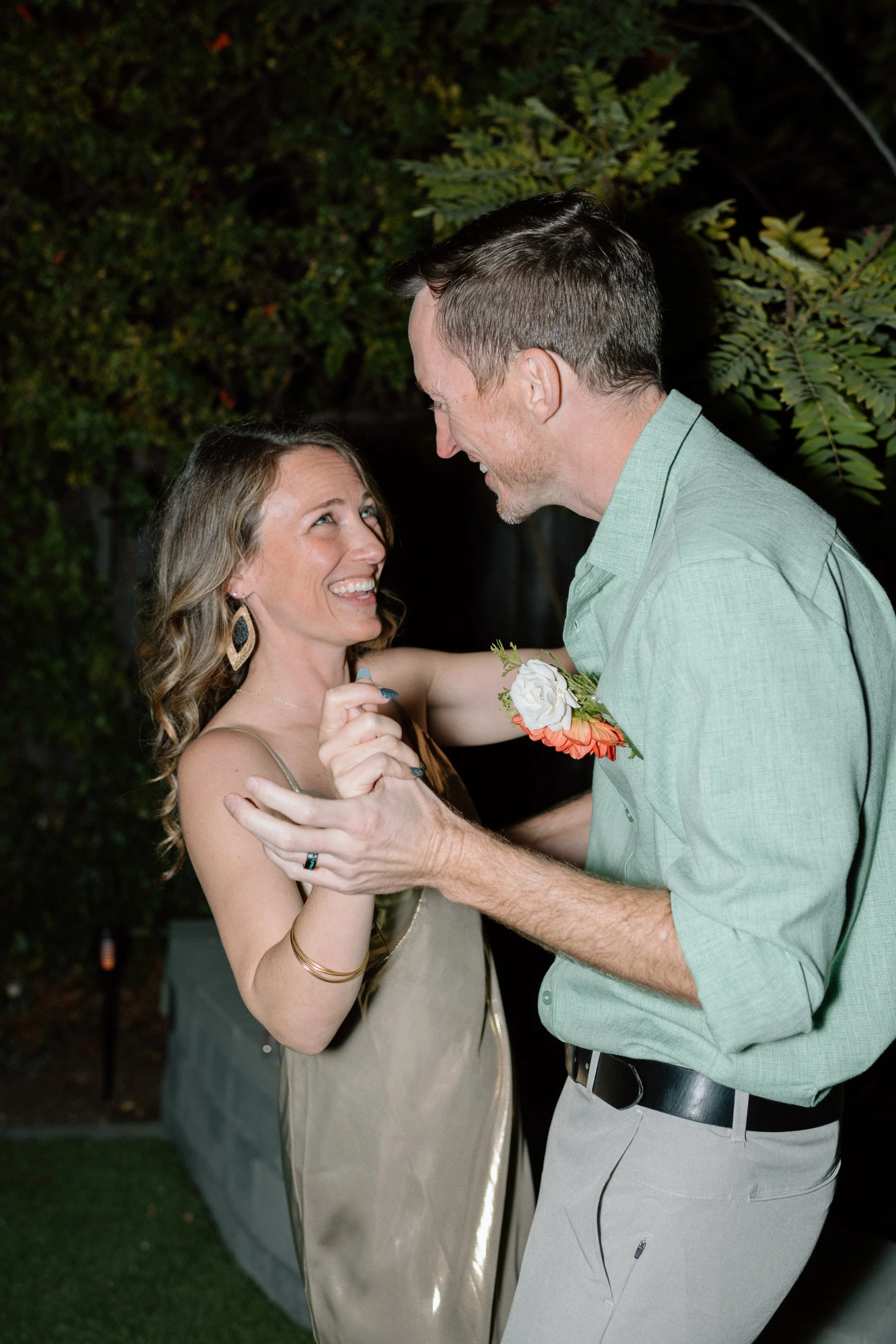
Smiling Amy dancing with her partner Kevin on their wedding day
A Real Answer from a Couples Therapist Who Gets It
If you've ever whispered this question to yourself at 2am, staring at the ceiling while your partner sleeps peacefully beside you — this post is for you. Grab a snack. We're going to talk about this honestly, with warmth, with clinical backbone, and yes, with a little humor. Because sometimes the only way through the heavy stuff is to laugh a little while we carry it. I have helped hundreds of couples through this, as well as personally went through this. You are not alone.
The Question That Breaks My Heart (In the Best Way)
I have sat across from hundreds of people in my therapy office — brilliant, funny, tender-hearted, wildly creative people — who have asked me some version of this same question:
"Why can't my partner just love me… for me? Without the label. Without the treatment plan. Without making me feel like I'm a project that needs to be completed before I'm worthy of real intimacy?"
Sometimes it comes out quietly, barely above a whisper. Sometimes it comes out angry and hot, after an argument about whether or not someone remembered to take their medication or finish their laundry. Sometimes it comes out as a sob in the middle of a session that neither person saw coming.
And every single time, I want to pause the clock and just sit with how much courage it takes to say that out loud.
Because here's the thing — this question is not a sign that you're being unreasonable. It's not evidence that you're resistant to growth, allergic to accountability, or using your diagnosis as an excuse. It is a deeply human cry for the most fundamental thing any of us needs:To be loved as we are.
Right now, as is. Raw, messy, imperfect, human.
Not as who we might become after enough therapy, medication adjustments, and emotional regulation worksheets, altering our personality, and who we fundamentally are now.
But here's also the other thing — and I say this with enormous compassion — the question is also covering up several other questions that are even harder to ask.
So let's peel this back. Slowly. Carefully. Without judgment.
What You're Actually Asking When You Ask This
When my clients say, "I just want to be loved for me," they are rarely — almost never — actually saying, "I refuse to grow or change or work on myself."
What they're usually saying is one or more of these things:
"I'm exhausted." The constant work of managing a neurodivergent brain in a neurotypical world is genuinely, physically, emotionally exhausting. Adding a partner who catalogs your symptoms feels like adding insult to injury.
"I feel more like a diagnosis than a person." When every conversation about your relationship detours into your ADHD, your autism, your trauma responses — you stop feeling like a partner and start feeling like a case study.
"I'm scared the real me isn't lovable." This is the deepest one. The one hiding underneath all the anger and frustration. The fear that if your partner could see all of you — the rejection-sensitive dysphoria, the executive dysfunction, the shutdown days, the sensory overwhelm — they'd leave.
"I need my partner to be on my team, not managing me." There's a particular grief that comes with feeling like your romantic partner has become your caretaker, your accountability coach, and your diagnostic committee all at once.
"I don't trust that love based on 'fixing me' will survive when I'm still me." This is genuinely wise. Love that is contingent on your improvement is not the kind of love that weathers a hard winter.
So when I hear "Why can't you just love me, for me?" — I hear all of those questions layered inside it. And they all deserve real answers, unpacked with self-compassion, and co-compassion.
The "Label Problem": Why Diagnoses Feel Like Criticism
Let's talk about labels for a minute, because this is something I navigate in my practice constantly.
For a lot of neurodivergent people — particularly those diagnosed with ADHD or autism in adulthood — a diagnosis is a relief and a wound at the same time. It's relief because suddenly your whole life makes sense. The way you've always felt different, struggled in ways that seemed invisible, been told you were too much or not enough — there's finally a framework for it.
But it can also be a wound because diagnoses, in the wrong hands, become weapons.
I don't think most partners wield them intentionally as weapons. I genuinely don't. But here is what can happen:
Before the diagnosis, a partner might say: "You forgot our anniversary AGAIN — do you even care about me?"
After the diagnosis, the same partner might say: "You forgot our anniversary again. Is this the ADHD? Did you take your medication? Did you use the calendar I set up for you?"
Now. On paper, the second version sounds more informed, more compassionate, more clinical. But here's what the person on the receiving end often hears:
"You forgot because you are broken. You are broken in a named, documented, clinically recognized way. And I have set up systems to manage your brokenness. You're welcome." It doesn’t feel good often, it makes the inner child feel like they are being parented, and takes away their autonomy at times.
The label didn't create more love. It created a more sophisticated taxonomy of disappointment.
This is one of the most common dynamics I see in couples where one or both partners are neurodivergent or have a medical condition that disables him. The diagnosis becomes the lens through which every conflict, every miscommunication, every forgotten task is filtered. And over time, the neurodivergent partner stops feeling like a whole person in their relationship and starts feeling like a symptom cluster walking around in a human body.
And for those with trauma histories? Oh, friends. This is particularly loaded.
Many people with complex trauma (C-PTSD) have entire nervous systems that were wired in environments where love was conditional. Where affection was withdrawn when you misbehaved, when you were too loud, when you cried too much, when you weren't achieving enough. The message absorbed into their bodies was: You must perform wellness in order to deserve love.
And then they enter a relationship where, even with the best intentions, their partner is essentially saying: "Work on yourself, and I'll be able to love you better."
Can you imagine what that lands like in a nervous system that grew up learning exactly that lesson?
Autism, ADHD, and Trauma: When Your Brain Is the Thing Your Partner Wants Fixed
Let me get a little more clinical here, because I think it helps to understand why this particular combination — autism, ADHD, and trauma — creates such a specific and painful relationship dynamic.
ADHD in Relationships
ADHD is not a productivity problem. It is a regulatory problem. People with ADHD have differences in dopamine transmission that affect not just attention, but emotional regulation, time perception, working memory, and impulse control.
What this looks like in relationships:
Forgetting important dates, conversations, or tasks — not because they don't care, but because their brain's filing system works differently
Hyperfocusing on a new relationship (the "hyperfocus honeymoon") and then appearing to "check out" once the novelty fades — which can feel like abandonment to a partner
Rejection Sensitive Dysphoria (RSD) — an intense, often overwhelming emotional response to perceived criticism or rejection that can look like overreaction but is neurologically real
Time blindness — being genuinely unable to perceive the passage of time the way neurotypical people do
Starting projects with enormous enthusiasm and struggling to finish them, which partners can misread as laziness or lack of commitment
Here's the thing about ADHD and love: people with ADHD often feel emotions more intensely, not less. They fall hard. They love deeply. They are some of the most passionate, loyal, wildly creative partners you will ever have.
But if their partner's primary experience of them is as someone who needs to be managed — reminders, systems, accountability check-ins — the ADHD partner often begins to feel more like a child being supervised than an adult being loved.
Autism in Relationships
Autism in the context of romantic relationships is wildly misunderstood, and honestly, the therapy field has not done a great job of getting this right. I recommend everyone to educate themselves on Autism.
The old narrative — that autistic people lack empathy, don't want connection, prefer to be alone — is not just outdated. It is clinically wrong and genuinely harmful.
Many autistic people in my practice experience what's called hyper-empathy — they feel others' emotions so intensely that they become overwhelmed by them. They want deep, authentic connection, but the performance of social connection that neurotypical culture demands is exhausting and often feels dishonest.
What this looks like in relationships:
Difficulty with small talk or "performing" emotional attunement in ways that feel performative
Strong preferences for routines and consistency that can feel rigid to a neurotypical partner
Sensory sensitivities that affect physical intimacy, shared living spaces, and daily routines
Communication differences — being direct and literal in ways that can read as harsh or cold
Masking — the exhausting performance of neurotypicality that many autistic people do all day and then completely drop at home (which can feel like their partner "gets the worst of them")
Here is the killer dynamic I see in couples with an autistic partner: the autistic partner masks all day at work, at the grocery store, at family dinners — and then comes home and unmasks, which looks to their neurotypical partner like shutting down, pulling away, or not caring.
And the autistic partner is thinking: I trust you enough to be real with you. This is me loving you.
Meanwhile, their partner is thinking: They save nothing for me. They're checked out. They don't care about our relationship.
They are having two completely different experiences of the same moment. And without the language to bridge that gap, it can feel like evidence that the relationship is broken — when actually it might be evidence that it's working, just in a different language.
Trauma
Trauma is the thread that runs through so much of what I've just described. Because here's the thing: neurodivergent people are significantly more likely to have trauma histories.
Why? Because growing up different in a world that doesn't understand or accommodate your brain means a lifetime of:
Being told you're too much, too sensitive, too loud, too weird
Being punished for behaviors that were neurological, not intentional
Failing in school systems not designed for your brain
Being socially excluded, bullied, or misunderstood
Receiving medical or therapeutic "treatment" that felt punishing rather than supportive
This creates what we callrelational trauma— wounds specifically around connection, trust, and intimacy. And when that person enters a relationship where they are again being asked to change, to improve, to become more acceptable — even by someone who loves them — that nervous system goes: Here we go again.
This is not being difficult. This is a nervous system doing exactly what it learned to do to survive.
Love vs. Accommodation: Where Couples Get Confused
Okay, I want to make a distinction here that I think is genuinely important and often missed.
There is a difference between asking someone to accommodate your needs and asking someone to fundamentally change who they are.
Let me give you an example.
If your autistic partner has a sensory sensitivity to loud noise, and you love hosting big, loud dinner parties — asking them to attend every single one of those parties without any accommodation is not neutral. It is asking them to suffer. It is, however kind you intend it, saying: My comfort with socializing matters more than your nervous system.
On the other hand, if your partner with ADHD forgets to pay bills on time and you set up automatic payments together — that's not "fixing them." That's accommodation. That's meeting your partner's brain where it actually is.
The question "why can't you just love me as I am?" sometimes, not always, conflates these two things.
Sometimes what feels like a demand to be "fixed" is actually a partner saying: "I need us to figure out a way to live together that doesn't leave me drowning."
And sometimes what's framed as "helping you grow" is actually a partner saying: "I want you to become someone different than you are so that I am more comfortable."
Both of these things are happening in relationships everywhere. And figuring out which one is operating in yours — or whether it's both, layered on top of each other — is genuinely complicated work.
This is actually why couples therapy with a neurodivergent-informed therapist can help. Not because you need to be fixed, but because you need a translator. Someone who can help you and your partner figure out what's actually being asked, what's actually being heard, and what's actually possible.
The Painful Truth About Unconditional Love (It's Not What Either of You Think)

Couple kissing the sunlight, women standing on her tip toes
Let me say something that might land with a gentle thud:
Unconditional love does not mean accommodation of all behaviors.
I know. I know. But stay with me.
Unconditional love — real, enduring, grown-up love — means: I love you, the fundamental you, regardless of your failures, your struggles, your worst days.
It does not mean: I will never have needs of my own. I will never feel hurt by things you do. I will never ask for things to be different between us.
Love and accountability can coexist. In fact, they must. Otherwise one person in the relationship eventually becomes a martyr, and the other becomes an emotional toddler who has never been asked to stretch. And I've seen both outcomes. Neither is great.
Here's Where I See Couples Get into Trouble:
The neurodivergent partner (or the partner with trauma) hears any request for change as evidence that they are fundamentally unlovable as they are.
The other partner, exhausted and hurting, begins framing everything as a symptom to be solved because it feels more manageable than saying "I'm lonely and scared and I don't know how to reach you."
Neither of these positions is loving. Both of them are understandable.
That's different from one person being the project and the other being the manager.
When "Getting Help" Feels Like "You're Not Enough"
This one is personal for a lot of my clients, and I want to name it directly.
There is a very specific pain that comes when the person who is supposed to love you most is also the person advocating most loudly for you to be in therapy, on medication, getting assessments, reading books about your own brain, attending support groups, and generally running a full-time personal development operation on top of your actual life.
I want to be careful here, because I am a therapist who obviously believes in therapy. And medication, when indicated, is a genuine gift for a lot of people. I'm not saying any of this is wrong.
What I'm saying is: the delivery matters enormously. The context matters. The power dynamic matters.
When a partner consistently positions themselves as the one who has it together and you as the one who needs intervention — even if it's completely unintentional — it creates a one-up/one-down relationship dynamic that quietly poisons intimacy.
Real intimacy requires vulnerability on both sides. It requires the space for both people to be a mess sometimes, to not have the answers, to be learning as they go.
And for the partner who has been told their whole life — by parents, teachers, therapists, bosses — that they need to be improved, that message coming from their romantic partner can feel absolutely devastating.
It doesn't matter that your partner means well. It doesn't matter that they've bought all the books and done all the research and are just trying to help. When every conflict circles back to your diagnosis, when every bad day becomes evidence for a new intervention, when you feel like you're in a constant performance review for your own relationship — that is not sustainable. That is not intimacy.
That is managed care. And you deserve more than managed care from your romantic partner.
What Your Partner Might Actually Be Feeling (Don't Shoot the Messenger)
Okay. Now I'm going to ask you to do something hard for a moment. I'm going to ask you to consider what your partner might be experiencing. I know. You're already doing so much emotional labor. Hear me out anyway.
Partners of neurodivergent people — particularly when one or both people also carry trauma — often feel incredibly lonely. Not because their partner doesn't love them. But because connection can be hard to access, communication can feel like a minefield, and they often don't have a script for how to navigate this relationship well.
Many partners of neurodivergent people grew up in neurotypical families, with neurotypical relationship models, and zero education about ADHD, autism, or trauma responses. They were handed a set of tools that genuinely don't work in this relationship. And they don't know that yet.
So they do what makes sense with the tools they have. They try to solve the problem. They research. They suggest interventions. They make systems. They track patterns.
And they wonder why none of it is creating the closeness they desperately want.
Here is what some of my clients' partners have said to me in sessions, when I've given them space to be honest:
"I feel like I can never say the right thing. Everything I do either isn't enough or is too much or is 'triggering' something. I'm terrified to even be honest about my needs because I've learned that it will cause a shutdown or an explosion."
"I love them so much. I just don't know how to reach them. So I try to fix things because at least that feels like doing something."
"I'm exhausted too. But I feel like I'm not allowed to say that because their struggles are 'clinical' and mine are just... complaining."
These are not bad people. These are two people in love who are ALSO struggling. Who are also scared. Who also deserve compassion.
This is why I don't take sides in couples therapy. Both people in this room are hurting. Both people are trying. Both people are telling a story about the relationship that is true from where they're standing and incomplete from where their partner is standing.
The relationship is the client. Not either individual.
The Real Villain in This Story (Hint: It's Not Either of You)
If I had to name the real antagonist in most of the relationship struggles I see — the thing that is actually causing the most damage — it would be this:
A world that was not designed for neurodivergent brains, and the shame that accumulates when you spend a lifetime navigating it.
Seriously. That's the villain.
The shame that you've internalized about your ADHD — the decades of "why can't you just focus," the lost jobs, the incomplete projects, the being called lazy or irresponsible — that shame doesn't stay in a box. It seeps into your relationships. It makes you defensive when your partner raises a concern because your nervous system hears "you're failing again."
The grief of being autistic in a world that pathologized your natural way of being — the years of being told your communication style is wrong, your emotional responses are wrong, your interests are too intense, your body language is off — that grief doesn't disappear when you fall in love. It follows you into every room, including your bedroom.
The trauma of having been taught that you are too much to be loved as you are — that love is something you earn, something that can be withdrawn, something contingent on your performance — that doesn't just switch off because your partner has good intentions.
These things have been written onto your nervous system in the ink of a thousand painful experiences. And they absolutely, without question, affect your relationships.
But here's what I need you to hear:
That is not your fault. And it is not evidence that you are unlovable. It is evidence that you have been trying to survive in a world that didn't make room for you, and that has cost you something enormous.
Your anger at the question — "why can't you just love me as I am?"— makes complete, total, clinical sense. You are not overreacting. You are not being difficult.
You are a person who has been asked to change themselves their entire life, and you are exhausted, and you just want one safe place where you don't have to.
I hear that. Completely.
What Healthy Neurodivergent Love Actually Looks Like
I don't want to just name the problems. Let me paint a picture of what I actually see when neurodivergent couples — or couples where one or both partners have trauma — get it right.
Because they do get it right. I've seen it. It's genuinely beautiful.
Healthy Neurodivergent Love Looks Like:
Curiosity instead of correction. Instead of "why did you do that?" it's "help me understand what was happening for you so I can see your perspective." The goal is understanding, not behavior modification.
Accommodations that come from collaboration, not management. Systems and supports are created together, based on what actually works for both people — not handed down by the "functional" partner to the "struggling" one.
Both partners' nervous systems are considered. The autistic partner's sensory needs AND the anxious partner's needs for predictability. The ADHD partner's need for spontaneity AND the partner's need for some structure. No one person's neurology is treated as the obstacle.
Repair is normal and expected. Both people know they will mess up. Both people have language for how to come back from it. Rupture and repair is not a failure — it's how intimacy deepens.
The diagnosis is information, not identity. "Your ADHD might be part of what made that hard" is useful. "The ADHD again" is dismissive. Healthy couples learn to use diagnostic language to build bridges, not to file grievances.
Therapy is a resource, not a verdict. Couples therapy is not "you need to be fixed." It's "we are two people who love each other and we'd like some help with this specific thing." Going to therapy means your relationship is worth investing in. It means you both care enough to show up.
Both people feel like whole people, not roles. Not caretaker and patient. Not functional one and struggling one. Two complete, complicated, lovable humans who have chosen each other.
The relationship has room for joy. I cannot tell you how many couples I've seen who are so consumed by the work of the relationship — the communication exercises, the attachment style analysis, the emotional regulation check-ins — that they have completely forgotten to enjoy each other. Healthy love laughs. It plays. It is sometimes absolutely ridiculous. Make room for that.
Real Steps You Can Take Right Now
Whether you're the one asking "why can't you just love me?" or the partner who doesn't know how to stop managing and start connecting — here are some things that can genuinely help.
For the Partner Asking:
"Why Can't You Love Me As I Am?"
Name the specific feeling, not just the category.
Instead of "I feel like you don't accept me, for me" try: "When you send me an article about ADHD after I forget something, I feel like I'm being evaluated, not loved." Specificity opens doors that generalizations close.
Separate the shame from the truth.
Sometimes the intensity of our reaction to a partner's concern is about old pain, not just the current moment. This doesn't mean your feelings aren't valid — they absolutely are. But it's worth asking: How much of this is about right now with my partner, and how much is the voice of everyone who ever made me feel like I wasn't enough?
Get clear on what you actually need.
Not just "stop labeling me." But: "I need you to be able to sit with me when things go wrong without immediately looking for a solution. I need you to say 'I love you' without the 'but.' I need to feel like you're on my side." Specific needs are negotiable. Vague needs leave everyone lost.
Consider what you're actually afraid of.
Is the question "why can't you love me as I am?" maybe really "I'm afraid that if you see all of me, and you'll leave"? If so, that fear deserves direct attention — possibly in individual therapy, and possibly in couples therapy together.
Allow yourself to be a full person, not just a neurodivergent person.
Your ADHD is part of you. Your autism is part of you. Your trauma history is part of you. But so is your sense of humor, your passions, your specific way of loving people, your midnight thoughts, your weirdo hobbies. Make sure your relationship has room for all of those parts. If you've been reduced to your diagnosis, it's worth asking when that started and how to reclaim more of yourself.
For the Partner Who Wants to Love Better:
1. Stop researching & pathologizing your partner.
Seriously. Put down the ADHD podcasts. You learning about neurodivergence is genuinely helpful — up to a point. Past that point, it becomes a way of keeping your partner at arm's length behind a wall of clinical knowledge. They are not a TED talk. They are a person.
2. Ask about their experience, not their symptoms.
"How are you feeling about us?" not "I read that rejection sensitive dysphoria might be why you reacted that way." One is intimacy. One is a diagnostic observation. They feel very different to receive.
3. Get your own support.
Partners of neurodivergent people often carry significant emotional burden without naming it or getting help with it. Individual therapy, support groups for partners of people with ADHD or autism — these are not betrayals. They are ways of not making your partner responsible for all of your emotional processing about the relationship.
4. Let yourself be taken care of too.
Sometimes the "managing" dynamic develops because one person has made themselves indispensable as the organizer, the planner, the researcher. And then they feel resentful that no one is doing that for them. But are you actually allowing yourself to be cared for? Are you letting your partner see where you struggle?
5. Learn your partner's love language — not their diagnosis.
How do they show love? How do they receive it? What lights them up? What makes them feel most safe? These answers are in your partner, not in a clinical handbook.
When to Know It's Time for Couples Therapy
I'm going to be honest with you: couples therapy is not a last resort. Couples therapy is actually most effective when it starts before things have deteriorated too much — before too much contempt has accumulated, before both people have already half-checked out.
Consider Couples Therapy if:
You find yourself having the same fight over and over with no resolution
One or both of you feel consistently unheard, unseen, or misunderstood
A diagnosis (ADHD, autism, or any mental health condition) has shifted the dynamic in your relationship and created distance
Physical or emotional intimacy has significantly decreased
You love each other but can't seem to reach each other
One person consistently feels like the "project" and the other feels like the "caretaker"
Communication has broken down to the point where you either fight or go silent — with no middle ground
You've been wondering whether this relationship is workable, but you haven't answered the question
When looking for a couples therapist, specifically ask about:
Their experience with neurodivergent couples
Their familiarity with ADHD in relationships and adult autism presentations
Their approach to trauma (look for someone who is trauma-informed, meaning they understand how trauma shows up in relational dynamics)
Whether they have a neurodivergent-affirming approach (meaning they do not frame neurodivergence as a problem to be solved)
A Good Couples Therapist Will:
Not take sides, but will name dynamics when they see them
Create enough safety that both people can actually say the things they're really afraid to say
Help you build a shared language for your specific relationship
Challenge both of you — gently and directly
Be able to laugh with you occasionally, because life is absurd and relationships are hard and sometimes you need someone to acknowledge that
Amy’s Final Thoughts: You Deserve to Be Loved as You Are
Here's where I land after all of this.
You deserve to be loved as you are. Full stop. Not as a project. Not as a potential. Not as a before-and-after.
As. You. Are.
That love is not incompatible with growth. It's not incompatible with therapy or medication or working on communication skills or learning how to be a better partner. Real love — the kind that lasts — grows alongside people. It doesn't wait for them to be finished before it shows up.
What it is incompatible with is the constant message that you are too broken, too difficult, too much or too little — that you need to earn your place in your own relationship.
You don't.
And also — and I'm holding both of these truths at the same time, because that's what nuance is — the people who love us are sometimes asking for things that feel like criticism but are actually just needs. Their needs matter too. Their exhaustion is real. Their longing for connection is real.
The magic of a truly great relationship — especially a neurodivergent one — is not that there are no rough edges. It's that both people have decided, over and over, that the love is worth the learning.
You are worth Loving. Exactly as You are.
Your relationship is worth fighting for. Not fighting with each other — fighting for each other. And if you need a little help with that fight? That's literally what I'm here for.
If this post resonated with you and you're wondering whether couples therapy might help — whether you're neurodivergent, your partner is, both of you are, or you're just two humans trying to love each other better — reach out. A 15 minute consultation call costs you nothing but a little courage, and you've already proven you have plenty of that by reading this far.
Written by a couples therapist specializing in trauma, ADHD, and Autism. This post is intended for educational and supportive purposes and does not constitute clinical advice or establish a therapeutic relationship.