Why Trauma Shows Up Stronger in High-Performing Relationships

two people staring lovingly into each other’s eyes.
High-performing couples—you know the type. They kill it at work, juggle schedules like Olympic athletes, and seem, from the outside, to have it all put together. And yet… their relationships often feel like emotional land-mines, often unknown to even themselves. Why does trauma show up stronger in high-achieving partnerships you ask? And why do so many successful couples find their relationships tougher than their highest success and alcolaids?
As a trauma-informed couples therapist in sunny San Diego California with decades of experience treating high-functioning adults, families, and couples, I’ve seen this dynamic play out again and again in different systems. There’s both science behind it—and a bit of that “wait… why is this happening?” humor and self-acceptance that can be the healing magic for these high achievers. Let’s unpack it from both research and clinical angles together, like always.
1. High Achievement ≠ Emotional Immunity
This may seem obvious, but it’s worth stating off the gate: high performance in career or life does not protect someone from trauma’s longterm effects. In fact, something about high achievement can magnify the trauma responses in relationships. As I have had to rumble with my own human-ess, my childhood trauma makes me an excellent therapist, however often a crumby family member. And that is why therapists cannot work with their family and or have dual relationships with clients to ensure that does not occur.
Early research on attachment and trauma reveals this dynamic clearly in the cycles of love. Adults with insecure attachment histories—often related to early trauma—tend to show stronger emotional reactivity in close relationships, especially under stress (Mikulincer & Shaver, 2003). These patterns can be well-hidden in professional settings, only to surface when emotional vulnerability is on the table in their personal life. Often times it does impact how it plays out at work as well.
So that high-performing CEO who can run global initiatives? May still collapse into a puddle of anxiety—or shutdown defensiveness—when their partner suggests, “We need to talk.” My least favorite words as a therapist. LOL!
2. The Performance Mask: Why High Achievers Hide Vulnerability
Now let’s sprinkle in a bit of clinical insight. High-performing clients often tell me things like:
“I just want the right strategy.”
“Tell me exactly what to do.”
“I don’t want feelings—I want solutions.”
These statements are familiar because they’re usually masking fear of emotional discomfort with a higher level of strategy also known as control, fear, or anxiety. From a trauma lens, responses like this are not uncommon. Many people who experienced early emotional pain learned early on—consciously or unconsciously—that feelings were “too risky” or “too much” and would often lean to overperforming to avoid those feelings. These survival strategies work great for getting things done at work… not so well for intimacy, emotional awareness, as they are often left emotionally numb and or stunted by the components. In trauma research, this is called emotional avoidance, a key feature of post-traumatic stress responses (Foa, Ehlers, Clark, et al., 2005). When emotion feels unsafe, avoidance becomes habitual. In the workplace? Avoidance can be channeled into productivity. In relationships? Not so much when it comes to the matters of the heart.
3. Stress + Attachment = Relationship Reality Check
Research from the early 2000s highlighted how stress triggers attachment systems (Hazan & Shaver, 2000). High performers operate near the edge of chronic stress—tight deadlines, high responsibility, constant expectations of them. Over time, biological stress responses can get sensitized.
Here’s where this becomes relationship gold (of the painful variety):
When life stresses hit—sick kids, financial uncertainty, aging parents—the nervous systems of high performers shift from achiever mode to survival mode. I have seen this firsthand within my own family and with so many clients. This triggers attachment needs that were neutralized or ignored for years.And here’s the kicker:
They often don’t recognize those attachment signals as needs. They may experience them as:
irritation
withdrawal
anxiety
rage
This fits with research showing that attachment insecurity is more reactive under stress (Mikulincer & Shaver, 2003). Partners start to feel this as:
“You don’t care about me.”
“You shut down.”
“Why are you so angry?”
In other words, the trauma echoes. Being able to identify the feelings as historical verses now is helpful to separate and to talk about with your partner, so there can be a plan in place for these trauma echoes.
4. The “Fixer” Myth in High-Achieving Relationships
Another frequent pattern I see clinically is the “fixer” mentality. High performers are solution-oriented by nature.
But here’s where it gets tricky in relationships:
Trauma healing isn’t linear. It’s messy, unpredictable, and full of emotion—precisely the kinds of things high achievers often hate and avoid. Couples will say:
“We argue about the same thing every week.”
“He won’t talk feelings.”
“She jumps to conclusions.
“They are too emotional.”
“We both can’t have the control.”
Sound familiar?
One reason this happens is that trauma impacts how people process emotional information. Research on trauma survivors shows alterations in neural processing of emotional cues and negative stimuli (Rauch et al., 2000). So when one partner says something that feels like rejection—even if it’s not intended that way or perhaps a bit—people with trauma histories can interpret it as danger due to feeling they will be abandoned.
And instead of curiosity, their partner hears defensiveness.
Instead of empathy, they hear cold logic.
It’s no wonder high achievers sometimes feel baffled by relationship conflict—they’re using a cognitive problem-solving brain on a fear-based emotional system. Ok, let’s remember this for ourselves!
5. Trauma Responses Create Game-Changing Conflict Cycles
Let’s get a little scientific:
When trauma survivors are triggered, they often move into one of four survival responses:
Fight (anger/aggression)
Flight (withdrawal/shutdown)
Freeze (numbing/dissociation)
Fawn (pretend, fake it, go along to get along)
This is classic nervous system science, described in trauma models like polyvagal theory and early affect regulation research of the 2000s (Schore, 2001; Porges, 2003).
Now imagine two high achievers in a relationship. Both have high expectations for performance, control, and logic. When one gets triggered emotionally by their partner, they may:
Try to fix it immediately
Avoid the conversation altogether as they do not like deficits
Get defensive as they cannot see themselves as less than
or shut down completely
And then BOTH partners feel misunderstood. This creates a conflict spiral that looks like this:
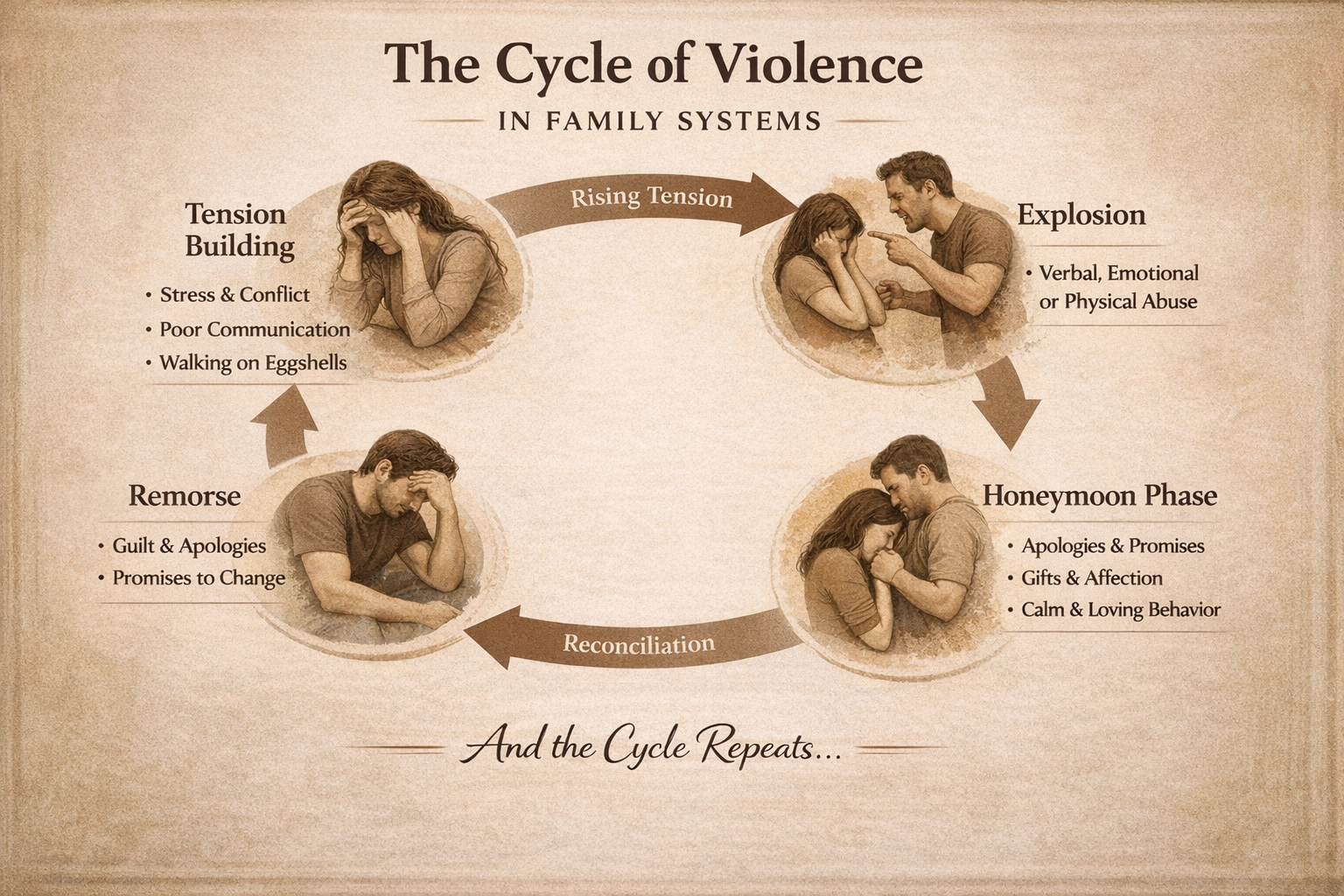
small image depicting the cycle of violence in relationships- stress, rising tension , explosion, honeymoon phase, remorse, repeat
Trigger → Survival Response → Misinterpretation → Defensive Escalation → Relationship Rupture
…instead of:
Trigger → Regulation → Empathic Response → Repair → Connection
It’s not that high performers don’t care—they just lack the nervous system regulation skills that trauma survivors often never learned.
6. Why Therapy Works (and Why High Performers Resist It at First, but shouldn’t)
Here’s the good news: high-achieving couples can absolutely get better at navigating trauma dynamics once they understand the underlying mechanisms. Hard part is actually getting them into a room where they will release their
Effective approaches include:
Emotionally Focused Couples Therapy (EFT) — which helps partners recognize and shift negative interaction cycles into secure bonding experiences. Research in the early 2000s showed EFT’s effectiveness for couples struggling with attachment wounds and trauma triggers (Johnson, 2004).
Gottman Method Couples: helps teaches relationship concepts from the Sound Safe House theory, where the walls are trust and commitment, and the foundation is from friendship, which allows for shared dreams and life meaning occurs.
Mind-body regulation practices — such as mindfulness and paced breathing, which help nervous systems shift out of survival mode and into connection mode. Studies during 2000–2005 also highlighted the benefits of such practices for trauma recovery and emotional regulation (Westen et al., 2004).
Psychoeducation — helping couples understand why their brains do what they do under stress reduces shame and increases connection.
But here’s a common clinical note: high performers often enter therapy saying:
“We need a roadmap—step by step!”
So in the first few sessions, they’re often less comfortable with the emotional process than the cognitive framework. It’s like someone asking for a GPS and getting offered a campfire and a compass instead. Over time though, once they feel safe and see results, they often say:
“Oh. So this feeling regulation thing really works…”
(with a bit of relief… and humor.)
7. Practical Tools for High-Achieving Couples to Regulate Trauma Responses
Let’s get practical. Here are evidence-based strategies that high performers can start using today:
✔ Build a Pre-Conflict Ritual
Before difficult conversations:
Sit facing each other, soften your facial expressions, and turn towards
Take 3 slow breaths together
State one intention (e.g., “I want to understand you today. I want this to make sense to us.”)
This is a micro version of activation of the social engagement system of us that helps shift out of threat mode.
✔ Replace “Fix Mode” with “Reflect Mode”
Instead of:
“Here’s what you should do…”
Try:
“Help me understand how that felt for you.”
This changes the nervous system from problem to connection.
✔ Normalize Nervous System Responses
When one partner reacts strongly, reframe it as:
“Your nervous system thinks you’re in danger right now.”
This helps reduce shame and defense.
✔ Use Time-Ins Instead of Time-Outs
Time-outs are great when rage is high, but “time-ins” (regulated pauses with agreed reconnection) help couples learn co-regulation.
8. Trauma in High-Performing Relationships Is Not a Deficit—It’s an Invitation
The irony with high achievers is that while we train them to conquer external challenges, emotional intimacy remains the ultimate frontier—and trauma is often the gatekeeper.
But here’s the most hopeful part:
Because high performers are motivated, disciplined, and results-oriented, once they see real relational progress, they tend to integrate it deeply, successfully, and quickly.
Trauma doesn’t have to be a recurring foe in your relationship.
With insight, regulation skills, and compassionate partnership, trauma responses can become signals for growth—not barriers to connection.
After all, in the world of high performance, the ultimate elite skill is not presentations, deals, or accolades…
…it’s sustaining love when the nervous system gets loud.