Financial Abuse Is Domestic Violence: What "With Survivors, Always" Means
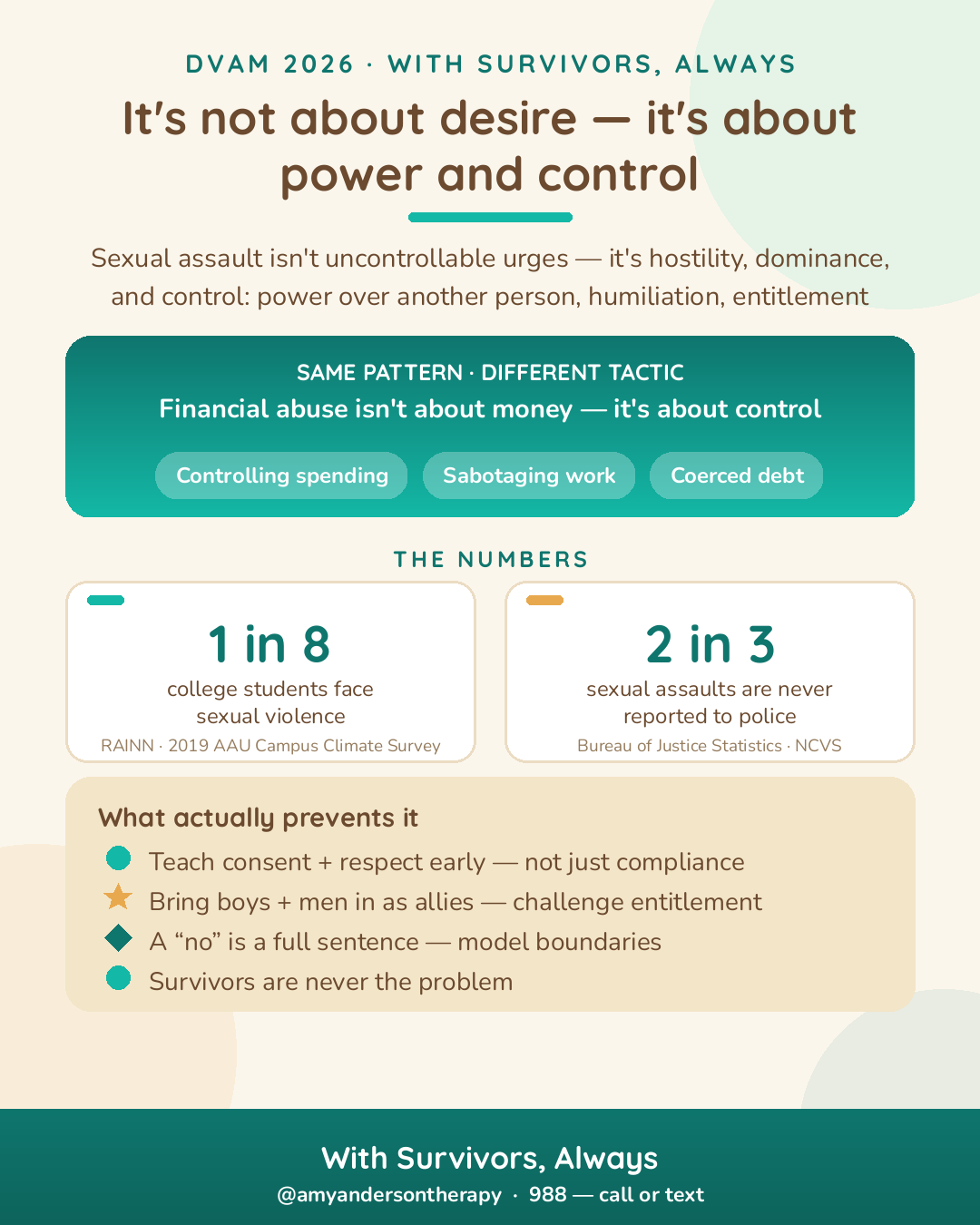
Information about intimate partner or domestic violent tendencies that utilize financial abuse.
October is Domestic Violence Awareness Month, and this year's theme is three words that land hard: "With Survivors, Always."
Not "with survivors when it's convenient." Not "with survivors until their story gets complicated." Always. In the middle of the leaving and the staying, the going back, the years it takes to untangle a life from someone who controls it — with survivors, always.
This month I want to talk about the kind of abuse that rarely makes headlines and almost never gets named: financial abuse. Because the month's own frame says it plainly — control of money and resources counts as domestic violence. Full stop.
Financial abuse is domestic violence
Let's get specific, because vague language helps nobody.
Financial abuse is when one partner uses money as a weapon of control. It’s a huge epidemic for why we have child abuse, child neglect, and mental health conditions developed through environmental dynamics.
It looks like:
Controlling all the money. Every dollar runs through them. You ask permission to buy groceries. There's an "allowance" — for a grown adult, in their own home.
Sabotaging your work. Showing up at your job, starting fights before big meetings, "forgetting" childcare so you miss shifts, harassing you until you quit or get fired. Then: see? You can't survive without me.
Coerced debt. Credit cards opened in your name. Loans you didn't agree to. Your credit destroyed while theirs stays clean — which means when you finally try to leave, no landlord will rent to you.
Hiding financial information. You don't know what accounts exist, what the mortgage balance is, or where the money goes. Financial decisions happen around you, never with you.
None of this is a "money problem." A money problem is two people disagreeing about a budget. Financial abuse is one person systematically removing the other's ability to survive independently. That's not a disagreement. That's a cage with a spreadsheet.
Why financial entrapment keeps survivors stuck
Here's the question survivors get asked more than any other: why don't you just leave?
And here's the honest answer most people don't want to sit with: leaving costs money.
First month's rent. A deposit. A car that runs. Childcare while you work. A phone plan in your own name. A lawyer — or at least the filing fees. For someone whose partner has spent years making sure they have none of these things, "just leave" isn't advice. It's a fantasy.
This is the part I need you to hear clearly: staying is often a financial calculation, not a character flaw. When someone stays, it is not because they're weak, codependent, or don't love their kids enough. It's because the math doesn't work yet. The abuser did that on purpose. Entrapment is the strategy — staying is the symptom.
As a trauma therapist, I watch survivors blame themselves for the staying. The shame is enormous. But shame is the wrong address for this. The pattern is the problem — the pattern of control — not the person trying to survive inside it.
Healing starts when we stop asking "why didn't she leave?" and start asking "what would it take for leaving to be possible?" That's a financial question. Which means financial literacy is a safety issue.
Small steps toward financial safety
I'm a therapist, not a financial advisor or a DV advocate — so take this as psychoeducation, not a plan built for your specific situation.
If you're in this right now, a local DV advocate can help you build a safety plan around money (the Hotline below can connect you).
That said, here are small, concrete steps survivors and their supporters should know about:
1. Copies of critical documents. Birth certificates, Social Security cards, passports, marriage license, bank statements, pay stubs. Photograph them with a safe phone or store copies somewhere outside the home — a trusted friend, a safe deposit box, a secure cloud account the abuser can't access. Documents are leverage. Abusers know it.
2. A separate account — opened safely. Even a small separate bank account or a cash stash with someone you trust can become an exit fund. Critical safety note: if your partner monitors your devices, mail, or location, opening an account can be dangerous. Use a safe device, opt for paperless statements, and talk to an advocate first about the safest way to do this in your situation.
3. Learn your own financial picture. What accounts exist? What's the debt? What's your credit score? (You're entitled to free credit reports.) Knowledge is the opposite of the confusion financial abuse depends on. You don't have to act on it today. Just knowing is a step.
4. Build one income-adjacent skill or connection. A certification, a freelance profile, a former colleague who'd vouch for you. Financial abuse works by convincing you that you have no options. Every option you quietly build weakens that story.
5. Safety-plan the money conversation. Never confront a controlling partner about money without a plan. Advocates at the National Domestic Violence Hotline help with exactly this — how to prepare financially without escalating danger.
Small things, often. That's how nervous systems heal, and it's how financial independence gets built too — one document, one account, one skill at a time.
A Note for Couples: When Financial Control Shows Up in your Relationship
Not every money conflict is abuse, and I want to be careful here. Plenty of couples fight about money because they have different histories with it, different anxieties, different family scripts. That's normal, workable stuff.
But there's a line, and it matters: disagreement is two people with a problem; control is one person becoming the other's problem. If one partner makes all financial decisions unilaterally, restricts the other's access to money or information, punishes spending with rage or withdrawal, or uses money to threaten the relationship itself — that's not a communication issue. That's control. And control doesn't get fixed with a better budgeting app.
If you're reading this and recognizing your own relationship: you don't have to decide what to call it today. You just have to know that help exists, that it's free, and that you don't need to be "sure it's bad enough" to reach out. You never have to earn the right to ask for help.
With survivors, always
The theme isn't "with survivors when they leave on our timeline." It's always. During the staying. During the going back. During the slow, unglamorous work of copying documents and building an exit fund one dollar at a time.
If you're a survivor reading this: the body keeps receipts — so give it good ones. Every small step toward financial clarity is a receipt your future self will cash. You're not behind. You're building.
And if you're someone who loves a survivor: the most powerful thing you can offer isn't advice. It's belief. Believe them about the money. Believe them about why leaving is hard. Then ask what would make it possible — and help with that.
If you need help now:
National Domestic Violence Hotline: call 1-800-799-7233 or text START to 88788 (free, confidential, 24/7)
988 Suicide & Crisis Lifeline: call or text 988 (24/7)
This post is psychoeducation, not therapy. Reading it doesn't create a therapist–client relationship, and it isn't a substitute for working with a licensed professional or a DV advocate in your state.
Please keep going: If trauma is living in your relationship — the patterns, the shutdowns, the fights that never resolve — my 16-week course Too Busy or Too Broke for Trauma Therapy ($199) walks you through rebuilding safety and connection one week at a time. And if you're ready for 1:1 support, reach out — spots are available for consultation at amyandersontherapy.com.