Juneteenth Celebrations amidst the current 2026 Unrest- How Deeply Impacting it is for Couples and Families
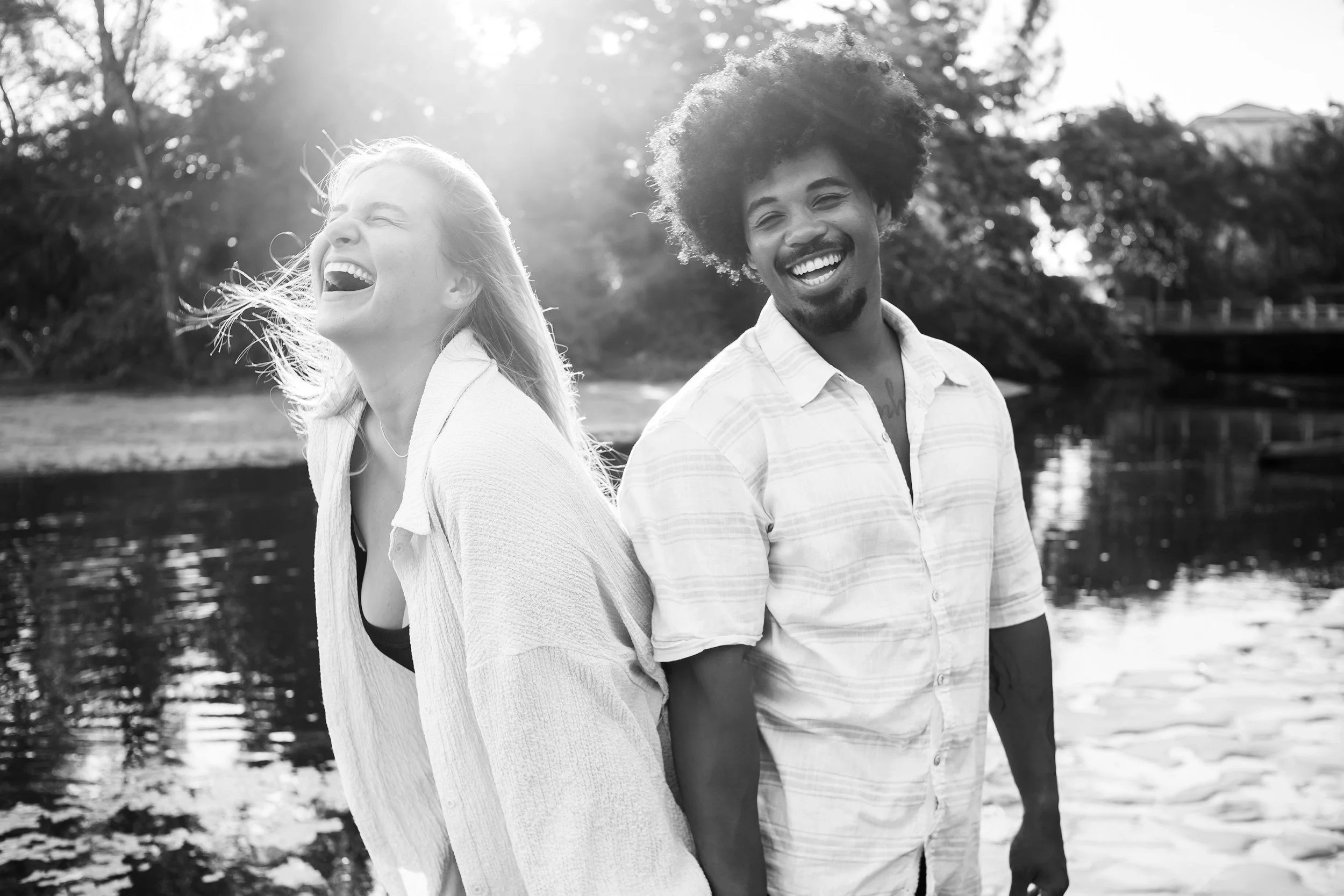
Couple (white woman & black man) laughing in front of water
Juneteenth (June 19th) commemorates the end of slavery in the United States and has been a federal holiday since 2021. Social justice and supporting my clients with information and evidenced based strategies to help them connect safely to themselves and others is my passion. I love supporting all my clients with celebrations, however I cannot do that with this sensitive historical subject as it is deeply complex towards their acceptance of self, being seen, heard, or considered in a deeply oppressive world in 2026.
Supporting my couples and families the past decade, we have witnessed unprecedented polarization in American society, measurably affecting intimate relationships, family structures, and social bonds. Below is a comprehensive, evidence-based synthesis of research findings.
The research is clear as you will read in this blog, political intermarriage dropped from ~20% to ~9% of couples per Pew Research. So many couples and families struggles with communication over politics, it’s becoming the number one deal breaker for singles dating per the university of Maryland. Political election-related relationship loss estimated 16% lost friend/family over 2016 election (Ipsos/Reuters 2017).
One of my specialities, family estrangement impacted 27% of Americans over the last 10 years (Cornell/Pillemer 2020). Young adult estrangement impacted approximately 41% of 18–29 year olds due to cutting contact over politics since 2016 (PRRI 2021). These are real family systems issues and resulted in permanent family damage - 30% say politics permanently damaged close family relationship (Survey Center on American Life 2022). No matter what you believe or who you support these outcomes show divisive ways of coping. To release engagement within your relationships is not healthy for ourselves, our families, our children, and especially our elderly. Divorce probability linkage rose 11–14% with partisan differences (Journal of Politics 2020). This most indeed impacted our celebrations- holidays- Thanksgiving gatherings 20–50 min shorter in divided households (Science Advances 2020)
As I have suspected from my own practice, and now backed with therapist reports an approximate 56% increase in politically-related relationship issues (AAMFT 2019). However, do not fear, after we get into the facts of the current challenges these couples face, we will get into the specifics on how to support them during this season of life. We are stronger with information, compassion, and tools!
Hate crimes had an 43% increase between 2015–2023 (FBI UCR Data)
Being a person of color or an ally in a relationship with someone who is a minority experiencing emotional unrest with their Country’s changing views of their support of their racial identity in the United States of America can be a form of turmoil. How you support your partner, child, or friend is imperative of their mental health and can be life changing for their connection to their nationalism.
Racial Divides: Documented Flashpoints
(2015–2025)
Major Milestones That Have Deeply Impacted Our Divide
| 2015 | Charleston Church shooting / Confederate flag debates | Renewed national conversation on systemic racism
| 2016 | Presidential election | 63% of Americans reported family tension (PRRI)
| 2017 | Charlottesville "Unite the Right" rally | Spike in reported hate incidents (FBI data)
| 2020 | George Floyd murder / BLM protests | Largest protest movement in U.S. history (15–26M participants)
| 2021 | Critical Race Theory debates | School board conflicts in 44 states
| 2023–2024 | DEI rollbacks / affirmative action rulings | Campus and workplace divisions
| 2025 | Federal DEI elimination orders | Reported workplace estrangements surged
Divorce Impact
Political Differences as a Divorce Driver
1. Wakefield Research Survey (2017):
- 24% of American couples reported that the 2016 election had caused significant stress in their relationship
- 11% of Americans knew a couple who had divorced or separated specifically over political differences following 2016
- 22% of millennials reported ending a relationship over political disagreements since Trump's candidacy
2. American Academy of Matrimonial Lawyers (AAML):
- Reported a noticeable uptick in divorce inquiries following both the 2016 and 2020 elections
- Attorneys specifically cited political and values incompatibility as increasingly cited grounds
3. Jeong & King, Journal of Politics (2020):
- Quantitative analysis showed that partisan identity differences within couples increased divorce probability by approximately 11–14% when controlling for other variables
4.Martindale-Hubbell / Legal Data (2021):
- Google searches for "divorce" spiked ~26% in the weeks following the January 6, 2021 Capitol riot, suggesting political events directly triggered relationship re-evaluations
The "Trump Divorce" Phenomenon
Multiple documented cases and surveys from 2017–2021 captured:
- A subcultural pattern journalists labeled "political divorces"
- New York Times, Washington Post, and The Atlantic published extensively documented first-person accounts (2017–2023)
- Therapists reported political values incompatibility entering couples therapy at unprecedented rates (American Association for Marriage and Family Therapy member surveys, 2018–2022)
Family Estrangements are Here for a Reason
This May Be the Most Profound Impact
1. Karl Pillemer, Cornell University — "Family Estrangement Study" (2020):
> One of the most rigorous studies on family estrangement in U.S. history found:
- 27% of Americans are currently estranged from a family member
- ~67 million Americans have cut off a family member
- Political and values disagreements were cited as a top-5 cause, newly emerging in significance since 2016
2. Ipsos/Reuters Poll (2017):
- 16% of Americans reported losing a friend or family member over the 2016 election
- 13% said their family was "less close" specifically due to political divisions
3. PRRI (Public Religion Research Institute) — American Values Survey (2021):
- 35% of white evangelical Christians reported conflict with family members over politics
- 28% of Black Americans reported intra-family conflict over how to respond to racial justice issues (i.e., whether BLM was seen positively or negatively)
- 41% of young adults (18–29) reported cutting off or limiting contact with a family member over political disagreements since 2016
4. Survey Center on American Life (2022):
- 30% of Americans said political differences had "permanently damaged" a close family relationship
- Parents and adult children represented the most common estrangement pair linked to politics
Holiday Estrangement Data
Political scientists Cho, Gimpel & Hui (2020) — Science Advances:
- Using smartphone mobility data covering 10+ million families, they found:
- Thanksgiving family gatherings in politically divided households were measurably shorter by 20–50 minutes in 2016 vs. previous years
- Effect was strongest in swing counties with exposure to partisan advertising
- This represents one of the most empirically rigorous demonstrations of political polarization affecting family time
Intersectional Impacts: Where Race and Politics Merge Matters on Relationship Impact
The 2020 Racial Reckoning's Family Impact
1. Family Process Journal (2021–2022) — Qualitative Research:
- White families with multiracial members reported disproportionate conflict during summer 2020
- Adult children confronting parents about racial attitudes was a dominant theme in therapeutic literature
- Many therapists reported a new phenomenon: clients seeking therapy to process ending family relationships over racial views — not just individual racism, but disagreement on systemic racism
2. Families of Color Internal Conflicts:
- Research from Journal of Black Psychology (2022) documented intra-community Black family divides over:
- Support for Black conservative vs. liberal politics
- Views on interracial relationships
- Class-based tensions amplified by racial discourse
3.Asian American Family Divides:
- A 2021 AAPI Data Survey found 44% of Asian Americans reported significant family tension over:
- Responses to anti-Asian hate crimes (pandemic era)
- Political party alignment differences across generations
- Immigration policy disagreements
Demographic Patterns In Political- Racial Divides
Generational Differences
Pew Research (2022–2024):
- Gen Z and Millennials were significantly more likely to estrange from older family members over:
- Racial justice views
- LGBTQ+ acceptance (often intersecting with racial/political identity)
- Immigration attitudes
- Baby Boomers were more likely to report being estranged from rather than estranging themselves
Geographic Patterns
Ennis, Political Geography (2022):
- Urban/rural family divides mirrored national polarization
- Families with members in different geographic contexts reported higher estrangement rates
- Returning college students to rural/conservative families documented as a specific high-conflict scenario
Real Mental Health Consequences Exist
The relational ruptures documented above carried measurable mental health costs:
| 40% of Americans reported stress related to political climate affecting their health | APA "Stress in America" 2017 |
| Family estrangement linked to 2–3x higher rates of depression and anxiety | Pillemer, Cornell, 2020 |
| 56% of therapists reported increase in politically-related relationship issues | AAMFT Member Survey, 2019 |
| "Ambiguous loss" clinical framework applied to political estrangement | Boss, Family Process, 2022 |
| Social isolation from political/racial conflict linked to adverse health outcomes | Harvard Social Connection Study, 2023 |
Current Racial Climate in 2026
It is not a new phenomenon that the US and many areas of the world hold ongoing tensions secondary to racial and national power and control imbalances. Today we will be discussing those that impact:
- Political polarization around race discussions
- Debates over DEI (Diversity, Equity, Inclusion) programs
- Rollbacks of certain civil rights protections
- Increased hate crimes in some areas of the world
- Social media amplifying racial tensions
- Debates about reparations
- Book banning and limiting racial history education
Juneteenth Impact on Multiracial Couples & Families
Positive Experiences:
Couples and Families have a federal holiday that allows opportunity to celebrate together
Deeper cultural understanding is formed when it events are recognized
Shared learning about American’s Black history
Strengthening bond through shared values
Attending Juneteenth events together to show unity and inclusion
Building cultural bridges across races
Challenges They May Face:
Social Pressures:
Unwanted stares in public from those who are racist.
Unsolicited comments or opinions
Family members with opposing views
Feeling unwelcome at certain events
Pressure to choose sides
Within the Relationship:
- Different lived experiences with racism & inclusion
- One partner may not fully understand the significance of the holiday and the need for the celebration
- Navigating family traditions to include inclusion
- Differing comfort levels at current and past events
- Conversations about privilege and tolerance
- Raising children with differing perspectives of their multiracial identity
How Multiracial Couples Can Navigate Juneteenth Together
Communication Tips:
- Have open honest conversations regularly if can be done safely
- Listen to each other's perspectives without judging or jumping to conclusions
- Acknowledge different experiences that paint your perspective one way or another to build compassion
- Learn about each other's heritage without the intent to change the narrative or experience
- Set boundaries with family, friends, and social media if needed
Celebrating Together:
- Attend Juneteenth events as a united couple brings cohesiveness and inclusion
- Cook traditional foods together that could help each other appreciate and honor each other’s cultural and racial backgrounds
- Read books about Black history together to better understand the oppression and changes that come from these horrible facts of history
- Watch documentaries together to better empathize
- Support Black-owned businesses whenever possible
Multiracial Relationship Statistics
Political Intermarriage Decline
Research consistently shows Americans increasingly marry within their political tribe: Pew Research Center (2016, 2020, 2023): Stats Don’t Lie
- In 1960, only 4% of Democrats and Republicans said they would be unhappy if their child married someone of the opposite party
- By 2023, that figure reached 47% for Democrats and 46% for Republicans — a dramatic reversal
- Only ~9% of married Americans had a spouse of a different political party by 2020, down from ~20% in previous decades
University of Maryland / YouGov Study (2020):
- Political affiliation was rated by singles as the #1 dealbreaker in dating, surpassing religion and income
- 71% of liberal women said they would not date a Trump supporter
- 47% of conservative men said they would not date someone who voted for Biden
Stanford Social Interaction Lab Research (2022):
- "Affective polarization" — emotional animosity toward the opposing party — was found to be a stronger predictor of relationship compatibility than personality traits in new relationships
Race-Based Marriage Tensions
- Interracial marriages, while at an all-time high (~19% of new marriages in 2019 per Pew), reported higher rates of external family pressure and conflict
- A 2021 Gallup poll found 29% of interracial couples reported significant family disapproval connected to racial/political identities — up from 14% in 2012
- The post-2020 BLM period specifically created tension in mixed-race families around discussions of systemic racism (reported in qualitative studies by Family Process Journal, 2021–2022)
Interracial marriages constitute 20% of US new marriages
Public approval of interracial marriage is significantly higher in 2026 ~94% (up from 4% in 1958- reason to celebrate right there)
Multiracial population growth is the fastest growing demographic in the US right now.
As expected, however the saddest in my opinion - the largest challenges reported is family acceptance biggest hurdle for multiracial couples and families.
Common Difficult Conversations Multiracial Couples & Families Face with the Juneteenth Celebration
I often see that the uneducated and the inexperienced with those of opposite or opposing races really struggle with compassionate inquiry of their family members. It gives off the vibe that their side of the family is more valued, which unfortunately provides a huge ick for those fostering multi-race relationships and family cohesiveness.
- "Whose side are you on?" - from family, friends, or social media
- Navigating different cultural expectations from both sides can be very challenging
- Explaining the relationship to older generations
- Dealing with microaggressions together by calling them out, supporting each other with speaking up and setting limits if need be
- Discussing systemic racism openly with each other children so they can be better aware
Strengths of Multiracial Couples
So many people are in multi-race relationships and benefit from learning about another culture and racial background. Once they start to raise children or take care of dependents, it only grows which is a beautiful component I have witnessed.
Often have greater empathy and understanding of being oppressed
Better at conflict resolution as they have had to navigate the uncomfortableness earlier in their lives
More culturally aware of other cultures and races
Children raised with broader perspectives
Natural bridge builders in communities
Strong communication skills
Safety Considerations in 2026
- Be aware of local political and racial climate before attending events
- Know your surroundings and be aware of people whom may not appreciate your relationship or family values
- Have a safety plan if tensions arise and avoid aggressive verbal and non-verbal communication
- Connect with supportive communities that value diversity, inclusion, and racial justice
- Know your rights before proceeding anywhere and ask for documentation whenever appropriate
Key Academic Frameworks
"Affective Polarization" (Iyengar & Westwood, 2015)
The foundational academic concept explaining that Americans don't just disagree politically — they emotionally hate the other side, which transfers directly into personal relationship decisions.
"Moral Foundations Theory" (Haidt, 2012 — Applied Through 2025)
Jonathan Haidt's work, extended through the polarization era, demonstrated that political differences reflect fundamentally different moral frameworks, making compromise and family reconciliation psychologically difficult.
"Political Identity Fusion" (2022–2024 research)
Emerging research showing political identity had become fused with personal identity for a significant minority (~25–30%) of Americans, meaning attacks on political views were experienced as personal attacks — escalating family conflicts.
Sources include: Pew Research Center, Gallup, PRRI, Cornell University, American Psychological Association, American Association for Marriage and Family Therapy, FBI Uniform Crime Reports, Science Advances, Journal of Politics, Family Process Journal, AAPI Data, Survey Center on American Life, and multiple peer-reviewed academic journals.
Amy’s Key Takeaway
Juneteenth for multiracial couples can be both a beautiful celebration and a complex navigation of racial identity, family dynamics, and social pressures. The key is open communication, mutual respect, and education. We cannot let fear and oppression win. The evidence overwhelmingly demonstrates that the political and racial divides of the past decade have moved beyond the public square and fundamentally restructured America's most intimate social units — marriages, families, and friendships. Several conclusions stand out to her from her research and knowledge of couples, families, and individual trauma mental health:
1. Political compatibility has replaced religious compatibility as the primary sorting mechanism in American romantic relationships
2. Family estrangement at the scale of tens of millions of Americans is a documented, measurable phenomenon directly linked to polarization
3. The 2016 and 2020 elections and the 2020 racial reckoning each served as acute rupture events with lasting relational consequences
4. Young adults are disproportionately driving estrangements, often from parents and grandparents
5. Mental health consequences are real and clinically documented, with estrangement linked to significant psychological harm on all sides
The United States is experiencing what sociologists describe as a "social fragmentation crisis" — where political and racial identity has become so central to personal identity that it increasingly determines who Americans love, marry, invite to celebrations, and choose to never speak to again. If you need support or Tools related to this information, check out my Tools and Resource page. If you would like to connect for more therapeutic services to help you, your couple, or family - I would be honored to help you along the journey.