

Attachment: The Blueprint Underneath the Fighting
Week 3
You're not fighting about the dishes or how often you both turn towards house tasks. Not the texting, the in-laws, the thermostat, or who left a wet towel on the bed — though I believe you that the wet towel is genuinely distressing.
You're fighting from a blueprint written decades ago, in a house you don't live in anymore, by people who were doing their best (or not). Your attachment system — the part of you that decides how to act when closeness feels threatened — learned its moves in childhood and has been refined by other close relationships since then. It's been running the same plays ever since.
This week, we map the blueprint of our attachments. Not to label anyone — "you're avoidant" and use it as a weapon, and if it becomes one in your house, we have a problem. We are aiming to understand what the fighting is actually about, under the surface with compassion - so you can stop arguing about the surface and start working on the values and needs underneath the surface.
As Charlie Mackesy put it: "Isn't it odd. We can only see our outsides, but nearly everything happens on the inside."
This course lives on the inside — the states, the stories, the alarm. That's where the relationship actually happens.
“What this course is: Psychoeducation — evidence-informed information, frameworks, and practice exercises to help you understand your relationship with self in relation to others. We will review patterns and build skills. It is not psychotherapy, couples therapy, or a clinical relationship. Nothing here diagnoses or treats a mental health condition. If you need clinical support — especially around trauma, addiction, or safety — work with a licensed professional in your state.
If you’re in crisis: call or text 988 (US Suicide & Crisis Lifeline).
National Domestic Violence Hotline:
1-800-799-7233 or text START to 88788.
Who this week is not for (yet): If there is ongoing physical violence, coercion, or fear in your relationship — or an undisclosed affair or active addiction without outside support — pause here and reach out for individual support first. Stabilization comes before coursework. That’s not failure. That’s sequencing.”
The Lesson
Four patterns that could be leaving us confused and unable to receive or give love a
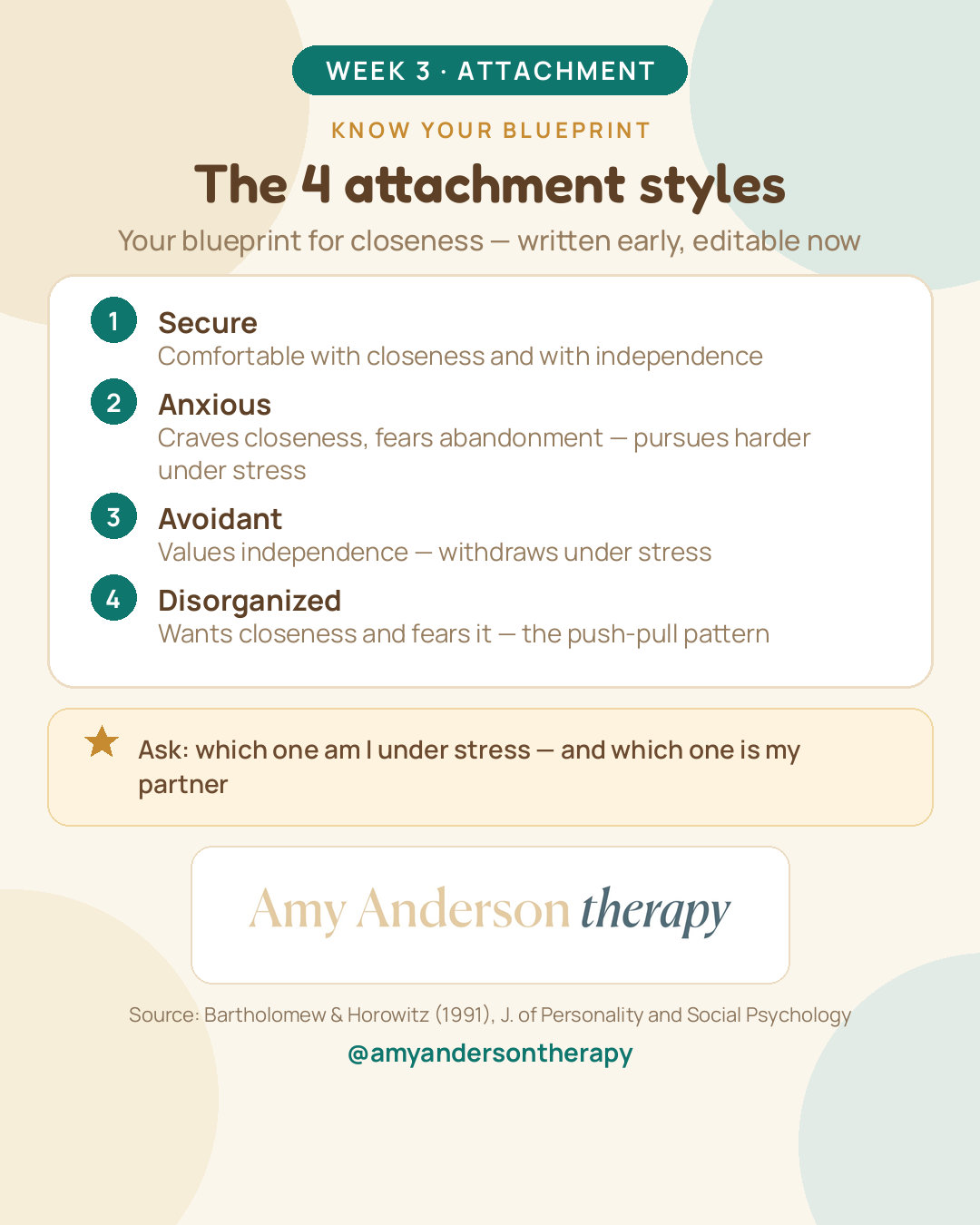
Attachment research describes a few consistent strategies people use when closeness feels uncertain. Read these as strategies you learned, not identities you are.
A useful frame from parts-informed work: when you're in it, try "a part of me wants to pursue right now" instead of "I am a pursuer." The strategy is something a part of you does — it's not who you are. That sliver of distance is where choice lives.
Ask: Which one am I under stress, and which one is my partner?
Anxious (the pursuer). Closeness feels essential and fragile at the same time. Under stress, you move toward: more texts, more questions, more "are we okay?" The fear underneath is abandonment — that if you stop reaching, they'll stop being there. What it looks like in a fight: escalation, pursuing a withdrawing partner around the house, needing resolution now. What it costs: you can chase someone into shutting down harder, which feels like proof they don't care. Brutal loop.
Avoidant (the withdrawer). Closeness feels essential and dangerous at the same time. Under stress, you move away: quiet, distance, "I need space," sometimes a door between you. The fear underneath is engulfment — that if you stay in it, you'll lose yourself or get hurt. What it looks like in a fight: stonewalling, shutting down, changing the subject, physically leaving. What it costs: your partner reads distance as not caring, which makes them pursue harder, which makes you withdraw further. Same brutal loop, other direction.
The pattern is the problem, not either person.
Nobody's the villain — two brilliant childhood strategies, colliding.
Disorganized (the freeze). The pattern the free internet content skips, so let's not. Disorganized attachment is what happens when the person you needed for safety was also the source of fear — the caregiver you ran to was the one you needed to run from. Under stress, there's no coherent strategy: you might pursue and then shut down mid-sentence. Approach, then freeze. Want closeness, then panic when you get it. Looks erratic from the outside. From the inside, it's a system with two opposite instructions running at once.
Secure (the goal, not the starting line). About half of adults test as predominantly secure, and here's what secure actually means: not that you're calm all the time — that you can return to connection after rupture. You ask for what you need. You tolerate your partner's bad mood without making it about you. You repair. Secure isn't a personality — it's a capacity. And capacities can be built. That's the entire point of this course.
Many individuals who were brought up with a parent or caregiver with mental health, addiction, or cultural share that they feel they could fall into dismissive avoidant attachment style, which falls under avoidant attachment mostly. They typically have a pattern of extreme self-reliance, emotional repression, and a strong resistance of emotional intimacy. No matter where you start with your understanding, please know that your relationship with self will allow the healing to flow best with another.
Most people are a blend, and most people shift by relationship and by stress levels. Secure at work and anxious with your partner. Avoidant in conflict and anxious about abandonment underneath. The question isn't "which one am I?"
It's "which strategy shows up when I'm scared?"
Why Trauma Scrambles the Patterns
Standard attachment theory assumes a basically consistent caregiver — maybe distant, maybe inconsistent, but one person. Trauma scrambles this in a few specific ways:
Unpredictability trains hyper-adaptation. If a caregiver was warm on Tuesday and terrifying on Wednesday, you learned both strategies: pursue hard (maybe today's a warm day) and withdraw fast (maybe it's not). That's the disorganized blend — not a character flaw, a rational response to irrational conditions.
Neglect trains self-reliance as armor. If nobody came, you stopped asking. Avoidance that looks like independence might be a kid who learned that needing people hurts more than going without.
Enmeshment trains anxiety as vigilance. If a caregiver needed you to regulate them, you learned to scan constantly for other people's states. That anxious radar isn't neediness — it's a skill that kept you safe, now running on a partner who doesn't need monitoring.
This is why "just be more secure" is useless advice.
The strategy was brilliant previously and allowed them to remain safe, loved, and considered when they could by their caregivers, past lovers, and significant relationships. It kept a kid safe in conditions they didn't choose.
The work now isn't to shame the strategy — it's to notice where it costs you and build a new option alongside it.
When Trauma Blurs the Love Map
Gottman researchers describe "love maps" — the detailed inner map you carry of your partner's world: their worries, their dreams, what's weighing on them this week. Trauma blurs that map from both sides. The partner carrying the trauma may go numb — cut off from their own feelings, unwilling or unable to share the story — and numbing dampens curiosity too. You can't map someone's inner world when you've gone offline from your own.
And the other partner's map blurs as well: they're trying to read someone whose moods oscillate, who seems like a different person some days, who withdraws without explanation. Confusion replaces curiosity.
Then there's the chameleon effect — shape-shifting to dodge a partner's anger or disapproval: agreeing when you don't, hiding what you feel, performing "fine." It kept you safe once.
But nobody can build an accurate map of someone who's performing. Part of this week's work is noticing where you're performing instead of revealing — and letting the map get honest again, one true answer at a time.
Trauma Bond vs. Secure Attachment: How to Tell
This distinction matters, because trauma bonds feel like the deepest love you've ever known. Here's the honest difference:
A trauma bond is intensity mistaken for intimacy. The cycle: rupture, pain, intense repair, relief — and the relief feels like love. But notice what's missing: there's no baseline of calm. The relationship lives at a 9 or a 2, never a 5. You feel most connected right after the worst fights. You're bonded to the cycle, not the person — to the dopamine of repair after the cortisol of rupture. If the relationship ended, what you'd miss most is the intensity, and you're not sure who you'd be without the drama.
Secure attachment is boring in the best way. The baseline is calm. Ruptures happen — every couple ruptures — but repair is steady, not theatrical. You feel connected in ordinary moments: cooking, driving, the quiet before sleep. You like who you are in the relationship. The connection doesn't require a crisis to feel real.
The test I give clients: if someone removed the highs and lows and left only the middle — the Tuesday evenings, the grocery runs, the ordinary — would you still want to be there?
If the answer is unclear, that's important data, not a verdict.
The Translation Guide
Here's the paid-content piece: what each partner's attachment-driven behavior means, and what each needs to hear.
When the anxious partner pursues (texts, questions, "we need to talk about this now"): it means:
"I'm scared you're leaving and I need proof you're here."
What they need to hear: "I'm not going anywhere. I need 20 minutes and then I'm yours."
Grounded & true presence plus a timeline. Not "calm down." Not a 2-hour processing session at midnight. Presence, with a return time equals secure safety.
When the avoidant partner withdraws (goes quiet, leaves the room, shuts down): it means:
"I'm overwhelmed and I'm trying not to hurt you or lose myself." What they need to hear: "Take the space you need. I'll be here when you come back." — permission plus reassurance. Not pursuit around the house. Not "you never talk to me" (true, and unhelpful mid-withdrawal).
When the disorganized partner freezes or flips (pursues then shuts down, wants closeness then panics): it means
"I want you and I'm terrified of you at the same time, and I don't know which feeling to trust."
What they need to hear: "We don't have to figure this out right now. I'm right here." — low demand, steady presence. No big conversations. Just: you're not in danger here.
Notice what none of these need: analysis, solutions, or the other person changing who they are. They need translation — the behavior decoded from "attack" into "fear," and met with the specific reassurance that fear is asking for.
Borrowed from CBT and ACT: Work the Alarm Before You Obey it
The attachment alarm is loud and fast — and it is not always right. Two skills, borrowed from CBT and ACT, for the moment the alarm fires:
Check the facts (CBT). The alarm says: they're leaving, they don't care, this is over. Before you act on it — before the 14 texts, the pursuit around the house, the shutdown — run the fact-check: What actually happened? They said they need 20 minutes. They've come back every time before. Their face was tired, not disgusted. The alarm predicts catastrophe; the facts usually describe something smaller. You're not arguing the feeling away. You're asking it to show its evidence.
Name it as a thought, not a fact (ACT defusion). "They're leaving" hits like reality. "I'm having the thought that they're leaving" hits like weather — real, passing, not a command. That tiny prefix — I'm having the thought that — puts you back in the observer seat. The thought can be loud and still not be instructions.
Neither skill kills the alarm. They just stop you from obeying it on autopilot — which is the difference between a strategy and a choice.
The Urge and Its Opposite (a DBT-informed move)
The attachment alarm doesn't just tell stories — it issues orders. The anxious order: pursue, now, harder. The avoidant order: leave, shut down, disappear. A DBT-informed skill called opposite action doesn't argue with the urge — it briefly does the opposite of what the urge demands, all the way, to see what happens.
Anxious urge says send the fourth text? Opposite action: phone in the other room for 20 minutes, one honest text instead of four. Avoidant urge says shut down and leave? Opposite action: stay five more minutes and say one true sentence — "I'm overwhelmed and I need a pause, but I'm coming back."
You're not suppressing the feeling. You're refusing to let the urge drive. Run it as an experiment, not a rule: try the opposite once, notice what changes. The alarm hates experiments — which is exactly why they work.
Why it Matters For Trauma
Attachment patterns are trauma adaptations wearing a relationship costume. The anxious pursuit, the avoidant withdrawal, the disorganized freeze — each one is a nervous system doing exactly what it learned to do when closeness was uncertain or unsafe.
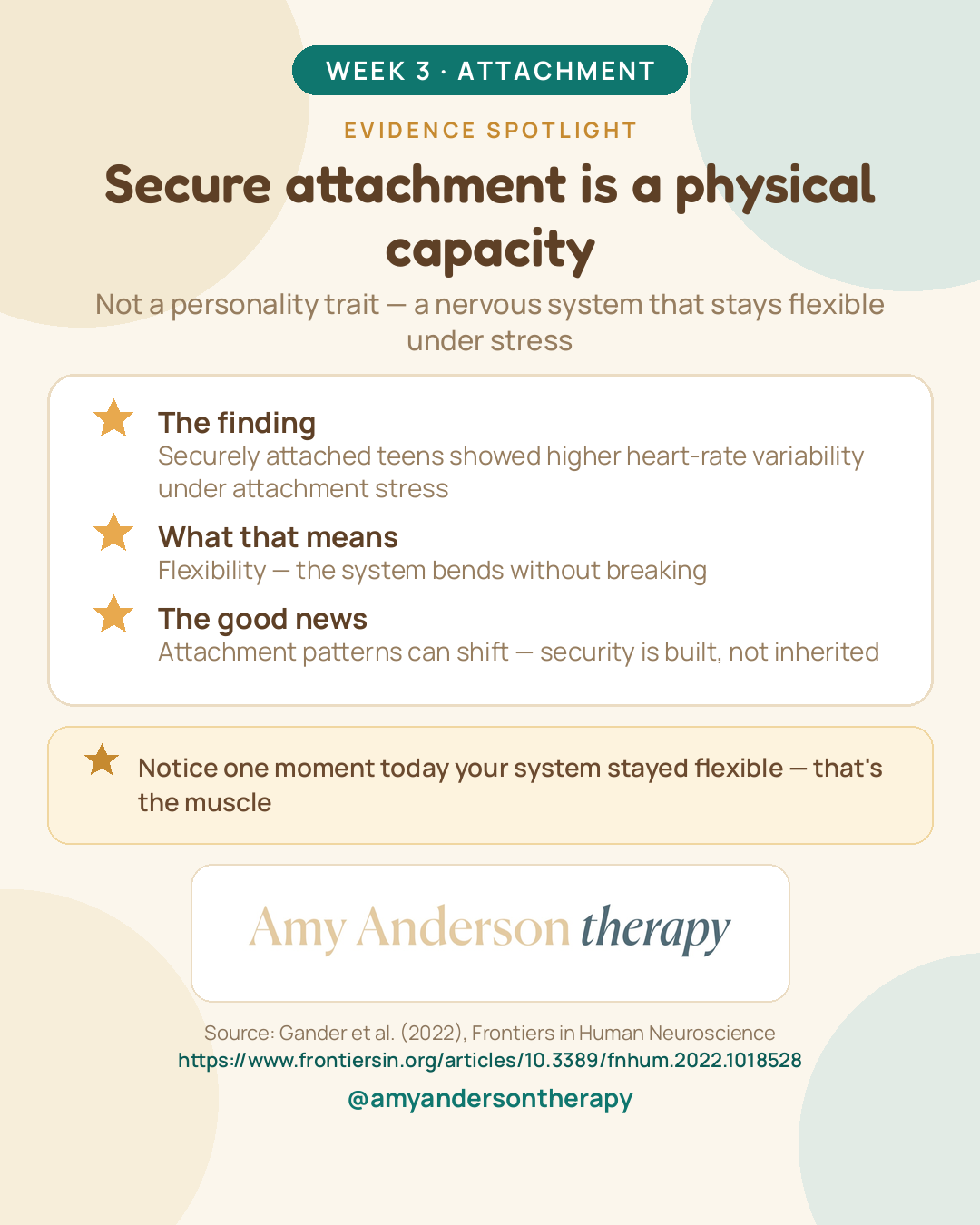
And here's the hopeful part, with evidence: security is a capacity, not a fixed trait. Securely attached adolescents showed higher heart-rate variability — a more flexible nervous system — during an attachment stress interview than their dismissing or unresolved peers (Gander et al., 2022). Security shows up in the body as flexibility under stress:
"Secure attachment is a physical capacity": not a personality trait — a nervous system that stays flexible under stress. The finding: securely attached teens showed higher heart-rate variability under attachment stress. What that means: flexibility — the system bends without breaking.
The good news: attachment patterns can shift and you are not doomed if yours is more anxious, avoidant, or disorganized compared to what you would like. Security is built, not inherited. Prompt: notice one moment today your system stayed flexible — that's the muscle.
In a randomized controlled trial with 26 couples, attachment-based Emotionally Focused Couple Therapy significantly increased intimacy and reduced shame compared to no treatment (Mirzazade et al., 2025).
You don't need the therapy to start building the capacity. Every time you notice the strategy instead of obeying it — "there's my pursue," "there's my withdraw" — you're doing the work. Awareness isn't the whole job, but nothing else works without it. Small things, often: one noticed strategy at a time compounds into a new default.
Try This
One thing today: write the two attachment sentences (Exercise 1).
That's the whole assignment if the week is full.
Exercise 1
Together & Solo: The Attachment Snapshot
Purpose: map your default strategies in writing, before the next fight maps them for you.
Time: 15 minutes.
Together: Each partner completes these two sentences — on paper, separately first:
"When I feel my partner pulling away, I ___."
"When I feel my partner coming closer, I ___."
Then share. No commentary on the first round — just listen. Questions second. The rule: you're mapping, not prosecuting. If your partner writes "when you come closer I shut down," your job is curiosity ("tell me what that feels like"), not defense.
Solo version: Answer the same two sentences for your most significant past relationship — or, if you're dating, the pattern across your last two or three. Look for the repeat. The repeat is the blueprint, not the person.
Why this works: writing recruits the observer. In a fight you are the strategy; on paper you can see it — and you can't change a strategy you can't see.
How you'll know it worked: you can name your default strategy during a conflict this week — "there's my pursue" — even if you still do it. Noticing before changing is the sequence.
Exercise 2
Together: The Translation Practice
Solo: The Translation Journal
Purpose: practice decoding behavior into the fear underneath it.
Time: 20 minutes together.
Together: Take one recent fight — small is fine, even better. Each partner writes three lines on separate paper:
What I did (behavior only: "I raised my voice," "I left the room")
What I felt (the fear underneath: "I felt you disappearing," "I felt trapped")
What I needed (the reassurance: "I needed to know you weren't leaving," "I needed 20 minutes without being followed")
Trade papers. Read your partner's before discussing. Then each person "translates" the other's behavior out loud: "So when you left the room, you weren't abandoning me — you were overwhelmed and trying not to make it worse." Let them correct you. The correction is the point — you're learning their language.
If this exercise starts escalating, use the Pause-and-Return Protocol from Week 1: name the state ("I'm in Yellow"), separate for 20–30 minutes and regulate instead of ruminating, return at a set time, check states before resuming. Pausing with a return time is not stonewalling — it's the skill working. The protocol handout is here if you need the refresher.
Solo version: Do the same three lines (did / felt / needed) for your most significant past relationship's recurring fight. Then write the translation your partner at the time couldn't give you — the fear underneath their behavior. This isn't about exonerating anyone. It's about seeing the blueprint instead of the blame.
Why this works: translating behavior into fear activates empathy circuits that blame deactivates. Your partner's prefrontal cortex can't process "you're attacking me" — but it can hear "you were scared."
How you'll know it worked: you translated one behavior this week — yours or theirs — from attack into fear, out loud or on paper. The translation habit is the skill.
Bonus — the 4-line thought record (5 minutes). Take one attachment flare-up from this week and run it through four lines: (1) Situation: what happened, facts only. (2) Story: what the alarm said ("they're pulling away because I'm too much"). (3) Distortion: name it — mind-reading, catastrophizing, all-or-nothing. (4) Fact-check: what the evidence actually supports. Couples: do yours separately, then trade. Solo: do it for the pattern across your last two relationships. You're not doing therapy on yourself — you're practicing the pause between alarm and action.
Reflect
Your 20-minute weekly check-in ritual — the only "homework" in this course: 5 minutes on a states check (Green/Yellow/Red — separately, then compare if you're a couple) · 10 minutes on this week's exercise · 5 minutes on the reflection prompt below. Same day, same time, every week. The ritual is the practice.
Journal on this — a few honest lines, not an essay:
"The attachment strategy I learned as a kid was brilliant — it kept me safe. The place it costs me most now is ___."
Then answer one more: What's one attachment-driven behavior you want to change — and what would you need to hear from your partner (or yourself) to make that change feel safe?
And the grief underneath this week: What attachment did you not get as a kid? Not the analysis — the loss. The comfort that wasn't there. The parent who couldn't attune, the house where you learned to scan instead of rest. Grieve it in a few honest lines. You can't build secure attachment on top of ungrieved grief — the old hunger keeps driving the new strategies. Naming the loss is what lets the adult strategies finally belong to you, not to the kid who had to invent them.
Evidence spotlight
Securely attached adolescents showed higher heart-rate variability during an attachment stress interview than dismissing or unresolved peers (Gander et al., 2022). Plain language: secure attachment is a physiological capacity — the nervous system stays flexible under attachment stress.
In a randomized controlled trial with 26 couples, attachment-based Emotionally Focused Couple Therapy significantly increased intimacy and reduced shame compared with no treatment (Mirzazade et al., 2025). Security is a capacity you can build — not a trait you're stuck with.
Full references live in your course research companion. These aren't here to impress you — they're here so you know this isn't just my opinion.
Go deeper
From Amy's blog — the free posts this week builds on:
Trauma Bonds vs. Secure Attachment: How to Tell the Difference—and How Couples Heal
Why Can Romantic Love Be So Scary for Some of Us? Even Toxic?
The blogs map the patterns. This week, you translated yours. Next week: the stories you inherited — family of origin, the inner child, and the age check.
Your homework this week
Write the two attachment sentences today (15 minutes). "When I feel my partner pulling away, I ___." "When I feel my partner coming closer, I ___." If the week is full, that's the whole assignment — but do it on paper, separately, then share.
Do the translation practice once (20 minutes). Take one recent small fight; write the three lines (did / felt / needed), trade papers, and translate your partner's behavior from attack into fear out loud.
Download the journal prompts — Attachment & the Alarm — and write a few honest lines on each of the five prompts across the week.
Run one opposite-action experiment. Anxious urge says send the fourth text? Phone in the other room, one honest text. Avoidant urge says shut down? Stay five more minutes, one true sentence. Notice what changes.
Run one 4-line thought record (5 minutes) on an attachment flare-up: situation, story, distortion, fact-check.
Hold your 20-minute weekly check-in ritual. States check, this week's exercise, reflection prompt. Same day, same time.
Companion workbook: complete the Week 3 worksheets — your attachment snapshot, your translations, your grief for what you didn't get.
Week 3 of 16 · Too Busy or Too Broke for Trauma Therapy · © Amy Anderson, LCSW.
This material is psychoeducational and is not a substitute for therapy, diagnosis, or treatment.