
Week 10 — Betrayal & Infidelity: A Trauma-Informed Path Through the Hardest Rupture
Week 10
Too Busy or Too Broke for Trauma Therapy: A 16-Week Trauma-Informed Course for Couples & Individuals · Amy Anderson, LCSW
Theme: Betrayal & Infidelity: A Trauma-Informed Path Through the Hardest Rupture
“What this is: Psychoeducation — evidence-informed information, frameworks, and practice exercises to help you understand your relationship patterns and build skills. It is not psychotherapy, couples therapy, or a clinical relationship. Nothing here diagnoses or treats a mental health condition. If you need clinical support — especially around trauma, addiction, or safety — work with a licensed professional in your state.”
“If you’re in crisis: call or text 988 (US Suicide & Crisis Lifeline) · National Domestic Violence Hotline: 1-800-799-7233 or text START to 88788.”
“Read this before anything else this week: If the betrayal is recent (under 3 months), undisclosed, or ongoing — pause the course exercises for this week and seek individual professional support first. The lesson still works as education; the exercises can wait. If there is ongoing physical violence, coercion, or fear in your relationship, pause here and reach out for individual support first. That’s not failure. That’s sequencing.”
Welcome to Week 10
This is the hardest week of the course. I’m not going to soften that.
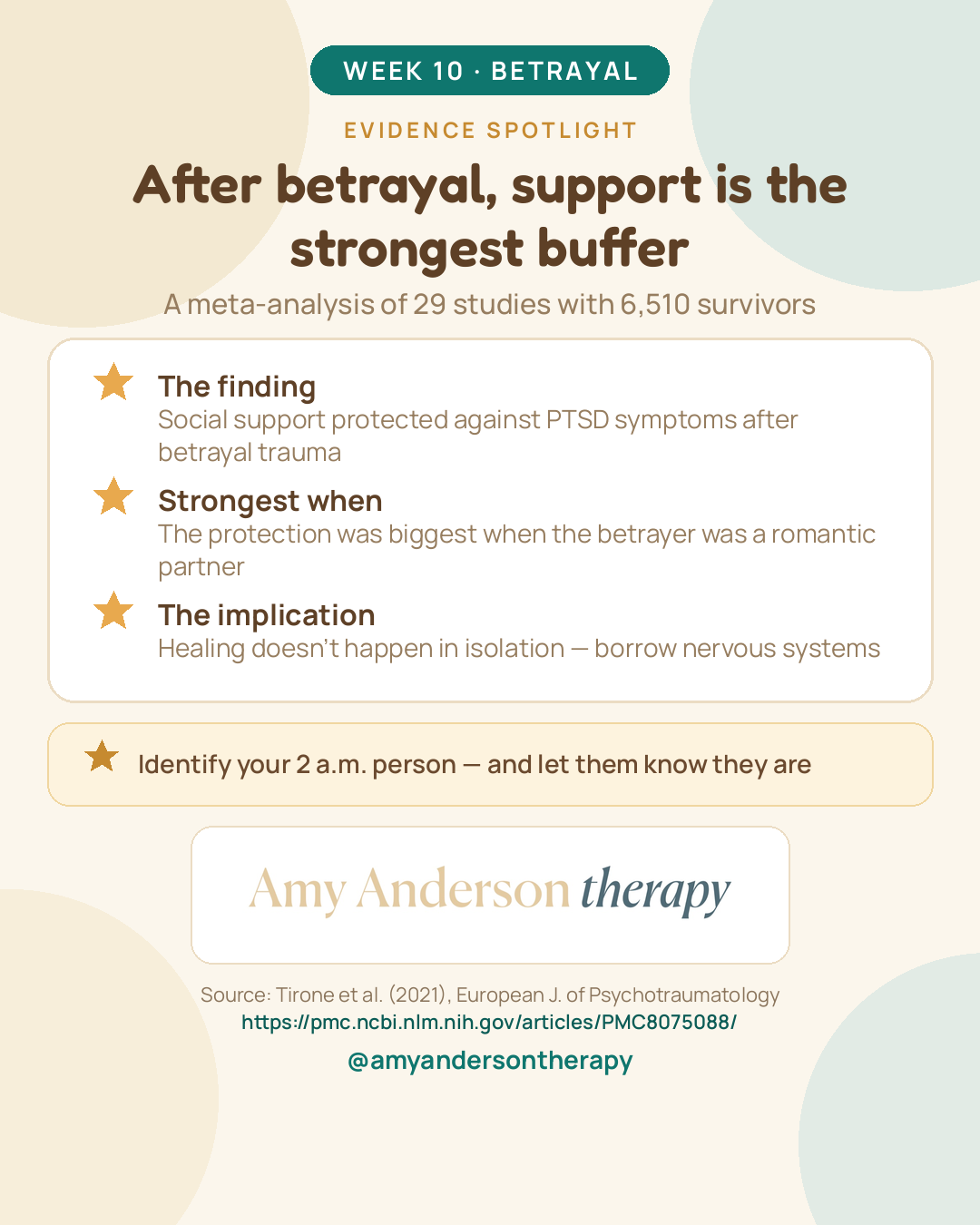
If you’re here because infidelity happened in your relationship — last month or last decade — you already know what the research confirms: betrayal by a romantic partner cuts especially deep — deeper than most other wounds, because of how much the bond mattered. Across 29 studies of betrayal trauma, social support protected against PTSD symptoms — and that protection mattered most when the betrayer was a romantic partner (Tirone et al., 2021). Translation: this wound cuts deepest precisely because of how much the relationship mattered.
Two things I want you to hear before we start. No rush to forgive. Forgiveness on a deadline isn’t forgiveness — it’s compliance. No pressure to leave, either. “Just leave” is easy to say from the cheap seats; you’re the one living inside the complexity. This week is about clarity: what happened, why it happened, what healing could look like — and what kind of help the healing actually needs.
The lesson
Infidelity is a trauma — here’s why that framing matters
An affair isn't just a bad thing that happened. It's a trauma because of who did it: the person your nervous system appointed as its safe harbor became the source of danger. That's the specific architecture of betrayal trauma — the threat and the safety live in the same person, so the system can't do the normal thing (run toward safety, away from danger). It freezes. It fragments.
This is why betrayed partners describe symptoms that look like PTSD: intrusive images, hypervigilance (checking phones, reading tone for lies), emotional numbing, a body that won't settle. You're not "crazy." You're not "unable to let it go." Your threat system is doing its job — it just can't find solid ground, because the ground moved.
And here's what the betrayed partner needs the involved partner to understand: the trauma isn't only about what happened. It's about the shattering of the story. "We were solid" turned out to be fiction — and now every memory gets re-examined. That re-examination, not just the event, is a huge part of the suffering.
Emotional vs. physical affairs — why both rupture attachment
People rank affairs. “At least it wasn’t physical.” “It was only texting.” Let me save you the ranking system: it’s not about the act. It’s about the exit.
Attachment — the bond this whole course is built on — runs on felt security and the sense that your partner’s primary emotional allegiance is here. Both kinds of affairs break that:
Physical affairs rupture the exclusivity of the sexual bond and carry the visceral shock of the body being shared elsewhere.
Emotional affairs divert the attachment energy itself — the confiding, the excitement, the “you’re the person I tell first” — to someone outside the relationship. For many betrayed partners, this one cuts deeper, because it’s the bond that was shared, not just the body.
Both involve secrecy, and the secrecy is doing half the damage. Every lie told to protect the affair taught the betrayed partner’s nervous system a lesson: your reality-testing can’t be trusted here. Rebuilding means restoring the betrayed partner’s trust in their own perceptions — which is why transparency (Week 9’s ingredient list) matters more than reassurance.
The childhood-trauma link: how old wounds set the stage
This doesn’t excuse anything. But it explains a lot — and explanation is a tool.
For the betrayed partner: if you grew up with betrayal by caregivers — the people who were supposed to be safe weren’t — your system learned early that love and danger come in the same package. An adult betrayal doesn’t just hurt in the present; it confirms the oldest story you carry. The intensity of your reaction may be bigger than this single event, because to your nervous system it isn’t a single event. It’s a pattern completing itself.
For the involved partner: childhood wounds show up on this side too. Growing up where needs couldn’t be met honestly — where vulnerability was punished or emotions were invisible — teaches a workaround: get your needs met sideways. Affairs are often less about the affair partner and more about an unbearable feeling the involved partner didn’t know how to name, let alone bring home. Again — explanation, not excuse. Understanding the mechanism is what makes changed behavior possible (Week 9, step two: the why).
Naming this link matters because it moves the conversation from “you’re broken / I’m broken” to “we’re both carrying old injuries that collided here.” That’s not softer. It’s more accurate. The pattern is the problem, not either person — even when the pattern has one person’s fingerprints all over it.
🐢 SLOW DOWN — and the rule for this week
This week’s exercises ask for vulnerability at high intensity. So the checkpoint is non-negotiable.
Signs you’re outside your window of tolerance — the zone where you can stay present with hard feelings without shutting down or flooding: intrusive images flooding while you try to write or talk · rage that wants a target · numbness so complete you can’t find words · the urge to interrogate for hours (that’s hypervigilance driving, not curiosity) · shutting down mid-sentence.
What to do instead: stop. Use the Pause-and-Return Protocol from Week 1 — name the state, separate for 20–30 minutes, regulate your body (not your argument), return at a set time, check states before resuming. If the flooding doesn’t clear within a day or two, or if every attempt at the exercises detonates: this work needs a professional container. Individual support first; couples work when there’s enough stability to hold it.
The rule — read twice: If the betrayal is recent (under 3 months), undisclosed, or ongoing — pause the exercises this week. Seek individual professional support first. The lesson still has value as education: read it, let it land, and come back to the exercises when the ground is more solid. Doing deep repair exercises on a fresh, open wound doesn’t accelerate healing — it re-traumatizes.
Do not do this work alone if: the affair is undisclosed or still ongoing · the betrayal happened less than 3 months ago · it’s entangled with addiction without outside support · there’s any violence, coercion, or fear · the involved partner won’t end the affair or offer transparency · either partner is having thoughts of harming themselves (call or text 988). Any one of these means: professional support first, coursework second.
Couples work vs. individual work: the right container
Not every betrayal should be worked on as a couple — at least not first. Here’s the discernment:
Individual work first when: the betrayal is fresh and the betrayed partner needs their own trauma processing before they can sit in a conversation with the source of it · the involved partner needs to understand their own pattern without performing insight for an audience · either partner’s nervous system can’t stay regulated enough for joint work · anything on the “do not do this alone” list above applies.
Couples work when: there’s basic honesty (no ongoing deception) · both partners are willing — not just compliant · each has enough individual stability to stay in the room · and ideally, with a trained professional guiding, at least at the start.
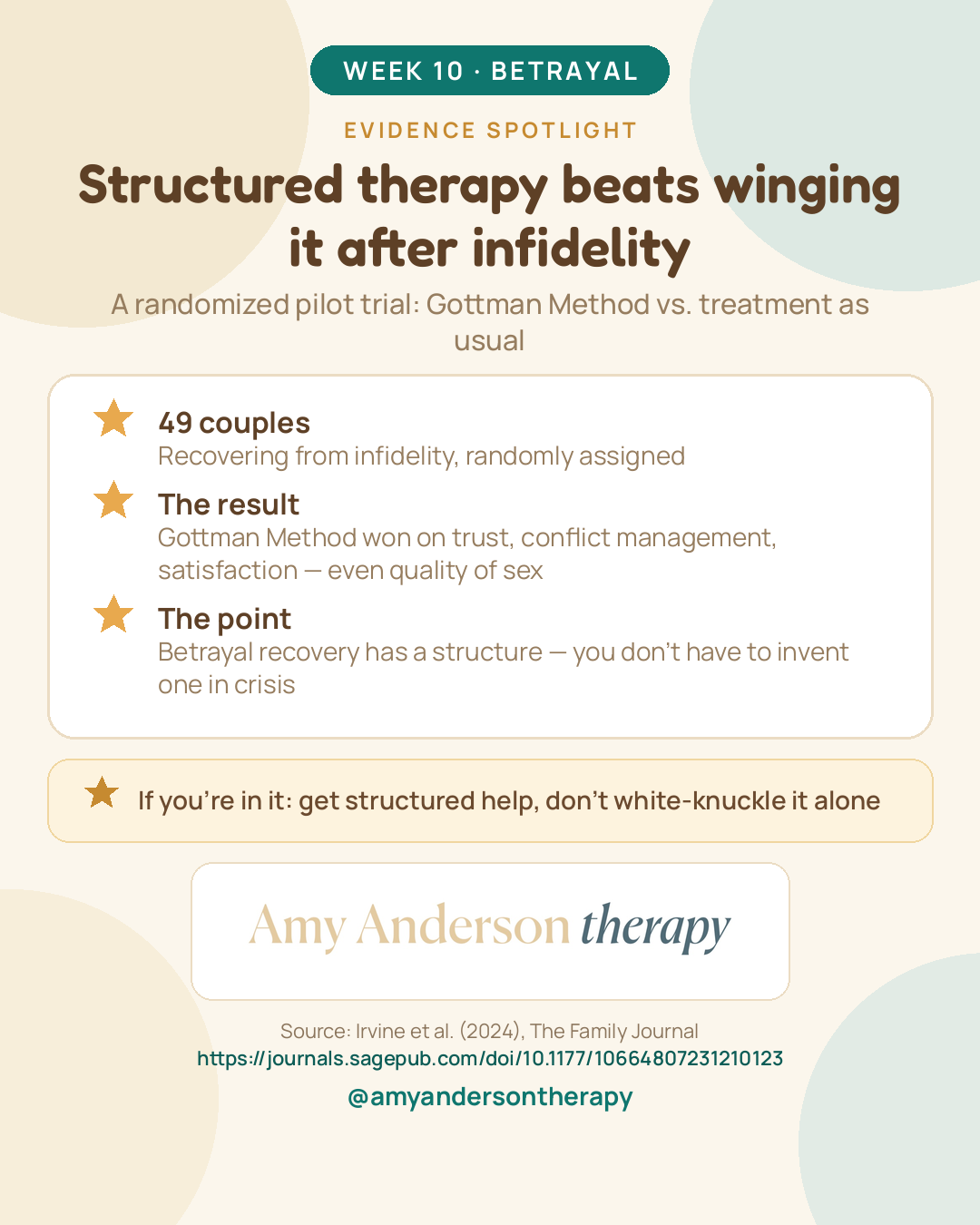
One more honest note: couples work after infidelity goes best with a trained guide. This lesson gives you the framework — the conversation structure, the rights, the roadmap. A professional gives you the container. Both matter. This is where structure beats winging it:
Disclosure: what helps vs. what re-traumatizes
The betrayed partner usually needs the truth. But how the truth gets told determines whether it heals or re-wounds.
What helps: truthful, complete disclosure — ideally guided by a professional, in a planned conversation, never ambushed. Answer the questions asked, honestly. Offer the why (remember Giacobbi & Lalot: clearly communicating the reasons for the betrayal is one of the five ingredients of trust repair). Keep the tone compassionate, not defensive. One disclosure, complete — not a drip-feed.
What re-traumatizes: trickle truth — new details surfacing over weeks or months, each one restarting the trauma clock. (This is the single most damaging pattern I see.) Graphic sexual detail the betrayed partner didn’t ask for. Disclosures weaponized mid-fight. Disclosure by text, or blurted without warning. And the “you made me do this” frame — which converts disclosure into a second betrayal.
A rule of thumb: the betrayed partner gets to ask. The involved partner’s job is to answer honestly and bear the discomfort of the answers — without managing, minimizing, or rushing the questioner.
The betrayed partner’s Bill of Rights in early repair
In the early weeks and months, you have the right to:
Ask questions — and get honest answers, without being told you’re “obsessing.”
Not be rushed — no timelines on your healing, no “when are you going to get over this.”
Feel all of it — rage, grief, numbness, love, hate, sometimes in the same hour. None of it means you’re doing it wrong.
Transparency — offered freely, not extracted. Location sharing, open devices, whatever rebuilds your reality-testing. (This is “active monitoring” and “proactive transparency” from the research — and it’s the involved partner’s offering, not something the betrayed partner should feel guilty about needing.)
Your own support — your own therapist, your own people. You don’t have to process this only inside the relationship that caused it.
Change your mind — deciding to try today doesn’t obligate you to stay forever. Clarity is allowed to evolve.
The involved partner’s accountability roadmap
If you were the one who betrayed: this is your job description for as long as repair takes.
End it completely. No contact. No “closure conversation.” No checking their socials. Ambiguity is the enemy.
Disclose fully — once, with guidance. Trickle truth is re-traumatization with better PR. Get professional guidance on the how.
Offer radical transparency before it’s demanded. Volunteer the access. Every time you offer before being asked, you make a deposit.
Tolerate the questions without defensiveness. “We’ve been over this” is the sentence that restarts the clock. Answer again. Calmly.
Do your own work. Understand your why — the unmet needs, the avoidance, the old wiring — with your own professional, not just in front of your partner.
Repair as long as it takes. Your timeline for being “done” with this is irrelevant. The betrayed partner’s nervous system sets the pace. Going back for the fortieth conversation when everything in you wants to snap “aren’t we done yet?” is a DBT-informed move called opposite action — acting against the urge because the goal matters more than the feeling. The feeling is real and understandable. Obeying it would cost you the repair.
“One more truth for the involved partner, before the phases: “Often the hardest person to forgive is yourself,” writes Charlie Mackesy. Noted — and here’s the reframe: self-punishment isn’t accountability. It’s suffering with better branding. The six steps above are the amends. The shame spiral is not.”
The three phases: atone, attune, attach
Gottman Method Couples Therapy — which I’m trained in through Level 3, including additional training on infidelity — maps infidelity recovery in three phases, and they give this week’s work a longer horizon:
Atone. The involved partner takes full responsibility: ends the affair completely, discloses honestly, tolerates the questions without defensiveness, offers transparency before it’s demanded. No “but you.” This phase is measured in months, not conversations.
Attune. The couple rebuilds emotional connection: the injured partner’s reality gets believed, conflict becomes discussable again, the friendship underneath gets repaired. This is Weeks 9 and 12’s work, done repeatedly.
Attach. Physical and erotic reconnection — on the betrayed partner’s timeline, with full consent. (This is where Week 11’s ladder lives, when you’re ready.)
Most couples try to skip to phase 3 — or get stuck in phase 1 forever. Knowing the phases lets you ask the useful question: which phase are we actually in? Work the phase you’re in. The next one comes when this one’s done.
When you’re ready to talk about the why: dreams within conflict
At some point — usually well into the attune phase — the betrayed partner needs to understand the why, and the involved partner needs to say it without turning it into a defense. Gottman’s “Dreams within Conflict” exercise was built for exactly this kind of conversation. The speaker’s job: talk honestly about your position and the dream, belief, or story behind it — what you were feeling, what you told yourself, what you couldn’t face — without criticizing or persuading. The listener’s job: make it safe enough to hear. Listen like a friend. Suspend judgment. Don’t solve, don’t rebut, don’t argue your point of view. The goal isn’t to agree with the why. It’s to understand it — because you can’t rebuild on a why you don’t comprehend. One conversation, one why, both green, no fixing. That’s the container.
Healing isn’t linear — and that’s normal
Twenty-five injured partners described healing from infidelity not as neat stages but as swinging back and forth between connection and disconnection — organized around four themes: talking, the truth, trust, and the ethical imbalance of what happened (Walravens & Rober, 2023).
Read that again if you need to: the research says it’s not linear. So if you had a good week and then a terrible Tuesday where you’re right back in the worst of it — that’s not failure. That’s the documented shape of this healing. The swings get less violent over time. They don’t disappear on a schedule.
Radical acceptance — and the values question
Two things that sound contradictory and both matter:
Radical acceptance (DBT-informed): the past can’t change tonight. You cannot un-happen what happened. Every hour spent fighting that reality is an hour stolen from the only place healing lives: forward. Radical acceptance isn’t approval, isn’t forgiveness, isn’t “getting over it.” It’s the decision to stop spending your energy on the one thing you can’t change — what already happened — so you can spend it on what you can: the next honest conversation, the next kept promise, the next small consistent data point.
The values question (ACT-inspired): whether you’re the betrayed partner or the involved one — what kind of partner do you want to be from here? Not “what will fix this.” Not “what will make the pain stop.” What kind of person, in this relationship or the next one. The betrayed partner might answer: “honest about what I need, unwilling to pretend.” The involved partner: “accountable, transparent, done with sideways.” Values don’t resolve the past. They aim the future — and on the nights the healing feels pointless, the values answer is what you hold.
Why it matters for trauma
Betrayal trauma is attachment trauma wearing a specific mask: the safe person became the dangerous person. For a nervous system, that’s worse than danger from a stranger — because the system can’t resolve it by fleeing. There’s nowhere to run that isn’t also a loss.
This is why the standard advice (“just communicate better”) fails here. You’re not dealing with a communication problem. You’re dealing with a safety system problem: the betrayed partner’s threat detection is now calibrated to the person they sleep next to. As I wrote on my blog: “A couples therapist who treats trauma like a communication problem is missing the actual wound.” (Read it here: Couples Therapy for PTSD: What 495 Couples Teach Us) Rebuilding means giving that system thousands of small, consistent data points that the danger has passed — which is why Week 9’s check-ins and this week’s transparency aren’t optional extras. They’re the mechanism.
And for those with childhood betrayal in their history: this week’s work may stir older material. That’s expected — and it’s a sign to lean toward more support, not less. Individual professional support alongside (or before) the couples exercises.
A tool for the hypervigilance — the compassionate thought-record. Checking the phone, reading tone for lies: that’s not “crazy,” it’s a threat system doing its job without solid ground. But it still costs you — sleep, peace, the relationship you’re trying to save. When the urge to check hits, run four lines: (1) Trigger: what set it off (“they were quiet at dinner”). (2) Story: what the alarm said (“they’re lying again”). (3) Distortion: mind-reading, catastrophizing — name it without shame. (4) Fact-check: what do I actually know? What have the transparency agreements shown this week? This isn’t for talking yourself out of legitimate distrust — if the facts show ongoing deception, believe the facts. It’s for separating the alarm’s noise from the evidence, so the evidence runs the verdict, not the fear.
An ACT-inspired tweak on step 2: prefix the story — I’m having the thought that they’re lying again. That prefix is called defusion: it puts a thumb’s width of distance between you and the sentence, so the alarm can’t pass it off as fact. The story might still be true. Now it has to earn that — in step 4.
For the intrusive images — a 60-second anchor. When an image hijacks you, the thought-record is for later; first, come back to the room. Name 5 things you can see, 4 you can touch, 3 you can hear — out loud if you can. Feel your feet on the floor. You’re not pushing the image away (that backfires). You’re reminding your nervous system where you are: here, now, not then. Sixty seconds, then decide what you need next.
“Amy’s rule: small things, often. Trust after betrayal isn’t rebuilt with one grand apology. It’s rebuilt with hundreds of boring, consistent data points. The check-ins are the medicine.”
Try this
Exercise 1 — Together: The Impact Letter
Purpose: let the impact be fully heard — with acknowledgment only, no defense — as the foundation of atonement. Time: 30 minutes to write; the conversation can span two days.
Betrayed partner: Write the impact using this template — feelings, not interrogation. This isn’t the place for questions about details; it’s the place for the truth of what this did to you.
What I learned, and when: (facts, brief)
What it broke: (the trust, the story I told about us, my sense of reality — name them)
What I feel now: (the honest inventory — rage, grief, numbness, all of it)
What I need going forward: (concrete — not “never hurt me again” but “I need ___”)
Involved partner: Read the letter fully — twice if you need to — before responding. Then respond only with acknowledgment, using this script: “What I heard is ___. I understand this cost you ___. I take responsibility for ___. I’m not going to defend or explain right now — I wanted you to know I heard you.” That’s it. No “but.” No timeline. No asking for reassurance that you’re forgiven. (Week 9’s repair structure lives underneath this — acknowledgment before accountability, always.)
Setup rules: both green before you start (check). A scheduled time, never ambushed. Pause-and-Return Protocol from Week 1 active — if either of you leaves your window, you pause, regulate, and return at a set time. This exercise can be split across two days. There is no prize for finishing it in one sitting.
Why this works: the script enforces the sequence most early repairs skip — full acknowledgment before a word of accountability, and no defense allowed in the same sitting. For the betrayed partner, being heard without a “but” is the first repair of the story that shattered. For the involved partner, the script makes staying in the chair possible: you don’t have to find perfect words, you just have to deliver the four sentences. Structure holds what shame wants to flee.
⚠️ If the betrayal is recent (<3 months), undisclosed, or ongoing: skip the together version. Do the solo version below, and seek individual professional support first.
Solo version: Write the letter you never got to send — the full, unedited impact. Or, if you were the involved partner: write the accountability statement you never got to say, the complete one. Read it aloud. Notice what your body does. (This exercise is for you, not a draft to send — sending is a separate decision, ideally made with support.)
How you’ll know it worked: the involved partner reflected the impact back accurately without defending, explaining, or asking for reassurance. Being heard without a “but” is the rarest thing in early repair — and the most healing.
Exercise 2 — Together & Solo: The Discernment Questions
Purpose: get honest about what rebuilding would actually require — from yourself first. Time: 20 minutes to write.
Five questions to clarify what you’d each need to even consider rebuilding. Answer separately, in writing. Share only if both of you choose to — and sharing isn’t required for the exercise to work.
What would I need to feel — not just hear — to consider rebuilding?
What would I need to see, concretely and repeatedly, over the next 6 months?
Am I considering staying from clarity — or from fear (of being alone, of the logistics, of admitting it happened)?
What does forgiveness mean to me — and am I anywhere near it? (There is no wrong answer. “I don’t know” is an answer.)
What would make me leave? (Naming the line isn’t threatening the relationship. It’s respecting yourself.)
If you’re doing this as a couple and you choose to share: read each other’s answers fully before responding, reflect back what you heard, and let the differences sit without fixing them. This is discernment, not negotiation.
If you’re solo: answer all five for yourself — for the relationship as it was, or as it is. Let the answers be what they are.
Why this works: question 3 is the load-bearing one, because fear-based staying recreates the betrayal’s shape — deciding sideways, for safety instead of truth. Writing moves the decision off the body, which is screaming, and onto the page, where it can be seen. And question 5 (the line) is self-respect made concrete: knowing where you’d walk is what makes staying a choice.
How you’ll know it worked: you answered question 3 (“clarity or fear?”) honestly — even if the honest answer was uncomfortable. Discernment starts with not lying to yourself.
Reflect
Your 20-minute weekly check-in ritual — the only “homework” in this course: 5 minutes on a states check (green/yellow/red — separately, then compare if you’re a couple) · 10 minutes on this week’s exercise · 5 minutes on the reflection prompt below. Same day, same time, every week. The ritual is the practice.
Journal on this — a few honest lines, not an essay:
“What betrayal taught me about what I need to feel safe is ___. Whether this relationship can give me that is a question I’m answering by ___.”
Then one more: What would “clarity” — not forgiveness, not reconciliation, just clarity — look like for you three months from now?
And the grief this week — because betrayal has its own specific grief: What did this take that can’t be given back? The innocence of the story you told about your relationship. The version of your partner you believed in. The ease you used to feel in your own home. Name what was lost, specifically. Grief for innocence-lost isn’t self-pity — it’s the honest accounting that has to happen before anything real can be rebuilt. Some things can’t be repaired. Grieving them is how you stop demanding the relationship resurrect what died.
Evidence spotlight
Across 29 studies of betrayal trauma (6,510 survivors), social support protected against PTSD symptoms — and that protection was strongest when the betrayer was a romantic partner (Tirone et al., 2021, European Journal of Psychotraumatology). The wound cuts deepest where the bond mattered most — and so does the healing.
25 injured partners described healing from infidelity not as neat stages but as swinging between connection and disconnection — organized around talking, the truth, trust, and ethical imbalance (Walravens & Rober, 2023, Family Process). If your healing isn’t linear, that’s normal. It’s the documented shape of it.
Full references live in your course research companion. These aren’t here to impress you — they’re here so you know this isn’t just my opinion.
Go deeper
From Amy’s blog — the free posts this week builds on:
Couples Trauma Therapist Guide: Infidelity, Narcissism & Repair
Infidelity After Childhood Trauma — A Trauma-Informed Guide for Couples and Therapists
Emotional vs. Physical Affairs: How Couples Therapy Approaches Both
When to Choose Couples Therapy vs. Individual Therapy After Infidelity
The blogs cover the what in depth. This week gave you the how of the conversation. Next week, we turn toward something tender: desire, intimacy, and the nervous system they run on.
Your homework this week
First: check the gate. If the betrayal is recent (under 3 months), undisclosed, or ongoing — the exercises wait. Do the Reflect journaling (solo) and get individual professional support this week. The lesson is the education; the exercises keep.
Write the Impact Letter — 30 minutes to write. Use the template above (facts, what it broke, what you feel now, what you need). Together version: scheduled time, both green, split across two days if you need to — the conversation is not a race. Involved partner responds with the acknowledgment script only. No “but.” No timeline.
Answer the five discernment questions — 20 minutes, separately. In writing, no sharing required. Then work the grief layer with the Betrayal journal prompts — what did this take that can’t be given back? Name it specifically.
Companion workbook: complete the Week 10 worksheets — the full-lesson versions of the exercises above, with the reflection prompts built in (30 minutes, then stop).
Identify your 2 a.m. person. Healing doesn’t happen in isolation — borrow nervous systems. Tell one trusted person this week what’s going on, or let your 2 a.m. person know they are. Five minutes. It counts.
Week 10 of 16 · Too Busy or Too Broke for Trauma Therapy · © Amy Anderson, LCSW.