
Week 11 — Desire, Intimacy & the Nervous System
Too Busy or Too Broke for Trauma Therapy: A 16-Week Trauma-Informed Course for Couples & Individuals · Amy Anderson, LCSW
Theme: Desire, Intimacy & the Nervous System
“What this is: Psychoeducation — evidence-informed information, frameworks, and practice exercises to help you understand your relationship patterns and build skills. It is not psychotherapy, couples therapy, or a clinical relationship. Nothing here diagnoses or treats a mental health condition. If you need clinical support — especially around trauma, addiction, or safety — work with a licensed professional in your state.
If you’re in crisis: call or text 988 (US Suicide & Crisis Lifeline) · National Domestic Violence Hotline: 1-800-799-7233 or text START to 88788.
Who this week is not for (yet): If there is ongoing betrayal without repair underway, or if physical intimacy currently feels unsafe or coerced in your relationship, pause here and reach out for individual support first. Desire can’t be rebuilt on an unsafe foundation. That’s not failure. That’s sequencing.
⚠️ This week’s slow-down notice: Week 11 touches the body, and for trauma survivors the body is where the alarm lives. If anything here spikes you — tightness, numbness, the sudden urge to skip — that’s your system talking, not a verdict on you. Pause, use your Week 1 tools, come back green. Do the body check-in solo a few times before anything partnered.”
Welcome to Week 11
Let’s start with the sentence that unlocks this whole week: desire isn’t about attraction. It’s about bandwidth.
You can love your partner fiercely, find them objectively gorgeous, and still feel nothing — or feel dread — when they reach for you. That’s not a love problem. That’s a nervous system problem. Desire runs on a system that needs three things: a baseline sense of safety, enough relaxation to let the body soften, and actual energy. Trauma, burnout, ADHD, sensory overwhelm — every one of them taxes that system. There’s nothing wrong with your desire. There’s something expensive about your life, and desire is paying the bill.
So this week, we rebuild intimacy from the nervous system up. Not with pressure, not with performance — with consent as the foundation and smallness as the strategy.
The lesson
Desire discrepancy is the norm, not the exception
Almost every couple has a gap between partners’ desire levels. Almost every couple treats the gap like a crisis — or worse, like evidence. If you loved me you’d want me. If you wanted me you’d initiate.
The gap isn’t the problem. The meaning made of the gap is the problem.
Research on 369 partnered adults found that better sexual communication was linked to lower perceived desire mismatch — largely because good communication raised satisfaction (Galizia et al., 2023). Read that carefully: the actual gap mattered less than whether couples could talk about it. The couples who suffered weren’t the ones with the biggest difference in desire. They were the ones who couldn’t say so out loud.
So if desire discrepancy is your issue: you’re normal. The work isn’t closing the gap. It’s building the conversation — and the nervous-system conditions — that make the gap livable, even tender.
How trauma gets into the bedroom
Trauma and desire are old enemies, and the mechanisms are specific:
Shutdown kills desire. You can’t feel arousal from red. Numb is numb everywhere — including there.
Hypervigilance makes surrender unsafe. Arousal requires letting your guard down. If your system learned that letting your guard down gets you hurt, it will not cooperate — no matter how much you “want to want to.”
The body as crime scene. For survivors of sexual trauma, the body itself can feel like the location of the harm. Desire asks you to inhabit a place you’re still trying to leave.
Dissociation during sex. Checking out mid-intimacy is the freeze response doing its job. It’s not rejection of your partner. It’s protection — miscalibrated, but protection.
And then the modern taxes: burnout (desire needs energy you already spent at work), ADHD (executive dysfunction around initiation, sensory overwhelm, rejection sensitivity turned all the way up), sensory sensitivity (textures, sounds, smells that yank you straight out of your body). None of these are character flaws. They’re bandwidth thieves.
Gottman’s Sound Relationship House — the model I’m trained in — has floors for exactly this: turning toward instead of away from each other, sharing fondness and admiration, building a felt sense of us. Trauma moves into the house and takes floors offline — and desire is usually one of the first to go quiet. In my Gottman training on PTSD and couples, the slide bank maps this directly: PTSD doesn’t just live in one partner; it lives in the relationship’s daily architecture. That’s not a character flaw in either of you. It’s what happens when the threat system moves in.
The three consent rules
Before the ladder, the foundation. These are non-negotiable — for couples doing this work, and for anyone, ever:
1. No pursuing after a no. A no is a complete sentence. The higher-desire partner’s job is to receive a no graciously — every single time. Why “every time”? Because the lower-desire partner’s nervous system is keeping score: is it actually safe to say no here? One punished no — the sigh, the cold shoulder, the clipped “fine” — teaches the system that honesty isn’t safe. And a system that can’t say no can’t say yes either. Protect the no, and the yes takes care of itself.
Gottman calls the running tally the emotional bank account — every interaction is a small deposit or a small withdrawal. A punished no is a withdrawal. A graciously received no is a deposit: your honesty is safe here. The balance is what the nervous system trusts over time — not any single interaction.
2. No sex as conflict resolution. Makeup sex trains the body to link arousal with alarm — desire gets wired to the fight, not to the person. Repair the rupture first (Weeks 9–10 exist for a reason), then reconnect physically. The ladder below assumes the repair work is underway. Unresolved betrayal poisons every rung.
3. Bring in medical support when the body needs it. Pain during sex, medication side effects that flatten libido, erectile or arousal difficulties, hormonal shifts — these are medical issues, not willpower issues. Desire cannot outrun physiology. A doctor (and where relevant, a pelvic floor specialist, or a psychiatrist to review medications) belongs on the team. No shame in it — you’d see a doctor for a knee that kept you from running.
The Intimacy Rebuild Ladder
The paid-lesson tool: a graduated, zero-pressure sequence from non-sexual touch back to erotic connection — designed for trauma-affected and sensory-sensitive couples. The principle is borrowed from exposure work and plain common sense alike: small, safe, repeated.
The rungs (adapt to fit you):
Non-sexual touch, no agenda. Holding hands. A hand on a back walking through a parking lot. Sitting close on the couch.
Extended non-sexual closeness. The 6-second kiss (below). Cuddling with clothes on, no expectation it leads anywhere.
Sensual touch, still no goal. Back rubs, foot rubs, hair stroking — pleasure without performance.
Erotic exploration, with explicit permission gates. Only when rung three feels boring — not thrilling, boring. Boring means safe. Each new step gets a verbal yes, and either partner can pause the ladder at any rung, indefinitely, no explanation required.
The rules of the ladder: you don’t climb to fix the relationship. You climb to rebuild the association between your partner’s touch and safety. If a rung spikes either of you — pause, regulate (Week 1 tools), and stay on the current rung until it’s genuinely dull. If a rung floods either of you — heart racing, thoughts gone, body gone cold — that’s physiological flooding, and the move is body-first: stop the ladder, settle the system (Gottman’s term is physiological soothing — the Pause-and-Return Protocol is exactly this), and climb again only from green. Skipping rungs to “get it over with” is how you teach the nervous system that this process isn’t safe either. One more ACT-inspired note: willingness. The ladder will feel awkward — vulnerable, unsexy, strange. Willingness is having the discomfort without obeying it: this feels weird, and I’m staying on the rung. You’re not waiting to feel ready. Ready isn’t coming. The rung is the point.
If touch brings flashbacks or body memories: stop the ladder entirely — this isn’t a rung problem, it’s a trauma file opening. Ground yourself (Week 1’s map, Week 2’s container), and bring it to a trained trauma therapist. The ladder resumes when the file has professional support around it. That’s not failure; that’s the right container.
A note on responsive desire for the lower-desire partner. Waiting to feel desire before acting is the trap — desire often follows action, not the other way around. That’s the responsive-desire principle: small bids first, feelings catch up. The 6-second kiss in Exercise 2 is exactly this. You’re not performing desire. You’re giving your nervous system the opportunity to notice it wants something — which it can’t do from avoidance. Start smaller than your pride wants. Smaller works.
Identify → Repair → Reconnect: the desire-discrepancy framework
When desire itself is the conflict, run it through three steps:
Identify. Name the discrepancy without blame, and map the nervous-system factors honestly. Whose bandwidth is taxed, and by what? Trauma history, burnout, meds, sensory stuff, unresolved resentment — lay it on the table. “I don’t want you” becomes “my system is running on fumes because ___.”
Repair. Address what’s poisoning the well. Unresolved ruptures, betrayals, the scorekeeping around rejected advances — this is Weeks 9–10 work, and it comes before the ladder, not after. You can’t build desire on top of an unrepaired rupture. The body knows.
Reconnect. Build the ladder. Start at rung one. Let it be small. Let it be boring. Boring is the goal.
The Sensory Profile
This single conversation prevents more fights than most therapy sessions. Each partner maps their touch landscape — privately first, then shared:
Touch I love: (be specific — “slow back scratches, not tickly”)
Touch I tolerate: (fine, not thrilling — “hugs from behind when I’m cooking”)
Touch that’s a no: (hard boundaries — “don’t touch my neck,” “no feet, ever”)
Share them with each other — or with a future partner, in writing, before things get physical. Specificity is kindness. “I don’t like that” in the moment, mid-touch, lands as rejection. “Here’s my map,” shared beforehand, lands as invitation.
The body check-in: a trauma-sensitive mindfulness practice (5 minutes)
Before any rung, any conversation, any bid — check in with the body. This is mindfulness stripped to what matters for desire:
Sit or lie somewhere private. Eyes open or closed — your choice, and you can change your mind halfway. Notice your body the way you’d notice weather: tight shoulders, buzzing stomach, numb legs — okay. No fixing, no judging, no forcing relaxation. When the performance-pressure soundtrack starts (“I should want this more,” “what’s wrong with me”), don’t argue with it — prefix it: ”I’m having the thought that I should want this more” — and come back to the body. Permission to stop at any second: if anything feels wrong, you stop. That’s not quitting the practice. That is the practice — your body learning it gets a vote.
Do this solo a few times before doing anything partnered. Desire can’t be coaxed from a body you haven’t checked in with.
Talking about sex without shame or shutdown
Sentence starters — steal these verbatim:
“Can I tell you something about my body I’ve never said out loud?”
“What helps me feel desire is ___. What kills it is ___.”
“When you ___, my body reads it as ___. What I’d love instead is ___.”
“I’m not saying no to you. I’m saying my system is at capacity tonight.”
And the listener’s job: receive it like a gift, because it is one. No fixing, no defending, no performing hurt. Reflect back what you heard. If shame floods either of you — and it might; shame is yellow too — use the Pause-and-Return Protocol from Week 1: name it, separate briefly, regulate, return at a set time. The conversation will still be there.
Two Gottman tools, adapted for this exact conversation. First, the softened startup: how a conversation begins largely predicts how it ends — so open with “I feel,” describe the situation (not the person), and state a positive need. ”I feel nervous bringing this up because it matters to me. I’d love for us to talk about what helps me feel desire — not to pressure anything, just to understand.” Same topic, different doorway. Second, the stress-reducing conversation: Gottman’s 20-minute end-of-day ritual where each partner gets to unload while the other listens, takes their side, and doesn’t fix. Borrow the structure for desire talks — 20 minutes, no fixing, no defending, just ”tell me more about that.” Most couples have never had one unhurried, non-defensive conversation about their sex life. One changes the whole climate.
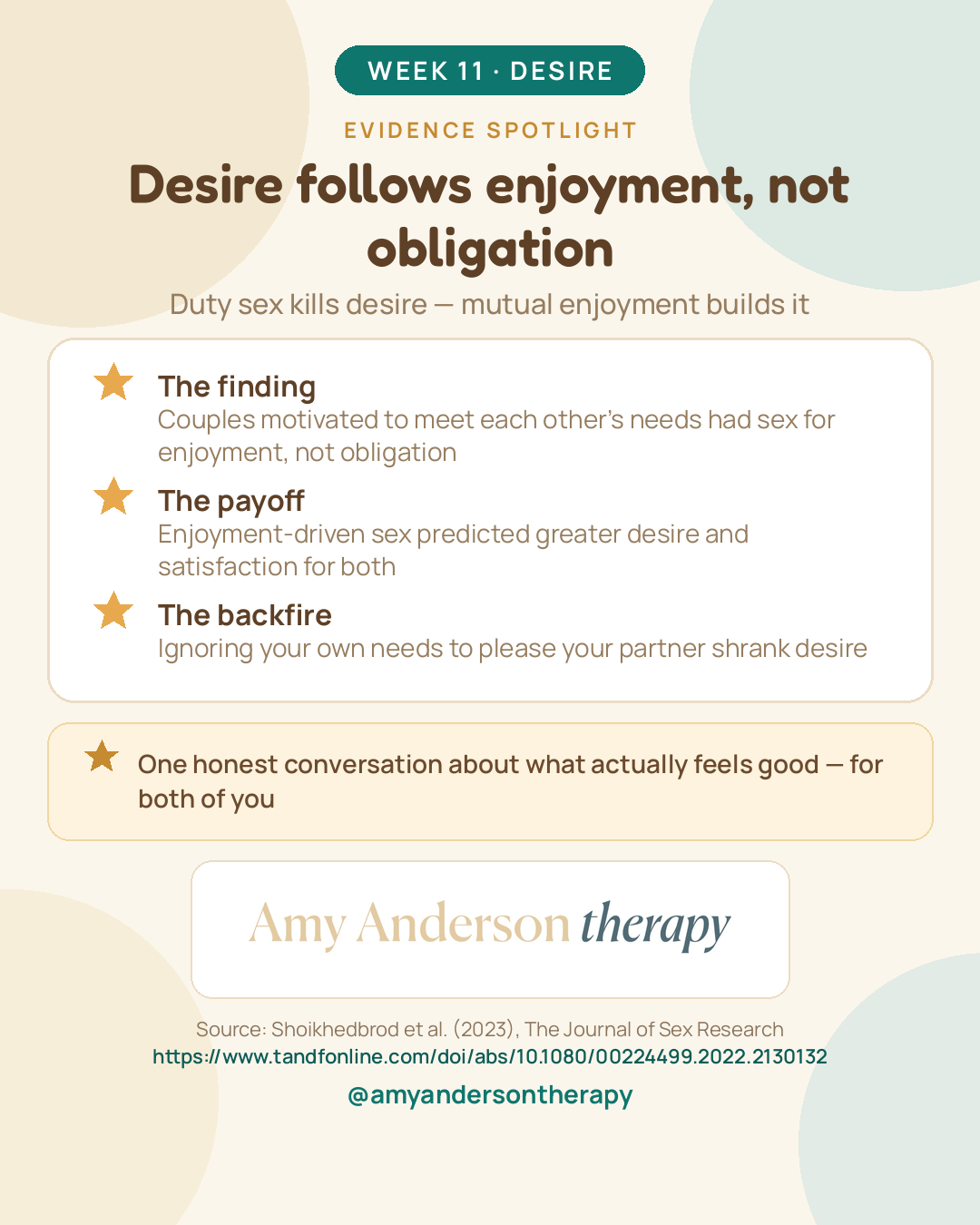
One more finding to carry into these talks: couples who were motivated to meet each other’s sexual needs — and did it for enjoyment rather than obligation — reported greater desire and satisfaction, both partners. But ignoring your own needs to please your partner backfired (Shoikhedbrod et al., 2023). Translation: generous, not self-abandoning. The difference matters.
Say it out loud: language that brings the heat back
Most couples don’t have a desire problem. They have a saying-it problem. You want your partner, they want you, and still nobody says it out loud — because saying it feels exposing, and exposing yourself in the bedroom feels riskier than staying quiet. So desire stays in your head, and the distance grows in the silence.
Plain, honest, playful language about what you want is the lowest-risk way to break the silence. It tells your nervous system this is play, not performance. And it teaches your partner exactly what works, instead of leaving them to guess. The evidence spotlight said it: the gap matters less than whether you can talk about it. This is the talking.
Ten phrases to steal. Say them as written, or bend them until they sound like you:
“I haven’t stopped thinking about you all day.” — Desire that started long before the bedroom.
“Come here. I want you closer.” — Direct. No guessing, no games.
“Tell me what you want. I want to hear you say it.” — Permission to ask out loud.
“You have no idea what you do to me.” — Let them feel their effect on you.
“Don’t move. Let me take my time with you.” — Slows everything down. Anticipation is the point.
“I love the way you sound when I touch you like this.” — Attention is the turn-on.
“I want you — not the polite version. All of you.” — The unedited version lands hardest.
“Keep your eyes on me.” — Presence. Stay here, with me.
“No editing tonight. Say the real thing.” — Drops the performance.
“You are so sexy it distracts me.” — A compliment with teeth.
How to start — the ladder, same logic as the touch ladder above:
Start in text. One phrase, daytime, low stakes. A text is easy to send and easy to receive.
Then try it outside the bedroom. The kitchen counts. Desire that only lives in bed stays fragile.
Agree on a pause word first. Anyone can use it, no questions asked. Safety is what makes play possible.
Debrief after. What worked, what felt silly, what to try again. The debrief is part of the intimacy.
And make it yours — the phrases you invent will always beat the ones you borrow: “I love it when you ___.” / “I want you to ___.”
Embarrassment is not a stop sign. It is the feeling right before something new gets good. If you both laugh, you are doing it right. And the consent rules from the top of this week still govern all of it: only with a willing partner, only what both of you want, and a no is a full sentence — checking in is part of the heat, not the end of it.
Free companion guide: Say It Like You Mean It — the ten phrases plus the full how-to, as a free PDF.
Why it matters for trauma
Trauma splits the body from the self — that’s dissociation’s whole job. But desire lives in the body. You can’t want from a body you’ve left. So the entire project of this week — the ladder, the sensory profiles, the slow boring rungs — is really one project: making the body feel like home again, so desire has somewhere to live.
That’s also why pressure is the enemy here. Every “we should be having more sex” lands on a traumatized system as a demand from an unsafe world — and the system answers the way it always does: shutdown or compliance. Compliance isn’t desire. It’s performance. The ladder works because it asks for nothing — and a system that’s asked for nothing can finally notice what it actually wants. The body keeps receipts — so give it good ones: rung after boring rung.
One more piece of psychoeducation from my EMDR training — the negative cognitions trauma installs, and where they live in the body: I’m not safe in my body. I can’t trust what I feel. I’m not in control of what happens to me. Naming the old sentence is not the same as believing it — it’s filing it. The counter-directions — I can learn to trust my body. I’m in charge of my choices. My body is mine — aren’t affirmations to chant. They’re directions to practice toward, one boring rung at a time. And the boundary, once more: noticing the cognition is psychoeducation. Reprocessing the memories that installed it is clinical EMDR, done with a trained therapist — never a rung on a self-guided ladder.
And the caretaker check, because it rides shotgun here: some of you learned to perform desire the way you learned to perform everything else — to keep the peace, to earn love, to avoid the sigh. That’s the caretaker role from the Inner Bonding work (Week 13 goes deeper): giving from fear instead of fullness. The evidence spotlight said it plainly — generous, not self-abandoning. A yes you perform to prevent a consequence isn’t desire. It’s compliance with better lighting. The ladder only works if the yeses are real — which is why protecting the no came first.
Try this
Exercise 1 — Together: The Sensory Profile
Purpose: replace mid-touch rejection with a shared map, given beforehand. Time: 15 minutes to write, 15 to share.
Each partner privately writes their three lists: touch I love / touch I tolerate / touch that’s a no. Be specific — body parts, kinds of touch, contexts. Then share. The reader’s only job: receive, ask curious questions (“tell me more about that one”) — no defending, no hurt-performing.
Ground rule: both green before you start. If sharing a “no” spikes either of you, pause — Week 1 protocol — and come back. A “no” shared calmly prevents ten rejections in the moment.
Solo version: Write your sensory profile as something you’d hand to a partner — clear, kind, specific. Notice what feels hard to write down. That’s usually the part most worth saying out loud someday.
Why this works: most mid-touch rejections aren’t rejections — they’re surprises. A no delivered mid-touch spikes both nervous systems because it’s unexpected; a map shared beforehand converts a potential rupture into information. And every time the map gets followed, the threat system gets one more data point that touch here is predictable — and predictability is the precondition for desire.
How you’ll know it worked: you referenced the map instead of freezing or faking it once this week. The map working means nobody has to guess.
Exercise 2 — Together: The 6-Second Kiss Ritual
Purpose: build a small, repeatable association between your partner’s touch and safety — the responsive-desire principle in miniature. Time: 6 seconds a day, for one week.
Every day for one week: one 6-second kiss — a small ritual borrowed from Gottman's work — with full presence. No agenda beyond it. Not a prelude. Just the kiss. Each partner privately tracks how it feels each day, one line. ("Day 3: I actually wanted it to last longer." "Day 5: I was thinking about email. Noticed, came back.")
At the end of the week, compare notes — with curiosity, not grading.
Solo version: Run the 6-second self-connection ritual — same principle, your own body. Every day for one week: hand on your chest, six slow seconds of noticing — warmth, breath, weight. No fixing, no judgment, just contact. Track one line a day ("Day 3: my shoulders dropped for the first time"). You're teaching your nervous system the same thing the kiss teaches a couple's: safe contact, repeated, rewrites the association.
Solo bonus — write your desire story: the honest one, not the performative one. What helps you feel desire? What kills it? What would you want a partner to know without you having to perform it? Write it as a letter to a future (or current) partner. You don't have to send it. You have to know it.
Why this works: the kiss is small enough to survive a flat Tuesday — and repetition, not intensity, is what rewrites the association between your partner's touch and safety. Six seconds is long enough to register and short enough to actually do.
How you'll know it worked: by day 4 or 5, the kiss stopped feeling like an assignment — even for a moment. "Boring and nice" is the ladder's first rung working.
Exercise 3 — Together: Build Your First Two Rungs
Purpose: design your actual first steps — specific enough to do on a Tuesday. Time: 20 minutes.
Using the ladder above, design just the first two rungs — yours, for this relationship, in your real life. What does rung one look like on a Tuesday? What's rung two — and what would tell you it's feeling "boring" (safe) enough to consider rung three? Write it down. Start this week.
Solo version: Map your own ladder — what would each rung look like for you, in your body, at your pace? Where do you guess you'd want to linger? There's no wrong answer; this is a map, not a test.
Why this works: small, safe, repeated steps teach the alarm a new association with touch — that's the exposure logic underneath. The "boring" rule is the quality control: the nervous system learns safety, not performance. One values check (ACT-inspired) before you start: what kind of intimate partner do you want to be from here — generous, or performing? The ladder only earns what it's done with honestly.
Exercise 4 — Together: Say One Phrase Out Loud
Purpose: give the language a first, low-stakes run — text first, voice second. Time: 10 minutes to choose, one text to send.
Each partner picks ONE phrase from the list in "Say it out loud" above — the one that feels most like them, or least terrifying. Send it by text first: daytime, no setup, no preamble. Notice what happens in your body when you press send, and what comes back. At your weekly check-in, debrief: what worked, what felt silly, what you'd try saying out loud next.
Solo version: Write the phrase you'd most want to hear — and the phrase you'd most want to say. Notice which one is harder to write down. That's usually the one most worth saying.
Why this works: language is exposure too. One small, safe, repeated bid teaches the system that wanting out loud is survivable — and survivable is the precondition for wanted.
How you'll know it worked: one phrase got sent this week — and the world didn't end. Awkward plus laughing together counts as worked.
Reflect
Your 20-minute weekly check-in ritual — the only "homework" in this course: 5 minutes on a states check (green/yellow/red — separately, then compare if you're a couple) · 10 minutes on this week's exercise · 5 minutes on the reflection prompt below. Same day, same time, every week. The ritual is the practice.
Journal on this — a few honest lines, not an essay:
"What I want my partner to know about my desire — that I've never quite said out loud — is ___."
Then one more: When did you last feel desire without pressure attached to it? What were the conditions — and what's one of them you could recreate?
And grief: What happened to the desire that used to come easy? Before the trauma, before the burnout, before the kids or the betrayal or the years of performing — there was a version of you that wanted without effort. Grieve that version's absence. Not to get her back exactly as she was — she lived in different conditions — but because ungrieved loss curdles into pressure, and pressure is desire's enemy. The ladder isn't about resurrecting the old desire. It's about making room for a new one.
Evidence spotlight
Couples motivated to meet each other’s sexual needs had sex for enjoyment rather than obligation — predicting greater desire and satisfaction for both partners. Ignoring your own needs to please your partner backfired (Shoikhedbrod et al., 2023, The Journal of Sex Research). Generous, not self-abandoning.
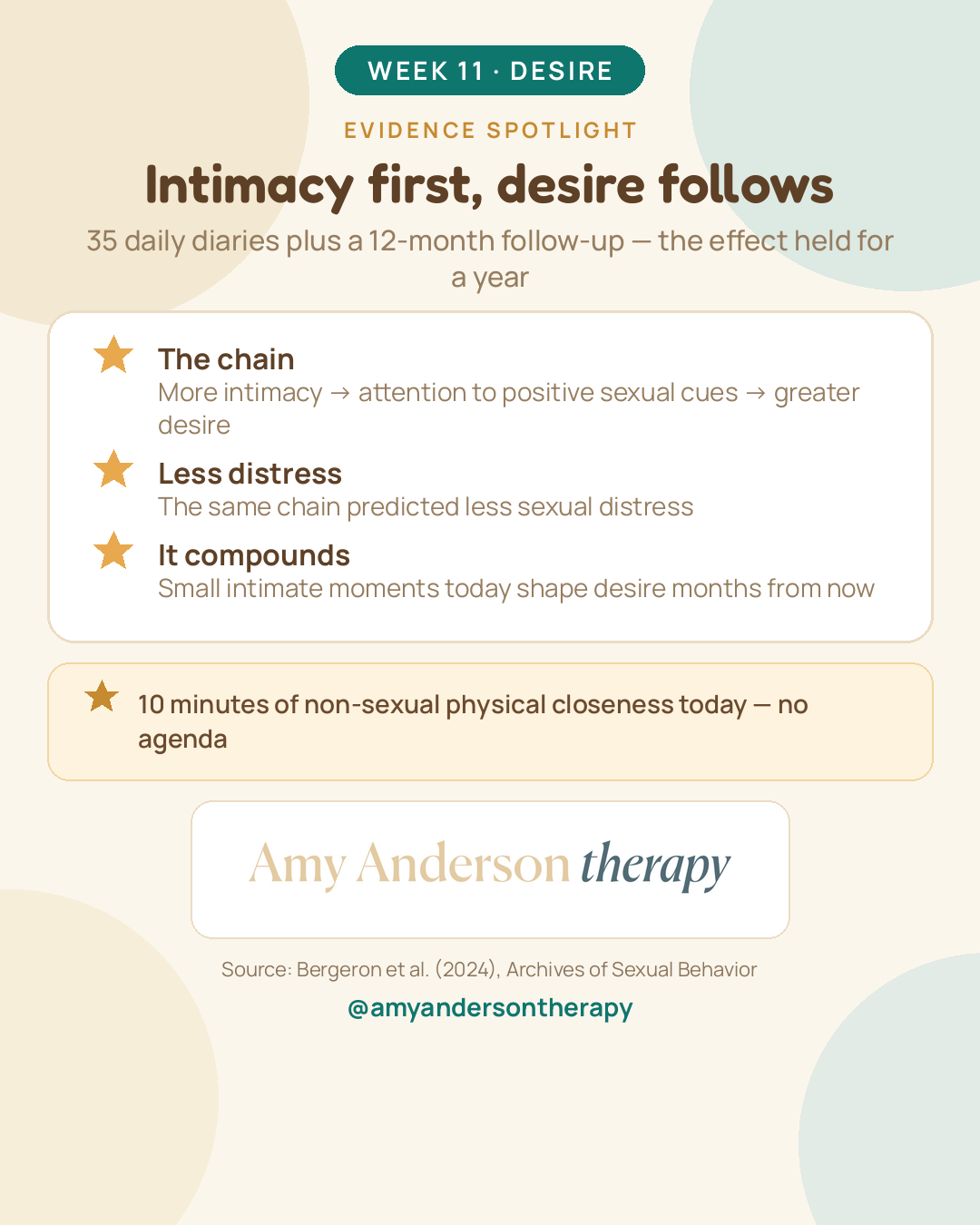
In 369 partnered adults, better sexual communication was linked to lower perceived desire mismatch — largely because good communication raised satisfaction (Galizia et al., 2023, Healthcare). The gap matters less than whether you can talk about it.
Full references live in your course research companion. These aren’t here to impress you — they’re here so you know this isn’t just my opinion.
Go deeper
From Amy’s blog — the free posts this week builds on:
The blogs normalize the struggle. This week gave you the ladder. Next week — the final week of this phase — we make it all sustainable: small things, often.
Your homework this week
Do the body check-in first — 5 minutes, solo. Before anything partnered, run the trauma-sensitive body check-in a few times this week. Notice the weather in your body, no fixing. Desire can’t be coaxed from a body you haven’t checked in with.
2. Start the 6-second kiss ritual — 6 seconds a day, for one week. Full presence, no agenda, not a prelude. Track one honest line a day, then compare notes at the end of the week — curiosity, not grading. “Boring and nice” is the rung working.
3. Write and share your sensory profiles — 30 minutes total. 15 minutes to write your three lists (touch I love / tolerate / no), 15 to share. Specificity is kindness. If sharing a "no" spikes either of you, pause and come back — Week 1 protocol.
4. Design your first two rungs — 20 minutes. Yours, for this relationship, on a real Tuesday. Write down what each rung looks like, and what "boring" (safe) would look like for rung three. Start rung one this week.
5. Companion workbook: complete the Week 11 worksheets — the full-lesson versions of the exercises above, with the reflection prompts built in (30 minutes, then stop).
6. Say one phrase out loud — start in text. Pick one phrase from "Say it out loud," send it by text this week, and debrief at your check-in. Awkward plus laughing together counts.
Week 11 of 16 · Too Busy or Too Broke for Trauma Therapy · © Amy Anderson, LCSW. This material is psychoeducational and is not a substitute for therapy, diagnosis, or treatment.