
Week 12 — Small Things, Often: Repair as a Daily Practice
Too Busy or Too Broke for Trauma Therapy: A 16-Week Trauma-Informed Course for Couples & Individuals · Amy Anderson, LCSW
Theme: Small Things, Often: Repair as a Daily Practice
“What this is: Psychoeducation — evidence-informed information, frameworks, and practice exercises to help you understand your relationship patterns and build skills. It is not psychotherapy, couples therapy, or a clinical relationship. Nothing here diagnoses or treats a mental health condition. If you need clinical support — especially around trauma, addiction, or safety — work with a licensed professional in your state.
If you’re in crisis: call or text 988 (US Suicide & Crisis Lifeline) · National Domestic Violence Hotline: 1-800-799-7233 or text START to 88788.
Who this week is not for (yet): If there is ongoing physical violence, coercion, or fear in your relationship — or the relationship is in acute crisis (a recent betrayal, an active addiction without support) — the daily rituals can wait. Stabilize first, with individual professional support. That’s not failure. That’s sequencing.”
Welcome to Week 12
Final week of Phase 3. You've learned the anatomy of repair, walked through the hardest rupture, and rebuilt intimacy from the nervous system up. Now the question that decides whether any of it sticks:
What do you do on an ordinary Tuesday?
Here's the uncomfortable truth: grand gestures don't save relationships. The big romantic weekend doesn't overwrite six months of missed bids. The tearful apology doesn't outlast the daily cold shoulder. What keeps relationships alive — what the best available research points to — is repetition of care. Small things, often. Not poetic. Just true.
This week makes everything operational: the daily rituals, the weekly conversation, and a menu so small it survives your worst week — not just your best.
The lesson
Why small deposits beat big ones
Your nervous system doesn't learn from intensity. It learns from frequency. One extraordinary date night is a data point; a hundred ordinary kind mornings is a pattern — and patterns are what the threat system trusts.
Think of it as deposits. Every small moment of turning toward your partner is a deposit in the emotional bank account. Every missed bid, every cold shoulder, every "not now" is a withdrawal. Couples don't usually go bankrupt from one huge withdrawal. They go bankrupt from a thousand tiny ones nobody noticed.
This is especially true for trauma-affected nervous systems, which run a background program asking one question on loop: is it safe here? A grand gesture doesn't answer that question — it's too rare to be trusted. But the same small kindness, repeated daily, becomes evidence the system can't argue with. Predictability is the opposite of what trauma taught. Repetition is the repair.
Bids for connection: the smallest unit of a relationship
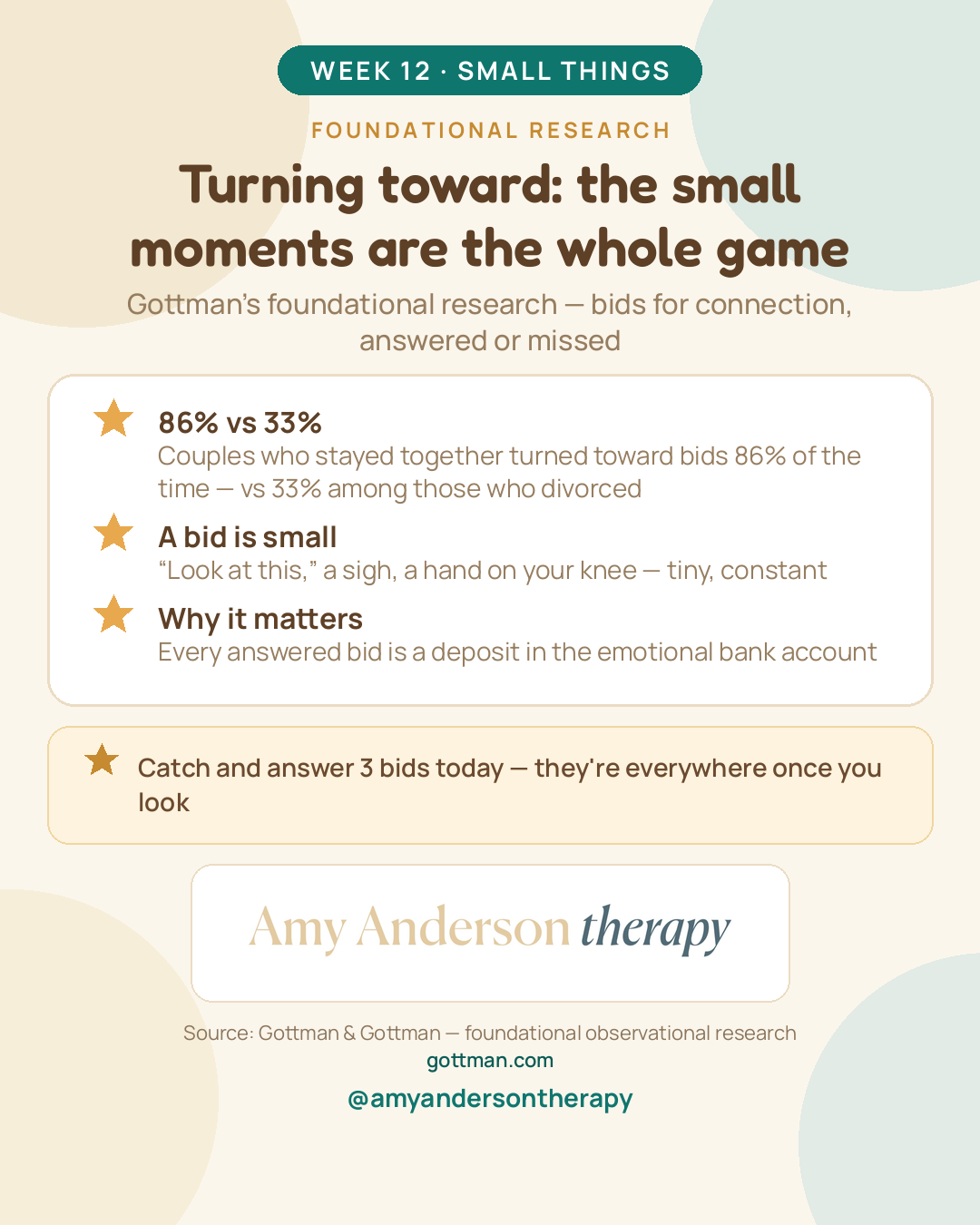
A bid is any small, everyday attempt to connect. That's it. They're usually tiny:
"Did you see that ridiculous meme I sent you?"
A sigh while looking at you, waiting to be asked about it.
"How was your day?" — asked like you actually want the answer.
A hand on your back walking past. Coffee brought without being asked.
Here's what makes bids tricky: they come in disguise — especially with high achievers, who route everything through logistics. "Did you see the email from the school?" might be a bid: are we a team on this? "We need to talk about the weekend plans" might be a bid: I want to feel close to you while we plan. If you're only listening for the logistics, you'll miss the bid underneath — and your partner will feel unheard about something they never quite said.
Every bid gets one of three responses:
Turn toward: you notice and engage. ("No! Show me." / a hand squeeze / "tell me more.")
Turn away: you miss it — distracted, tired, scrolling. (Not hostile. Just absent.)
Turn against: you respond with irritation. ("Not now." / the eye roll.)
Missed bids aren't fatal — everyone turns away sometimes; you're human, not a concierge. The damage comes from patterns of turning away, and from turning against. And here's the hopeful part: noticing is a skill. Most couples aren't rejecting each other's bids on purpose. They literally don't see them. This week's tracker fixes that.
Why it matters for trauma
Traumatized nervous systems don't register grand gestures. A surprise trip doesn't overwrite 200 missed bids, because the threat system doesn't do math on special occasions — it does math on ordinary days. "Was it safe on Tuesday? What about Wednesday?" A hundred safe Tuesdays is what convinces it. The body keeps receipts — so give it good ones: small, dated, ordinary.
There's a second reason smallness matters: trauma makes big feel dangerous. Big romantic gestures can actually spike a hypervigilant system — what do they want? what's the catch? Small, predictable care asks nothing back. It just keeps showing up. That's the exact opposite of what trauma taught: that closeness is unpredictable and costly. Small things, often, is the re-education.
And my positioning, stated plainly: in my Gottman training on PTSD and couples, the presenters were blunt about how minimal the existing PTSD couples therapies are. Almost none of them touch the daily, ordinary layer — the Tuesdays. That's the gap this week is standing in. Not a new theory. The ordinary.
Try this
Exercise 1 — Together: The Bid Tracker
Purpose: train yourself to see bids — especially the disguised ones — before you can turn toward them. Time: 5 minutes a day for one week, 20 minutes to review.
An honest note on the numbers
You've probably heard the famous figures: couples who stayed together turned toward each other's bids the vast majority of the time, while couples who split missed most of them — and the "magic ratio" of five positive interactions to every negative one. I want to be straight with you: those numbers come from Gottman's original observational studies, and no 2021–2026 peer-reviewed replication of those specific figures was found. So I teach the practices — bids, turning toward, the daily rituals — because the practices are sound and the method as a whole has recent support. I don't teach the numbers as settled science, because they aren't. You deserve that honesty.
Here's what is recent: in a randomized pilot trial with 49 couples recovering from infidelity, Gottman Method Couples Therapy outperformed treatment-as-usual on trust, conflict management, relational satisfaction, and quality of sex (Irvine et al., 2024). That's the strongest recent peer-reviewed support for the method overall — and it's the method's practices, not its famous ratios, that did the work.
The "6 hours" — adapted for real, tired, trauma-affected lives
Gottman famously described "six hours a week" that keep a relationship healthy: partings, reunions, admiration, affection, a weekly date, and a State of the Union conversation. Beautiful framework. Completely unrealistic for two burned-out, trauma-affected adults with jobs and possibly kids.
So here's the adapted version — the same functions, shrunk to fit real life:
Partings (2 min): one real goodbye. Not shouting "bye!" at a door. Eye contact, one sentence about the day ahead, the 6-second kiss if that's yours now.
Reunions (5 min): the first five minutes home set the temperature. Phone down. One real question. Let the nervous systems land before the logistics start.
Admiration (1 min): one specific appreciation a day. Not "you're great" — "the way you handled that call with your mom today — I noticed, and I admired it." Specificity is what makes it land.
Affection (stolen moments): touch with no agenda, scattered through the day. The ladder's rung one, as a lifestyle.
The weekly check-in (30–45 min): the State of the Union — template below. This is the one that does the heavy lifting.
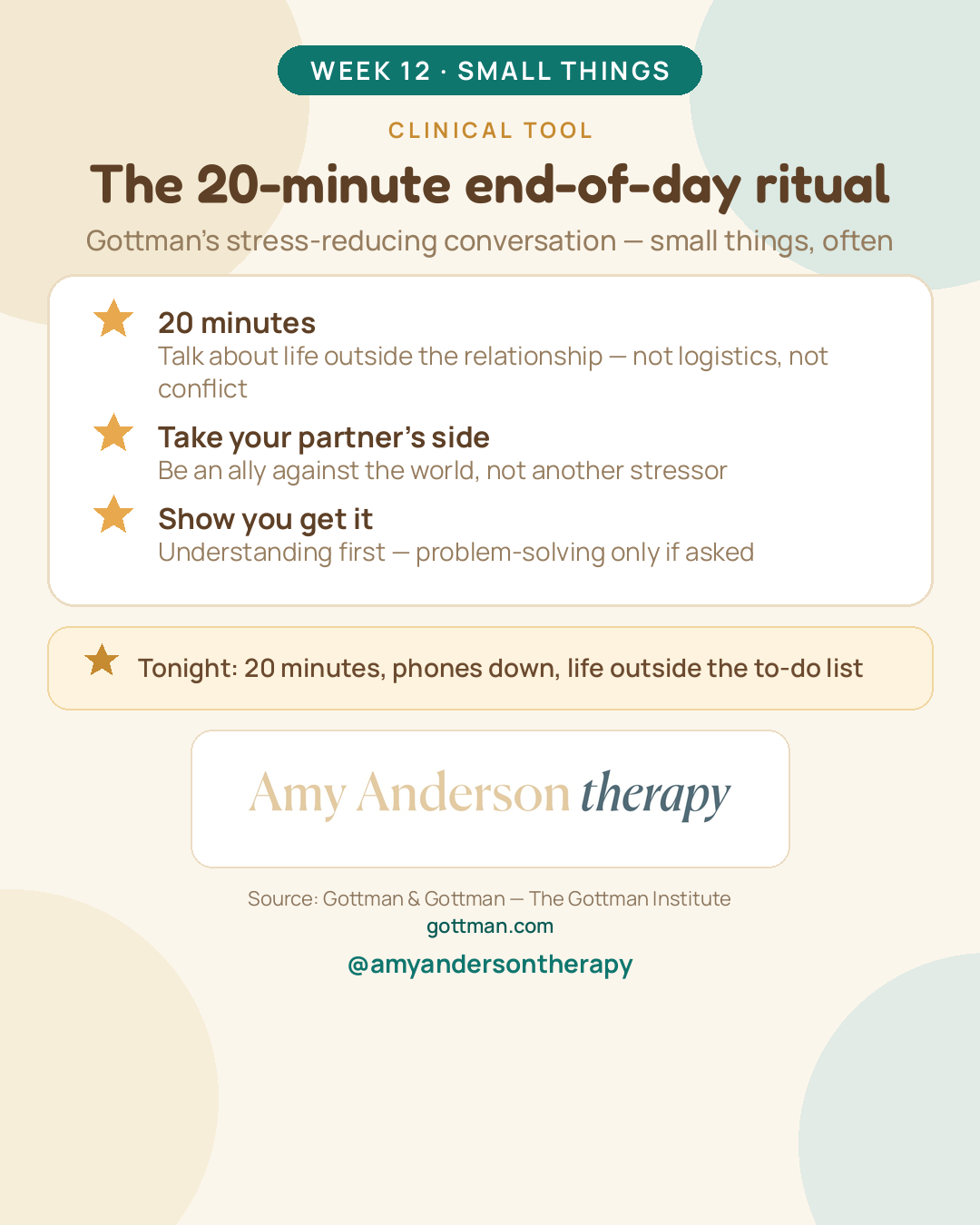
Decompress (20 min): the end-of-day stress-reducing conversation — Gottman's ritual where each partner gets to unload the day's stress while the other listens, takes their side, and does not fix. Not problem-solving. Just: your stress matters to me, and we're on the same side of it. For trauma-affected couples, this is the daily proof that home is a shelter, not another front.
That's not six hours. It's closer to two — and two hours you'll actually do beats six you won't.
Gottman calls these rituals of connection — the small, repeated practices that carry a couple's shared meaning. The adapted versions above are the same rituals, sized for real life.
If it helps to see the architecture: Gottman's Sound Relationship House names the floors these rituals are building — turning toward instead of away, sharing fondness and admiration, managing conflict without contempt. The daily rituals aren't random kindnesses. They're load-bearing walls.
The two the adaptation skipped: date night and love maps
Two more from the same tradition, worth keeping even in tired seasons:
Date night — the bar is the floor. Not a production. Coffee after the kids are down. A walk with no phones. Takeout on the porch. The function of date night isn't romance — it's uninterrupted us-time that isn't about logistics or problems. Monthly is fine. Protected on the calendar is what makes it real.
Love maps — stay a student of your partner. A "love map" is the accumulated knowledge of your partner's inner world: their current stress, their quiet dream, what they'd do with a free Saturday, what they're worried about but haven't said. Love maps decay — people change, and the map from three years ago is out of date. The weekly check-in is where you update it: one curious question a week. "What's something on your mind lately that I don't know about?" Staying current is a small thing. It compounds.
Integration lives here: what psychedelic-assisted therapy gets right
I'm a psychedelic-assisted therapist (18+ CE credits in psychedelic-assisted therapy for couples and trauma; 2-day MDMA couples intensive with MAPS, 2023), and this week is where that training speaks most directly. In psychedelic-assisted therapy, the powerful session isn't the healing. The healing happens in integration — the weeks afterward, when insights get translated into daily practices, relationships, and choices. An insight you don't live is just a nice story about yourself.
Same here. Weeks 1–11 gave you insights, maps, and tools. This week is the integration phase of the course: the small daily deposits are how the insights become a different relationship. And the same rules apply: integration can't be rushed, it happens in ordinary life (not in peak moments), and it works best witnessed — by a partner, a community, or a professional.
One boundary, stated clearly: psychedelics remain illegal in most contexts, and nothing in this course is guidance for using them. If you've had a legal psychedelic experience — a clinical trial, ketamine therapy where it's legal — and want support integrating it into your life and relationship, that's work for a trained provider in a legal context, not a DIY project. (Integration support in legal contexts is part of my practice.) The principle, though, belongs to everyone: preparation makes deep work possible; integration makes it last.
The State of the Union — trauma-adapted template
Once a week, 30–45 minutes. This is the conversation where small things get maintained before they become big things. For trauma-affected couples, we add one thing at the very start: the nervous system check.
Check states (2 min). Each partner: "I'm green / yellow / red right now." If anyone's yellow or red — Pause-and-Return Protocol from Week 1: regulate first, or reschedule. Never hold a State of the Union from yellow. That's how it becomes a State of the War.
Appreciations (5 min). Two or three specific appreciations each. Start here on purpose — it puts both nervous systems in a receiving state before anything hard.
One issue (15–20 min). One. Not the list. Use the Week 9 repair structure for it: what's the issue, what's the impact, what's needed. Listener reflects before responding.
Logistics & looking forward (5 min). The week ahead, practically — and one thing you're each looking forward to, together or apart. End pointed toward the future, not the wound.
If 45 minutes feels impossible: do the 20-minute version — states, one appreciation each, one small thing. The regularity matters more than the length.
For one week, each partner keeps a simple log — phone notes are fine:
Bid I made: (what I did or said)
How they responded: (turned toward / turned away / turned against)
Bid I noticed from them: (the ones you caught)
At the end of the week, review together — with curiosity, not scorekeeping. The goal isn't a percentage. The goal is sentences like "I didn't realize that was a bid." That sentence — said with genuine surprise, not sarcasm — is the whole exercise working. Notice the disguised ones especially: the logistics that were really bids, the sighs that were really invitations.
Rules for the review: both green (check states first — Week 1 protocol if not). No defending missed bids; just notice. End by each naming one bid you'll make deliberately this coming week. If the urge is to skip the review because "it'll just turn into a fight" — that's the alarm talking about the past, not the present. Going anyway, regulated and curious, is opposite action (DBT-informed): the feeling gets acknowledged, the streak gets protected.
Solo version: Track bids for one week in your friendships, family, or dating life — bids you make and bids you notice from others. Notice your own patterns: do you bid often or rarely? Do you catch others' bids, or miss them? Your bid pattern with friends is usually a preview of your bid pattern with a partner.
Why this works: you're training pattern-recognition, not performance. Most couples miss bids because they literally don't see them — the log makes the invisible visible, and the review turns noticing into a shared skill. One "I didn't realize that was a bid" can rewrite a dozen old resentments in a single sentence.
How you'll know it worked: the review produced at least one genuine "I didn't realize that was a bid." That sentence is the entire exercise.
Exercise 2 — Together: Design Your Worst-Week Menu
Purpose: build a connection floor so low you can stand on it during your worst week. Time: 15 minutes.
Think of the worst-week menu as a container — the EMDR resourcing tool from Week 2. When the week is too much, connection goes in the box: small, lidded, scheduled. Not spilling everywhere, not disappearing entirely. Contained.
List 5 connection rituals that take under 5 minutes each. These are your floor, not your ceiling — designed for the week when you're sick, slammed, grieving, or just done. One filter from the Inner Bonding work before you build the list: am I giving from fullness or from fear? The caretaker gives to earn safety — and a worst-week menu built from fear becomes another performance. Test every ritual: would I still do this if nobody were keeping score? Keep the ones that pass. Examples: the 6-second kiss at parting · one specific appreciation over coffee · phones down for the first 5 minutes home · a 2-minute shoulder squeeze while the kettle boils · one "thinking of you" text with something specific in it.
Write the menu down. Put it where you'll see it. The test isn't "does this feel romantic." The test is "could we do this on our worst week?" If yes — that's the menu.
Solo version: Design your self-connection menu — 5 small things, under 5 minutes each, that return you to yourself on your worst week. (Hand on chest and three slow breaths. Step outside and feel air. One song, full attention. Cold water on your face. Write one true sentence.) You can't turn toward anyone from red — this menu is how you get yourself back to green. If the giving-from-fear pattern runs deeper than a menu — if you can't remember the last time your own needs led — the CoDA recovery community exists for exactly this pattern (coda.org). Not a diagnosis. A room full of people doing the same work.
Why this works: the menu removes decision-making from the week when decision-making is offline. Pre-decided rituals mean connection runs on autopilot instead of willpower — and willpower is exactly what a hard week has already spent. The floor holds so the ceiling doesn't have to.
How you'll know it worked: you used the menu during a genuinely hard week — not a good one. The menu proves itself in the storm, not the sunshine.
The values filter (ACT-inspired). Before you finalize the menu, run each ritual through one question: does this match the relationship I actually want? Not the relationship you think you should want — the one you'd choose. Keep the 2–3 that light you up, not just the ones that seem responsible. A menu built on values gets used. A menu built on shoulds gets abandoned by February.
Bonus — the I-Appreciate list (5 minutes). Each partner writes 10 specific things they appreciate about the other — and here's the key: character, not just chores. Not "thanks for doing the dishes" — "I appreciate your steadiness," "I appreciate how funny you get when you're tired," "I appreciate that you always notice when I'm off." Gottman tradition uses an adjective checklist for exactly this, and I'm borrowing the concept: appreciation for who they are, not just what they do. Read them aloud to each other. It's awkward, and it's the fastest deposit you'll make all week.
Exercise 3 — Together: Your First Mini State of the Union
Purpose: install the weekly maintenance conversation that keeps small things from becoming big things. Time: 20 minutes this week; 30–45 going forward.
This week, hold a 20-minute version: states check (green/yellow/red each — reschedule if not green), one specific appreciation each, one small issue using the Week 9 structure, one thing you're looking forward to. Set a timer. When it rings, you're done — even mid-sentence. (The timer is what makes it safe to start.)
Schedule next week's full one before you close. Recurrence is the practice.
Amy's rule: the body keeps receipts — so give it good ones. Repetition is the receipt your nervous system files. Every small, consistent deposit is proof your alarm can retire from its second job.
Solo version: Hold a State of the Union with yourself — 15 minutes, weekly. States check (where am I — green, yellow, or red?), one thing you appreciate about how you handled this week, one thing you're looking forward to. Same structure, one participant. It counts.
Why this works: the timer is what makes the conversation safe to start — a nervous system can tolerate hard things when it knows they end. And scheduling the next one before you close is the anti-avoidance move: problems discussed on a schedule never get to become ambushes.
How you'll know it worked: next week's is already scheduled before you close this one. Recurrence is the practice — the second meeting matters more than the first.
Reflect
Your 20-minute weekly check-in ritual — the only "homework" in this course: 5 minutes on a states check (green/yellow/red — separately, then compare if you're a couple) · 10 minutes on this week's exercise · 5 minutes on the reflection prompt below. Same day, same time, every week. The ritual is the practice.
Journal on this — a few honest lines, not an essay:
"The small thing my partner does that matters most to me is ___. The small thing I could do more often — that costs me almost nothing — is ___."
Then one more: What's one bid you've been missing — theirs or yours — that you want to start catching?
And grief, because this week earns it: What did the years without small things cost? The seasons you ran on logistics and called it a relationship. The tenderness that withered while you were both surviving. Grieve that — not to punish yourselves, but because naming the cost is what makes the deposits feel like choosing instead of catching up. The small things aren't just nice. They're the years you get to have differently from here.
Evidence spotlight
In a randomized pilot trial with 49 couples recovering from infidelity, Gottman Method Couples Therapy outperformed treatment-as-usual on trust, conflict management, relational satisfaction, and quality of sex (Irvine et al., 2024, The Family Journal).
An honest footnote: the famous "turning toward" percentages and the 5:1 positive-to-negative ratio come from Gottman's original observational studies — no 2021–2026 peer-reviewed replication was found. The trial above is the strongest recent support for the method overall. I teach the practices, not the numbers.
Full references live in your course research companion. These aren't here to impress you — they're here so you know this isn't just my opinion.
Go deeper
From Amy's blog — the free posts this week builds on:
The blog introduces the concept. This week made it operational. Phase 3 complete — repair named, betrayal faced, desire rebuilt, and the daily practice installed. Next: Phase 4, Integration & Future — who you're becoming, individually and together.
Your homework this week
Track bids for one week — 5 minutes a day. Keep the log: bids you made, how they were answered, bids you noticed from them. Then do the 20-minute review together — curious, not scorekeeping, both green first. End by each naming one bid you'll make deliberately this coming week.
2. Design your worst-week menu — 15 minutes. Five connection rituals, under 5 minutes each. Run each through the filter: giving from fullness or from fear? Write the menu down and put it where you'll see it. Then add the I-Appreciate list — 10 specific, character-not-chores appreciations each, read aloud.
3. Hold your first mini State of the Union — 20 minutes. States check, one appreciation each, one small issue on the Week 9 structure, one thing you're looking forward to. Timer on. Schedule next week's (30–45 min) before you close — the recurrence is the practice.
4. Start one daily ritual tonight. Pick from the adapted "6 hours" list — a real 2-minute parting, 5-minute reunion, one specific admiration, stolen-moment affection, or the 20-minute stress-reducing conversation. Two hours you'll actually do beats six you won't.
5. Companion workbook: complete the Week 12 worksheets — the full-lesson versions of the exercises above, with the reflection prompts built in (30 minutes, then stop).
Week 12 of 16 · Too Busy or Too Broke for Trauma Therapy · © Amy Anderson, LCSW. This material is psychoeducational and is not a substitute for therapy, diagnosis, or treatment.