Welcome to Week 13
Twelve weeks in, you have real tools. You can name your nervous system state. You know your patterns. You've got repair scripts, rituals, a map.
And some of you have used every one of those tools perfectly — while a voice in your head narrated the whole thing like a hostile sports commentator.
"You're doing this wrong. They don't believe you. You sound ridiculous. Why are you even trying — you're still the same person."
That's the inner critic. And here's the uncomfortable truth of Phase 4: every communication skill fails against the voice in your head. You can learn the perfect repair script and still torpedo it with contempt for yourself mid-sentence. You can practice turning toward your partner and still hear, in the background, that you're too much and not enough at the same time.
So this week, we go inside. We meet the critic — not to kill it (spoiler: you can't, and trying makes it louder) — but to understand what it's protecting you from, and to negotiate a new job description for it.
Week 13 — The Inner Critic & Radical Acceptance
Too Busy or Too Broke for Trauma Therapy: A 16-Week Trauma-Informed Course for Couples & Individuals · Amy Anderson, LCSW
Theme: The Inner Critic & Radical Acceptance
“What this is: Psychoeducation — evidence-informed information, frameworks, and practice exercises to help you understand your relationship patterns and build skills. It is not psychotherapy, couples therapy, or a clinical relationship. Nothing here diagnoses or treats a mental health condition. If you need clinical support — especially around trauma, addiction, or safety — work with a licensed professional in your state.
If you’re in crisis: call or text 988 (US Suicide & Crisis Lifeline) · National Domestic Violence Hotline: 1-800-799-7233 or text START to 88788.
Who this week is not for (yet): If there is ongoing physical violence, coercion, or fear in your relationship — or an undisclosed affair or active addiction without outside support — pause here and reach out for individual support first. Stabilization comes before coursework. That’s not failure. That’s sequencing.”
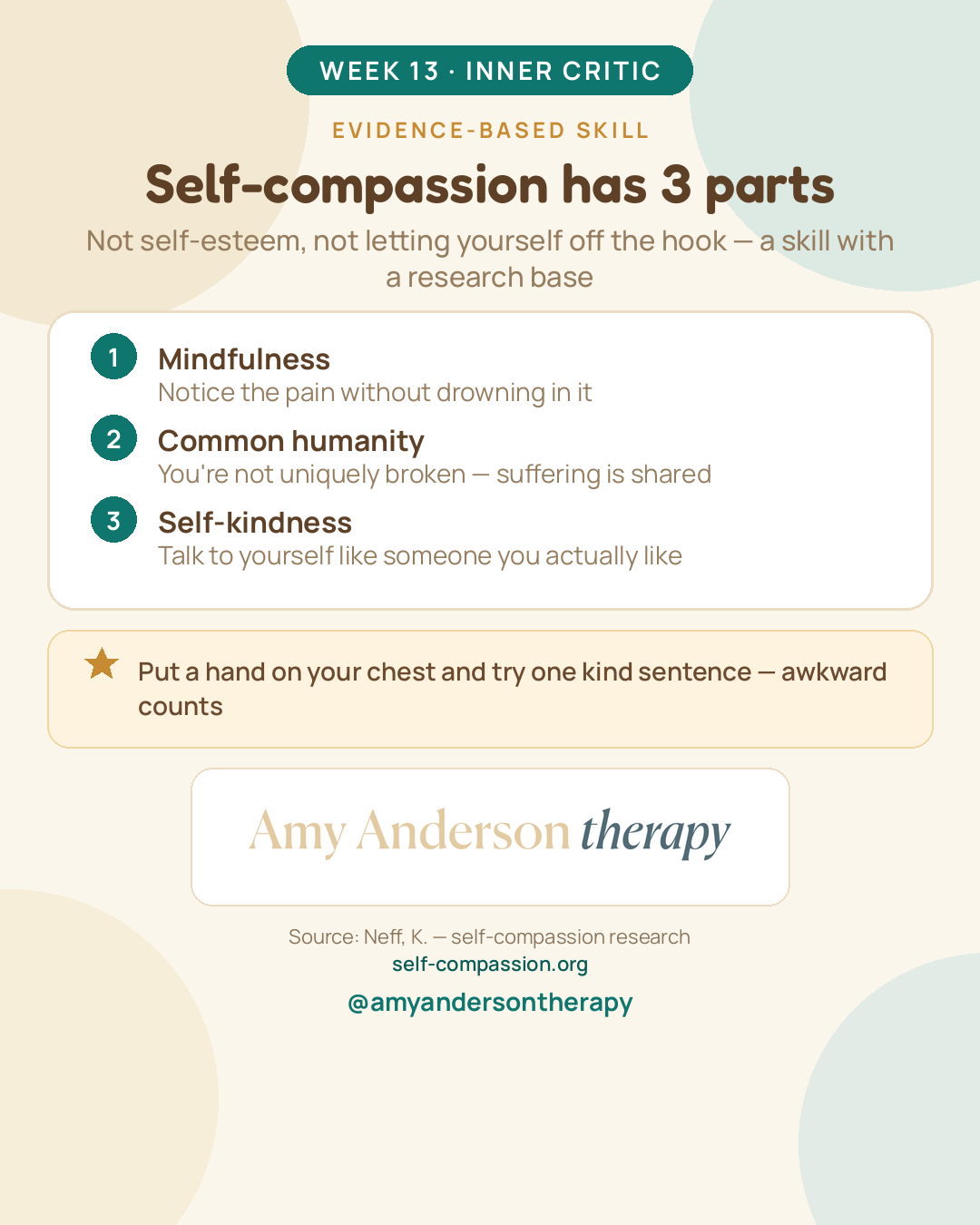
"Being kind to yourself is one of the greatest kindnesses," writes Charlie Mackesy. File that under things the critic will immediately argue with. Notice the argument happening — that is the critic, doing its job, loudly. You're watching it instead of obeying it. That's the whole week.
Then we turn outward, to the second half of this week: radical acceptance. Because some things about your partner, your story, and your relationship will not change. Not with the right script, not with enough therapy, not if you just explain it one more time. This week you learn the difference between accepting what's real and giving up — and how to tell them apart.
The lesson
Every skill fails against the voice in your head
Picture it. You've done the work. You notice you're in yellow. You call the pause. You come back regulated. You start your repair — "I felt hurt when..." — and right on cue, the critic chimes in: "You sound weak. They're going to use this against you. You're pathetic for needing this conversation."
So you rush it. Or you over-explain. Or you pre-emptively attack so they can't. The tool was fine. The operator was getting heckled.
High achievers have the loudest critics on the planet. You've spent your whole life turning that voice into fuel — I'll prove them wrong, I'll be perfect, I'll never be caught off guard again — and it worked, professionally. It got you the career, the credentials, the life that looks incredible from the outside.
But the critic doesn't know how to clock out. It followed you home. And a voice that's great at driving performance is terrible at intimacy. You cannot optimize your way into being loved, and you cannot criticize yourself into feeling safe.
The critic is a part, not the whole of you
Here's the reframe that changes everything: the critic is not you. It's a part of you. This is the core idea from Internal Family Systems, or IFS — a parts-based framework I've had initial training in, which this lesson draws on for its language of parts, protectors, and self-leadership.
Think of your inner life like a committee. There's the part that shows up at work and crushes it. The part that wants to be held. The part that's still seven years old and braced for the yelling. And then there's the critic — the loud one with the clipboard, auditing everything.
The critic is not evil. It's not even wrong about everything. It's a protector. It developed a strategy a long time ago: if I point out every flaw before anyone else can, you won't be blindsided. If I keep you small and perfect, nobody can reject the real you — because they never see you.
That strategy probably worked once. For a kid in an unpredictable house, self-monitoring was survival. For a young professional in a competitive field, perfectionism was armor. The problem isn't that the critic exists. The problem is that it's still running a childhood strategy in an adult relationship — and it has no idea the war is over.
Charlie Mackesy names the lie underneath the armor in one line: "The greatest illusion is that life should be perfect." Perfect was the strategy. You're allowed to retire it.
Practically, that means one thing: you don't fight the critic. You interview it. Treat it like an enemy and it digs in harder. Parts don't respond to force — they respond to leadership, to being seen by the adult you actually are now.
The guided parts dialogue: interviewing the critic
This is the core practice of the week — a written walkthrough you do with a journal. Exercise 1 below is the full version; here's the teaching so you understand what you're doing and why.
Step 1 — Notice and name it. When the critic shows up this week, pause. Where do you feel it in your body? Chest? Throat? Behind the eyes? Give it a name or a description — "The Auditor," "The Drill Sergeant," "Mom's voice with my face." Naming it separates it from you. You're not a bad person. You have a loud part.
A language tip that makes this work better: say "a part of me feels like a failure" instead of "I am a failure." That tiny grammatical shift — called unblending in parts work — is the difference between being the critic and noticing it. You can't interview a voice you're fused with.
A second language tip, borrowed from ACT: prefix the critic's sentence with "I'm having the thought that...". "I'm having the thought that I'm a failure" lands differently than "I am a failure" — same words, but now you're the one having the thought instead of being it. Defusion, one prefix at a time.
Step 2 — Thank it for its job. This feels ridiculous the first time. Do it anyway. Silently, to the part: "I know you're trying to protect me. I know you've been working really hard for a long time." This isn't agreeing with it. It's the dialectical move — two things are true: the critic hurts you and it's trying to help. Acknowledging the intent is what gets it to lower the volume enough to talk.
Step 3 — Ask the key question. This is the whole interview, right here: "What are you afraid would happen if you stopped?"
Write down whatever comes. Usually it's something like: "If I stop pointing out your flaws, you'll get lazy and everyone will leave." Or: "If I stop, you'll relax, and relaxing is when bad things happen." Or: "If I stop, you'll be ordinary."
That fear is the critic's actual job description. It's not "make you miserable." It's "keep you from being blindsided / abandoned / ordinary / unsafe." Once you know the fear, you're not arguing with noise anymore. You're talking to a scared protector.
Step 4 — Ask how old it thinks you are. Gently: "How old do you think I am right now?" Critics almost always answer with a childhood age. They formed when you were small and they never got the update that you grew up, got competent, built a life. You can tell it: "I'm [your age] now. I have resources that kid didn't have. You can stand down a little."
Step 5 — Negotiate a new role. You're not firing the critic — its sharp eye is genuinely useful sometimes (editing, discernment, high standards at work). You're reassigning it: "I don't need a full-time heckler anymore. I need an advisor I can consult — not a narrator running 24/7. When I ask for your eye, give it to me. Otherwise, you're off duty."
Parts don't transform in one conversation. But the first interview changes the relationship from obedience to leadership. You stop being the critic and start having one.
One DBT-informed move for the week after the interview: opposite action. The critic's urge is usually to hide, isolate, or over-perform. The opposite: one small self-compassionate action in the other direction — text the friend back, take the walk, say the need out loud. You're not arguing with the critic. You're proving, behaviorally, that its orders are optional.
A stabilization tool from EMDR: safe place and container
I'm trained in EMDR, and I want to be precise about what belongs in a course versus a therapist's office. EMDR reprocessing — revisiting traumatic memories with bilateral stimulation — is clinical work. It does not belong in a self-guided course, and nothing here will ask you to do it.
What does belong here is Phase 2 of EMDR: resourcing and stabilization — the skills a trained EMDR therapist teaches before any reprocessing ever happens. Two of them plug directly into critic work:
Safe place. Close your eyes and bring to mind a real or imagined place where you feel completely at ease — a beach, a room, a person, a memory. Notice what you see, hear, smell. Find where calm lives in your body right now and rest your attention there for two minutes. When the critic is screaming, you now have somewhere to stand while you interview it. Practice this calm so it's available when you're not.
Container. Visualize a container with a lid — a vault, a box, a trunk. When the critic loops or a distressing image shows up at a bad time (mid-workday, mid-conversation), mentally place it inside, close the lid, and tell yourself: "I'm putting this away until [specific time], when I'll look at it properly." This isn't avoidance — avoidance has no return date. The container is a scheduled appointment with the feeling.
These are stabilization skills, not treatment. If the critic is wired to trauma that floods you — if you need more than skills — that's the signal to do this work with an EMDR-trained therapist, not a worksheet.
The critic's greatest hits: a map of the three clusters
From my EMDR Basic Training, one more piece of psychoeducation — the chart of negative cognitions that trauma installs. The critic's greatest hits cluster into three families, and naming the cluster takes some of its power:
Responsibility / defectiveness: I'm not good enough. I'm unlovable. I'm a failure. I'm permanently damaged. The critic's home turf — every flaw as proof that you're the problem.
Safety / vulnerability: I can't trust anyone. I'm not safe. It's not okay to feel what I feel. The critic as guard dog — don't trust, don't feel, don't need.
Power / control: I'm powerless. I can't stand up for myself. I can't handle it. The critic as the voice of learned helplessness — don't try, you'll fail.
A CBT lens on the same material: the critic also speaks in cognitive distortions — catastrophizing ("this will ruin everything"), mind reading ("they think I'm pathetic"), all-or-nothing ("I failed once, so I'm a failure"). Tagging the distortion — that's catastrophizing, not data — is the cognitive version of tagging the cluster. Same move: file it, don't obey it.
And the DBT-informed companion move: check the facts — before you obey the critic's verdict, ask: what are the actual facts here, separate from my interpretation? The critic rarely survives the fact-check.
When the critic speaks this week, try tagging the cluster: "That's defectiveness talking." "That's the safety cluster." You're not disputing it — you're filing it. And the boundary, stated once more because it matters: naming the cluster is psychoeducation. Working through the cluster — reprocessing the memories that installed it — is clinical EMDR, done with a trained therapist, not a worksheet. The map is yours. The excavation isn't.
When the critic aims outward
Here's the part nobody wants to hear: the critic doesn't just live in your head. It leaks.
The voice that says "you're not doing enough" to you becomes the voice that says "you're not doing enough" to your partner — maybe not out loud, but in the sigh when they load the dishwasher wrong, the correction of their story at dinner, the mental scorecard of everything they're not.
Researchers call it partner-directed perfectionism — the critic aimed outward. And the evidence this week says what your partner already knows: it costs the relationship. Perfectionism turned on a partner tracks with lower satisfaction and more conflict. Not because you have high standards. Because being audited doesn't feel like being loved.
Gottman gives this a blunter name: criticism — the first of the Four Horsemen. The horsemen are the four communication patterns his lab found most corrosive: criticism, contempt, defensiveness, and stonewalling. Criticism is the critic with a microphone — you always, you never, what's wrong with you. The antidote is one you already know: a gentle startup, complaint without character assassination, observation instead of verdict. When you catch the critic aiming outward, you're not just being unkind. You're riding the first horseman. Dismount.
So this week, notice the direction. When you catch yourself mentally red-penning your partner, ask: "Is this about them — or is my critic just looking for a new target because I wouldn't let it aim at me today?" Often it's the latter. The critic needs a job. If you won't let it narrate your inadequacy, it'll happily narrate theirs. Redirect it back to Step 2: thank it, ask what it's afraid of, and choose — consciously — not to outsource your self-attack onto the person you love. The pattern is the problem, not either person.
There's a difference between a complaint and the critic talking — and Nonviolent Communication (Marshall Rosenberg's framework, which runs underneath this whole course) gives it precise language. NVC separates observations (what happened — camera-recordable, no verdict) from evaluations (your judgment about what it means). A complaint stays in observation: "I felt hurt when the plans changed without a heads-up." The critic lives in evaluation: "You're so inconsiderate, you always do this, why am I even with someone like you." One invites repair. The other is a character assassination wearing honesty's clothes. Your partner can tell the difference even when you can't. When you catch a verdict forming, translate it back to observation. That's the whole skill — and you'll see it again in Week 15.
Two more Gottman frames for the same leak. The critic aimed outward raids the emotional bank account — every audit, sigh, and correction is a withdrawal, and nobody feels loved by an auditor. And it knocks out a whole floor of the Sound Relationship House: sharing fondness and admiration. You cannot admire someone you're simultaneously grading. The admiration doesn't come back by trying harder. It comes back when the critic clocks out.
The critic's codependent cousin: giving too much
There's a pattern that rides shotgun with the inner critic, and most of you already know its name: codependency. Straight talk first — "codependency" is a pop-psychology label, not a diagnosis, and researchers argue about the word. What's not arguable is the pattern underneath it, which walks into my office weekly: giving too much to earn love, and abandoning yourself to keep it.
Here's the mechanism. The critic says "you're too much and not enough." The codependent answer is: "fine — I'll make myself indispensable so nobody ever has a reason to leave." So you give. Emotional labor, social effort, financial generosity, sexual availability, intellectual deference — too much in every direction while your own needs go unfed. Then resentment builds, because giving without receiving is slow starvation. Then guilt arrives for feeling resentful — "good partners don't keep score" — and the critic uses the guilt as fresh ammunition. Round and round.
The framework I use for this comes from Healing Your Aloneness by Erika Chopich and Margaret Paul — the Inner Bonding work. I'm putting it in my own words here (the book itself is worth your time if this lands). Their core insight: underneath the giving live shame, guilt, blame, and the critic — old conclusions about your worthiness, absorbed young and never examined. The giving isn't generosity. It's a strategy: if I'm needed, I'm safe from abandonment.
So audit it honestly — not "am I codependent," but: where am I giving from fullness, and where am I giving from fear? Fullness replenishes. Fear depletes. Your body knows the difference even when your story doesn't. (Week 14 goes domain by domain — social, emotional, financial, sexual, intellectual — so you'll get the full map there.)
The way out isn't to stop giving. It's to include yourself in the circle of people you take care of. That's what the critic interview was actually about: the adult stepping in for the kid who learned love had to be earned. Same move, wider lens.
One more layer from the Inner Bonding chart, because couples so often arrive as one of each: the two roles this family produces. The Taker — entitled, critical, always owed — the critic aimed outward as a lifestyle. The Caretaker — empathic to the point of self-erasure, always giving, never needing — the critic aimed inward, performing worthiness. The taker says you're not enough for me. The caretaker says I'm not enough, so I'll earn my place. Same wound, different masks. If you recognize your relationship in that pairing, the work isn't picking the healthier role — it's both partners stepping out of the roles entirely, toward wholeness: giving from fullness, receiving without having to earn it first. The pattern is the problem, not either person.
Radical acceptance is not resignation
Now the second half of the week — and it's the harder half.
The name comes from DBT's distress-tolerance skills, borrowed here in plain language. (I'm not DBT-trained — this is a life skill, not DBT therapy — but the skill itself is exactly what couples need.)
There are things about your partner that will not change. Things about your story that can't be undone. Realities in your relationship that no amount of skill, insight, or love will transform. Maybe it's their temperament. Maybe it's the infertility, the estranged parent, the chronic illness, the career that will always demand too much. Maybe it's something from your own history that shaped you permanently.
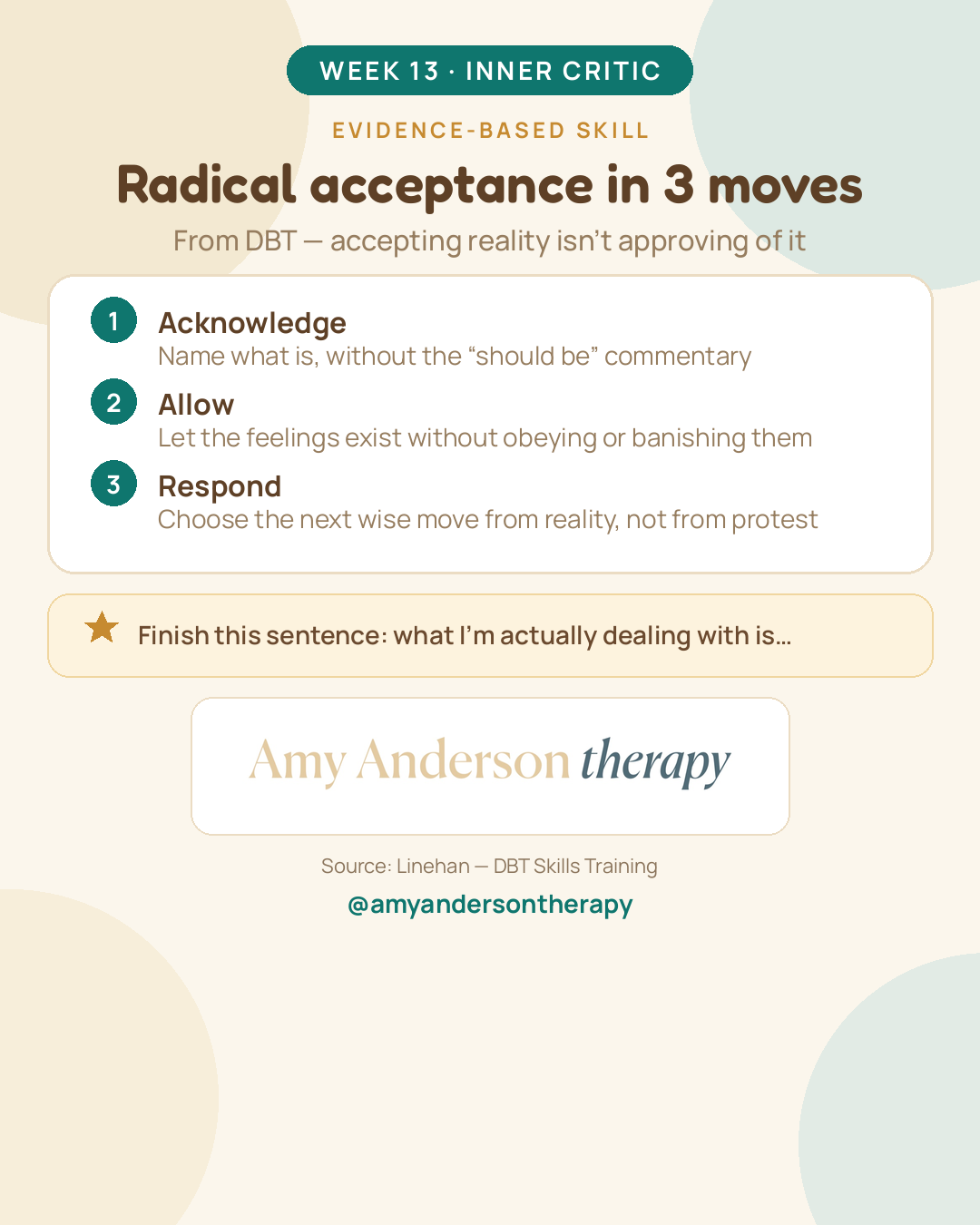
Radical acceptance means accepting what is — completely, at the root (that's what "radical" means) — without requiring it to be different first. Not approving of it. Not liking it. Not calling it good. Just: this is true, and I stop spending my life force fighting the fact of it.
Here is what radical acceptance is not:
It's not resignation. Resignation says: "Nothing will ever change, so why try." It's hopelessness with a shrug. Radical acceptance says: "This is what's true. Given that it's true, what do I do with what's actually here?" One shuts down possibility. The other clears the fog so you can see the possibilities that are real.
It's not approval. You can accept that your partner is conflict-avoidant without deciding conflict-avoidance is great. Acceptance is about reality, not endorsement.
It's not a one-time event. You'll accept the same reality seventeen times. Grief comes in waves. That's not failure — that's how acceptance actually works.
It's not for everything. Some things should not be accepted — abuse, contempt, betrayal without repair. Acceptance applies to realities, not to mistreatment. If you're unsure which one you're dealing with, that's a question for a professional, not a worksheet.
The doorway to acceptance is grief. You cannot accept what you haven't grieved. If you've spent five years trying to change your partner's emotional expressiveness, acceptance means grieving the fantasy partner who narrates their feelings like a podcast host — and then choosing the real person in front of you, on purpose. The grief is the price of admission. Most people skip it and call the numbness "acceptance." It's not. It's avoidance with better branding.
The three-column sort (your Exercise 3 this week) is the practical tool:
Changeable — things that can actually shift with effort, skill, or time. (How we handle the morning routine. Whether we do a weekly check-in.)
Influenceable — things you can't control but can nudge. (Your partner's stress level. The in-law dynamics. Your own reactivity — yes, that's influenceable, not changeable on demand.)
Grieve or accept — things that are what they are. (Their temperament. The past. The diagnosis. The fact that they'll never be the person who plans surprises.)
Most couples' suffering lives in column 3 being treated like column 1. You keep applying effort to something effort can't move, and then you conclude the relationship is broken — when really the strategy is broken. Sort honestly, grieve what's in column 3, and watch how much energy comes back.
The younger part behind the critic
One more thread, because it matters: the critic is often guarding someone younger. When you soften toward the critic — really soften, not perform it — sometimes a smaller, older feeling shows up underneath. The kid who learned to be perfect to be safe. The one who decided that being loved was conditional on being impressive.
That's the inner child piece, and you don't have to do deep excavation here. Just notice: when the critic is loudest, how old do you feel? If the answer is small — that's information, not pathology. It means this week's work isn't just cognitive. It's developmental. You're giving that younger part what it actually needed back then: an adult who says, "I've got this. You can rest."
A concrete way in, borrowed from Week 4's inner-child work: find a photo of yourself at the age the critic formed — seven, ten, twelve. Look at that kid. Really look. Then say the adult sentence out loud to them, not to the critic: "I've got this. You can rest." It's harder to audit a child when you're looking at their face. That's the point.
Being that adult for yourself is what makes you capable of being a partner instead of a project manager. That's the whole game of Phase 4.
Why it matters for trauma
Trauma installs the critic. That's the connective tissue.
When bad things happened and you couldn't control them, your young brain did the only math available: it must be my fault, and if I'm perfect, it won't happen again. The critic was born as a survival strategy — a way to manufacture control in an uncontrollable situation. Self-blame felt safer than powerlessness. For a lot of trauma survivors, the inner critic isn't a bug. It's the scar tissue over the wound.
So working with the critic isn't self-improvement fluff. It's trauma work at the level where trauma actually lives — in the automatic, bodily, pre-verbal conviction that you are the problem. Every time you interview the critic instead of obeying it, you're updating an old survival file with new information: the danger passed. The strategy can retire.
In Cognitive Processing Therapy — which I'm trained in — the critic's greatest hits have a name: stuck points. Old conclusions filed as facts: "I'm too much." "I'm not enough." "If I were better, this wouldn't have happened." They're called stuck points because thinking alone rarely moves them — which is why this week works through relationship with the part, not just argument with the thought. Noticing the stuck point ("there's that old conclusion again") is the first step to unsticking it; deeper restructuring is work for a professional.
And radical acceptance? Trauma survivors often struggle with it in a specific way: acceptance can feel like the freeze response. Like giving up. Like what you did when you couldn't fight back. So be precise with yourself this week: acceptance is a choice made from green — regulated, conscious, eyes open. Freeze is a state that happens to you from red. They feel similar from the inside and they are opposites. If acceptance feels like collapse, you're not accepting yet — you're shutting down. Come back to green first (Week 1's map is still your foundation), then choose.
One more trauma thread: many of you learned to aim the critic outward because aiming it inward was unbearable. Criticizing your partner can be a dissociative strategy — it puts the "problem" over there so you don't have to feel what's happening in here. Noticing that isn't an accusation. It's an invitation to turn the attention back to the only nervous system you can actually regulate: your own.
Try this
Exercise 1 — Together & Solo: The Critic Interview
Purpose: interview the critic as a part — in writing — instead of obeying it. Time: 20 minutes, today.
The guided parts dialogue — do it in writing, not just in your head. Writing slows the critic down enough to actually hear it.
Set a timer for 20 minutes — do this today, not "sometime this week." At the top of the page, write the critic's name (from the lesson — The Auditor, The Drill Sergeant, whatever fits).
Part A — Let it talk. Write as the critic, in its voice, no filter: "I say these things because I'm afraid ___." Let it list its complaints, its warnings, its greatest hits. Don't argue. Just transcribe.
Part B — Respond as your adult self. Now switch pens, or start a new section. Respond to the critic directly: thank it for working so hard, name what it's afraid of, tell it how old you actually are now, and negotiate the new role — advisor on call, not full-time narrator. Write the reassignment out: "Your new job is ___. You're off duty unless I ask."
Part C — One insight to keep. Finish this sentence: "What surprised me about the interview is ___."
Together: Each of you does Parts A–C privately, then shares your Part C with each other — just the insight, not the whole transcript. Witness, don't fix. ("Thank you for sharing that" is a complete response.)
Solo: Do all three parts, then add one more: trace the voice. Whose voice is it, really? A parent's? A coach's? An ex's? A culture's? Write the name or role — not to blame them, but to locate the critic in history instead of mistaking it for truth. Then answer: "What did that person fear that they passed to me?"
Why this works: writing externalizes the part — the critic moves from a voice you're fused with to words you can look at. That's unblending in action.
How you'll know it worked: you can hear the critic start up this week and think "there's the Auditor" — with a flicker of curiosity instead of instant obedience. The relationship changed, even if the volume hasn't yet.
Exercise 2 — Together: The Acceptance Conversation
Purpose: grieve what's not changing so you can stop spending your life force fighting it. Time: 25 minutes.
Do this regulated (green), not mid-conflict. Have your Pause-and-Return Protocol from Week 1 available — naming what you can't change about each other can spike big feelings, and that's exactly when you pause, regulate, and return.
Sit together. Each partner completes this sentence privately first, then shares:
One thing I've been trying to change about you that probably won't change is ___. What it's cost me to keep fighting it is ___. What it would free up if I stopped is ___.
Then, out loud to each other, practice the acceptance statement:
I choose to stop fighting ___ and start working with it by ___.
Examples: "I choose to stop fighting that you're not a morning person, and start working with it by handling mornings myself without resentment." / "I choose to stop fighting that you'll never love my family the way I do, and start working with it by building the connection with them myself."
Rules: No defending, no rebutting, no "well the thing I'd change about you..." This isn't a trade. Each person names theirs and the other witnesses. If it gets hot — yellow or red — call the pause, separate for 20–30 minutes, regulate, and return at a set time. The protocol exists for exactly this.
Solo version: Apply the three-column sort (Exercise 3) to a pattern in your dating history — something you kept trying to change about a partner or about the dynamic. Which column did it actually belong in? What did fighting it cost you? Write the acceptance statement for the pattern: "I choose to stop fighting ___ and start working with it by ___" — this time aimed at your own selection patterns going forward.
Why this works: grief is the exit ramp from the fight — you can't accept what you haven't mourned, and you can't mourn what you won't name.
How you'll know it worked: you named one thing you've been trying to change, said the acceptance statement out loud — and felt grief instead of rage. Grief is the doorway. Rage was the guard.
Exercise 3 — Together & Solo: The Three-Column Sort
Purpose: sort your suffering into what you can change, influence, or need to grieve — and stop spending change-energy on Column 3. Time: 20 minutes.
The Radical Acceptance Worksheet. Do this on paper with three actual columns.
Column 1 — Changeable. List what's genuinely shiftable with effort or skill. Be honest: is it changeable, or do you just wish it were?
Column 2 — Influenceable. List what you can nudge but not control. (Your partner's habits. Your family's dynamics. The pace of change itself.)
Column 3 — Grieve or accept. List what's true and isn't moving. Their temperament. The past. The body, the diagnosis, the history.
Now pick one item from Column 3 — just one — and write two things:
What I need to grieve about this is ___. (The fantasy, the timeline, the version of the story where this was different.)
The acceptance statement: "___ is true. Given that it's true, what I'll do differently is ___."
Together: Compare columns. Notice where you disagree about which column something belongs in — that disagreement is the work. Talk it through in green. If you land in different columns, that's okay; name it and revisit next month.
Solo: Do the sort for your own life and patterns — not just dating. Where are you spending change-energy on Column 3 items? What's one thing you'd get back if you stopped?
Why this works: most of your exhaustion lives in Column 3 being treated like Column 1 — the sort gives all that effort somewhere true to go.
How you'll know it worked: one item moved from Column 1 (where you'd been fighting it) to Column 3 — honestly, not resentfully. The re-sort is the breakthrough.
Reflect
Your 20-minute weekly check-in ritual — the only "homework" in this course: 5 minutes on a states check (green/yellow/red — separately, then compare if you're a couple) · 10 minutes on this week's exercise · 5 minutes on the reflection prompt below. Same day, same time, every week. The ritual is the practice.
Journal on this — a few honest lines, not an essay:
My inner critic is loudest when ___. What it's actually trying to protect me from is ___. What I'd say back now is ___.
Then one more, for the week: What's one thing in Column 3 that I've been treating like Column 1 — and what would change if I grieved it instead of fought it?
And the grief underneath this whole week: What did the critic steal? The years of performing instead of living. The risks not taken, the softness not allowed, the love not received because you were too busy auditing yourself to be in it. Grieve that — specifically, honestly. The critic told you the auditing was protecting your future. It was actually spending it. Naming what it cost is what makes the reassignment stick: you're not just giving the critic a new job. You're taking your life back from the old one.
Evidence spotlight
In a 2024 meta-analysis of 23 studies, perfectionism was modestly linked to worse marital outcomes — and partner-directed perfectionism (the critic aimed outward) was tied to lower satisfaction and more conflict (Hadian et al., 2024). The critic doesn't just hurt you; it leaks into the relationship.
In 479 couples followed over time, partners who could hold onto their own sense of self while staying close — higher differentiation of self — had better relationship quality and stability, even through stressful periods. Plain language: you don't have to disappear to be loving. Giving from fullness, not fear (Rodríguez-González et al., 2023).
Full references live in your course research companion. These aren't here to impress you — they're here so you know this isn't just my opinion.
Go deeper
From Amy's blog — the free posts this week builds on:
Reach out if your struggling — spots are available.
Radical Acceptance in Relationships: Letting Go with Self-Compassion
When Success Isn't Enough: How Inner Child Work in Couples Therapy Heals Modern Love
The blogs introduce the critic and the idea of acceptance. This week, you interviewed the critic and sorted what's yours to change from what's yours to grieve. Next week: the optimized life — burnout, perfectionism, and control — and what happens when you stop treating your relationship like a project to manage.
Your homework this week
Short on time? Do items 1–3 — the interview, the safe place, the sort. That's the week working. The rest is there when you have the bandwidth.
Keep the weekly check-in ritual (20 min, same day/time). 5 minutes states check (green/yellow/red — separately, then compare) · 10 minutes on one of this week's exercises · 5 minutes journaling the reflection prompt below. The ritual is the practice.
Do the Critic Interview today (20 min, written). Download the Interviewing the Critic worksheet and complete Parts A–C. If you're doing it as a couple, share only Part C — the insight, not the whole transcript. Then complete the Week 13 chapter worksheets in the companion workbook.
3Practice safe place, 2 minutes daily. Download the Safe Place & Container worksheet. Visit your safe place once a day in green — practice it calm so it’s available when you’re not.
Tag the cluster all week. Every time the critic speaks, file it: "That's defectiveness talking." "That's the safety cluster." "That's catastrophizing, not data." Count how many times you notice before Friday. Noticing is the rep.
Do the three-column sort (20 min, paper, three actual columns). Changeable · Influenceable · Grieve or accept. Move at least one item from Column 1 to Column 3 — honestly, not resentfully. Write the acceptance statement for it.
Have the Acceptance Conversation (25 min, green, together or solo). "One thing I've been trying to change about you that probably won't change is ___..." Witness, don't fix. If you're solo, run the sort on a dating pattern instead.
Journal the prompt (5 min). "My inner critic is loudest when ___. What it's actually trying to protect me from is ___. What I'd say back now is ___. What's one thing in Column 3 I've been treating like Column 1 — and what would change if I grieved it instead of fought it?"
Week 13 of 16 · Too Busy or Too Broke for Trauma Therapy · © Amy Anderson, LCSW. This material is psychoeducational and is not a substitute for therapy, diagnosis, or treatment.