
Week 14 — The Optimized Life Is Lying to You: Burnout, Perfectionism & Control
Too Busy or Too Broke for Trauma Therapy: A 16-Week Trauma-Informed Course for Couples & Individuals · Amy Anderson, LCSW
Theme: The Optimized Life Is Lying to You: Burnout, Perfectionism & Control
“What this is: Psychoeducation — evidence-informed information, frameworks, and practice exercises to help you understand your relationship patterns and build skills. It is not psychotherapy, couples therapy, or a clinical relationship. Nothing here diagnoses or treats a mental health condition. If you need clinical support — especially around trauma, addiction, or safety — work with a licensed professional in your state.
If you’re in crisis: call or text 988 (US Suicide & Crisis Lifeline) · National Domestic Violence Hotline: 1-800-799-7233 or text START to 88788.
Who this week is not for (yet): If there is ongoing physical violence, coercion, or fear in your relationship — or an undisclosed affair or active addiction without outside support — pause here and reach out for individual support first. Stabilization comes before coursework. That’s not failure. That’s sequencing.”
Welcome to Week 14
Last week you met the inner critic. This week, you meet the system it built.
High achievers don't just bring ambition into relationships. They bring an entire operating system: optimization culture, productivity frameworks, KPIs for the soul. Your calendar is color-coded. Your mornings are "optimized." You've read the books, bought the planners, hacked the habits.
And then you applied all of it — to your marriage. Date night became a project with deliverables. Sex became another metric. Rest became "recovery" scheduled between sprints. Conflict became a problem to solve efficiently instead of an experience to move through together.
Here's the lie, stated plainly: a better system will not fix a dysregulated life. You cannot productivity-hack your way out of burnout, and you cannot optimize your way into intimacy. The tools that built your career are actively eroding your relationship — not because you're doing them wrong, but because a relationship is not a project. It's a place you live.
This week we dismantle the optimization story, name the perfectionism and control hiding inside it, and rebuild around something sturdier: your actual values. Not the values on the vision board. The ones your calendar would reveal if it could talk.
The lesson
The lie: optimization as a love language
Somewhere along the way, high achievers started treating their relationships like startups. There's a shared calendar, a division of labor spreadsheet, a "process" for conflict. Date night gets scheduled quarterly like a board meeting. You track the relationship's health the way you track quarterly earnings — are we trending up?
None of this is evil. Organized people organize things; that's fine. The problem is what optimization replaces: presence. Spontaneity. The unproductive, inefficient, gloriously wasteful parts of love — the long dinner that goes nowhere, the Saturday with no plan, the conversation that doesn't resolve anything but leaves you feeling closer.
Optimization culture teaches that every problem has a system-shaped solution. Feeling disconnected? New ritual. Fighting about chores? New app. Not enough intimacy? Schedule it, track it, review the metrics. And when the system doesn't work, the high-achiever conclusion is never "maybe this isn't a systems problem." It's "I need a better system." So you optimize the optimization. Meanwhile the actual issue — two dysregulated nervous systems, a critic running the show, values buried under tasks — goes untouched. Because you can't spreadsheet your way into feeling safe.
Ask yourself the week's core question, honestly: if your relationship were a job, would you be thriving at it — and would you even want to work there?
Perfectionism doesn't stay at the office
Last week we covered the inner critic. This week: what happens when the critic gets a project manager title and starts running your shared life.
Perfectionism in relationships rarely looks like color-coded closets (though it can). More often it looks like this:
The optimized date night. Researched, reserved, reviewed — and completely devoid of play. You've turned romance into event planning, and your partner feels like a stakeholder, not a lover.
Sex as performance. Another arena to excel in. Were you good enough? Was it often enough? Was it the right kind? Desire can't survive an audit.
Parenting as KPI. Milestones tracked, enrichment scheduled, every moment "intentional." The kids get a project manager, not a parent — and you and your partner become co-CEOs of Child Corp instead of a couple.
Conflict as inefficiency. Feelings are messy and slow, so you rush to the solution. "Okay so what's the action item here?" Your partner wasn't looking for a project plan. They were looking for you.
Rest as failure. Downtime feels dangerous — like falling behind. So even your "rest" is productive: the podcast at 2x speed, the "relaxing" hobby with a progress tracker. Your nervous system hasn't stood down in years, and you call that discipline.
And here's the sneaky one: perfectionism disguised as high standards for the relationship. "I just believe we can do better." Maybe. Or maybe "better" is the critic's word for "never enough," and your partner is exhausted from being someone's improvement project. There's a difference between growing together and being renovated. People can feel the difference.
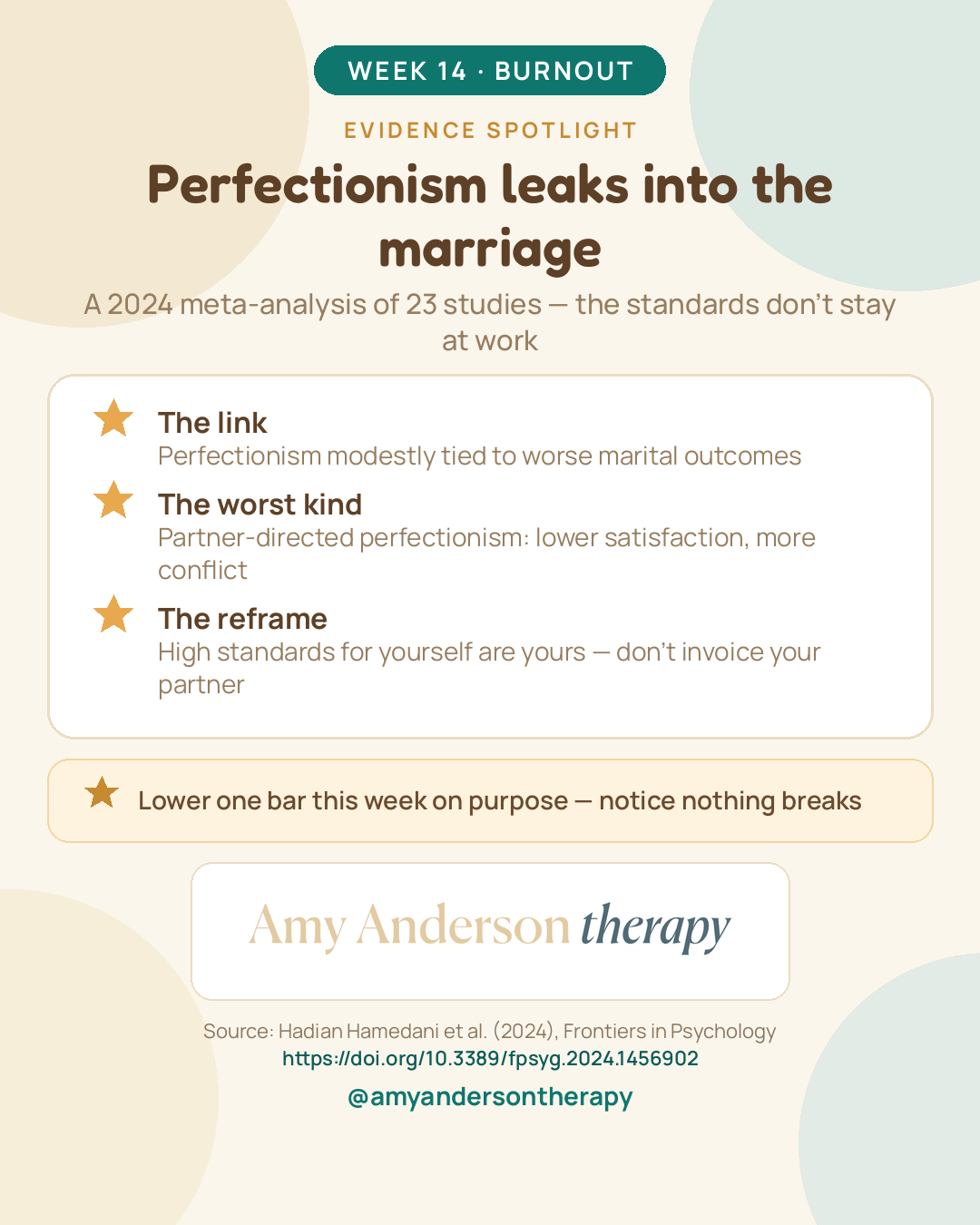
Control disguised as care (let's ditch the label)
Nobody wakes up and decides to be controlling. The partner who manages everything — the calendar, the finances, the emotions, the conflict, the household, the social life — didn't choose that job out of dominance. They chose it out of anxiety. Usually old anxiety. Often trauma-shaped anxiety.
Here's the translation: "I need to manage everything" is the critic's cousin saying "if I don't stay on top of it all, something terrible will happen." Control is a regulation strategy. When your nervous system learned early that the world is unpredictable and the adults can't be trusted to handle it, you made a vow: I'll handle it. All of it. Forever. And you've been keeping that vow for decades.
So let's ditch the "control freak" label — it's a shame costume on a scared part. But ditching the label doesn't mean keeping the behavior. Control has real costs:
It robs your partner of competence. If you redo everything they do, the message isn't "I love you." It's "I don't trust you." Over time, they stop trying — and then you resent them for not trying. That's a closed loop.
It makes you the single point of failure. Everything depends on you, so you can never rest, so you burn out, so you resent everyone for needing you. The martyrdom was optional. The system required it.
It confuses care with management. Your partner doesn't need a project manager. They need a partner — someone who can tolerate the discomfort of not controlling the outcome and stay present anyway.
The control-to-trust translation — for the partner who manages everything (and if that's you, read this twice):
When you feel the surge to take over, fix, manage, or correct — pause and translate. Underneath "I'll just do it myself" is usually one of these:
"I'm anxious and managing this is how I calm down." → Translation: I need regulation, not control. Use your actual tools (walk, breath, Week 1's map) instead of reorganizing the situation.
"If I don't do it, it won't be done right." → Translation: I'm afraid of the discomfort of imperfection. That's the critic talking. Let it be done differently. Different isn't wrong.
"They'll be upset if I don't handle it." → Translation: I'm people-pleasing to prevent conflict. That's the false peace (below) — and it always sends a bill later.
"I don't trust them to handle it." → Translation: I don't trust myself to tolerate what happens if they don't. That's the real one, most of the time. Trust isn't a feeling you wait for. It's a practice you build by surviving the discomfort of letting go — one delegated dishwasher-load at a time.
Start small. Delegate one thing this week and do not check on it. When the surge to intervene hits, urge surf it — the DBT-informed move for riding an urge without acting on it: the wave peaks and passes if you don't feed it. Notice what happens in your body. That's the work — not the task, the tolerance.
The price of false peace: people-pleasing and burnout
There's a special flavor of control that doesn't look like control at all: people-pleasing. The partner who never rocks the boat, never states a need, never admits they're drowning — because keeping the peace is the control strategy. If everyone's happy, nobody leaves. If nobody's upset, nothing unpredictable happens.
But it's a false peace. The conflict doesn't disappear; it goes underground. It becomes resentment, exhaustion, the slow leak of desire, the mysterious burnout that "came out of nowhere." (It didn't. It came out of years of self-abandonment with a smile.)
Trauma fuels this directly. If you learned early that your needs were dangerous — that expressing them caused withdrawal, anger, or chaos — then people-pleasing isn't a personality flaw. It's a survival strategy that kept you safe with unsafe people. The tragedy is that you're still running it with a safe person, and it's starving the relationship of the one thing it actually needs: you. Your real needs, your real no's, your real tired. A partner can't love someone who's performing "fine."
Burnout, then, isn't just a work problem. It's what happens when the optimization system, the perfectionism, the control, and the people-pleasing all run simultaneously with no off switch. You're not burned out because you're weak. You're burned out because you're running four full-time jobs — employee, household manager, emotional regulator for two, and critic-in-chief — and calling it "just life."
Giving too much, taking too little: the five-domain audit
Last week we named the pattern — giving too much to earn love. Now let's get specific, because codependent giving doesn't spread evenly. It concentrates in domains, and the domain tells you what you're actually afraid of. (Same Healing Your Aloneness / Inner Bonding frame from last week, in my words.) Walk all five and be honest: where am I giving from fear — and where am I taking too little?
Emotional. You're everyone's regulator — absorbing moods, preempting reactions, managing the temperature of every room. Underneath: if I stop managing feelings, someone falls apart or leaves. Taking too little of: being regulated by someone else. Letting comfort in.
Social. A calendar full of obligations you never wanted. You never decline, never disappoint. Underneath: if I'm not useful and present, I'll be forgotten. Taking too little of: chosen solitude. Time with people who don't need you to perform.
Financial. Generosity as approval-seeking. Rescuing, over-giving, dodging the money conversation because needing something feels dangerous. (Week 6's money work lives here — revisit it.) Underneath: if I'm not generous, I'm selfish, and selfish people get left. Taking too little of: asking. Receiving without earning it first.
Sexual. Availability without desire. Performing pleasure. Never stating a need because their experience feels more urgent than yours. Underneath: if I say no — or ask for what I want — the desire dies. Taking too little of: your own erotic life. Wanting, out loud.
Intellectual. Deferring. Letting them be right. Swallowing the sharper thought because being fully yourself feels like too much. Underneath: if I'm at full brightness, I'll be left. Taking too little of: being met. Being known all the way.
One question per domain: "What would it take to receive a little more here?" Receiving is the rep the giver never does. Start with the domain that stung most to read.
If the giving-from-fear pattern feels bigger than a worksheet — if you can't remember the last time your own needs led — the CoDA recovery community exists for exactly this pattern (coda.org). Not a diagnosis. A room full of people doing the same work.
And the other pole: taking too much. Too much blame, too much responsibility, too much credit for what's wrong. That's the critic's fuel — it feeds critical thoughts, which pull you into withdrawal, which slides toward depression. Giving too much depletes you outward; taking too much collapses you inward. Same fear underneath: if I don't carry it all, I'll be abandoned — or I'll be the problem. So the audit runs both directions: where am I giving from fear — and where am I taking on what was never mine to carry?
The Inner Bonding lens on your results. That chart from last week names the two roles: the Caretaker (empathic to the point of self-erasure) and the Taker (entitled, critical, always owed). As you read your audit, notice which role runs each domain. Most givers are caretakers in four domains and takers in one — usually the domain where they take too much blame. There's no prize for identifying as the "good" role. Both are fear wearing different outfits. The question for every domain is the same: what would this look like from wholeness instead of from the role?
The values question per domain (ACT-inspired). For the domain that stung most: what would this domain look like if it served my values instead of my fear? Not the overhaul — one image. Emotional: "I'd tell my partner I'm struggling before I'm drowning." Financial: "I'd ask for what I need without rehearsing an apology." Write the one image down. That's the direction; the reps below are how you walk it.
Rebuilding around values: the audit
You can't just remove optimization. Nature abhors a vacuum, and so does a high achiever's calendar. You have to replace it with something — and that something is values.
Not aspirational values. Not the framed words in the hallway. Your actual values — the ones revealed by where your time, attention, and tenderness actually go. The Values Audit (Exercise 1) makes the gap visible: here's what you say matters, here's where last week actually went, and here's the distance between them. That distance has a name. It's where the burnout lives.
The rebuild is embarrassingly small. Not a life overhaul — one gap, one tiny values-aligned change. Fifteen minutes of unscheduled time together. One dinner with phones in another room. Saying no to one thing that serves the image but starves the value. Small is the point. Optimization thinks in overhauls; values think in moments. Small things, often.
This is also where Gottman's work earns its keep — I'm trained in Gottman Method Couples Therapy (Level 3), and one of its foundational findings from decades of observational research is almost insultingly simple: couples who last aren't the grand-gesture couples. They're the small-things-often couples — the coffee made without asking, the hand on the back in the hallway, the turning toward each other's small bids for connection, dozens of times a day. Your values rebuild isn't a new system. It's a hundred tiny turn-towards. Small is the entire technology.
Underneath it: Gottman's emotional bank account. Burnout doesn't just empty your personal reserves — it overdraws the shared one. Every missed bid, every optimized interaction, every not now is a withdrawal nobody meant to make. The rebuild isn't a grand deposit. It's the daily small ones — which is exactly what the values work is funding.
One named ritual worth stealing for the rebuild: Gottman's stress-reducing conversation — 20 minutes at the end of the day, each partner unloads while the other listens, takes their side, and does not fix. For two burned-out high achievers, this is the daily proof that the relationship is a shelter, not another job. It belongs on the worst-week menu too.
And one rebuild tool that's somatic, not cognitive: your body has been running the optimization system too — braced shoulders, shallow breath, jaw like a vice. Twice a day this week, 90 seconds: shake it out (literally — hands, shoulders, whole body), then three slow exhales, out longer than in. It looks ridiculous. It works because burnout isn't just in your head — it's physiological. You can't think your way out of a body that's been bracing for a decade. You show the body, physically, that the emergency is over.
And the DBT-informed companion: opposite action for the collapse. Burnout's urge is to shut down, cancel, disappear. The opposite: one small values-aligned action, done badly if necessary. Not the whole day reclaimed — one thing. Text the friend back. Take the walk. Say the need out loud. Opposite action doesn't fix burnout. It proves to your nervous system that collapse isn't the only option — one rep at a time.
The "good enough" practice
Perfectionism is an exposure problem: the only way out is through deliberate, repeated contact with imperfection — and discovering you survive it. So this week's second practice is simple and genuinely uncomfortable: do one thing imperfectly on purpose, together.
A messy date night — no reservations, no plan, see what happens. An unscheduled Saturday. A dinner that's just... fine. Cooked badly, eaten happily. The point isn't the activity. The point is watching what the critic does when there's nothing to optimize — and choosing, together, not to obey it.
For the solo folks: "good enough" dating. Not settling — sufficiency. The date who was kind and interesting but didn't check every box. The evening that was pleasant instead of electric. Perfectionism in dating is just the critic with a checklist, and it will keep you alone and "right" forever. Good enough is where actual love lives — it's always been a little rumpled.
Why it matters for trauma
Control is trauma's favorite costume. Here's the link, stated clearly:
When you couldn't control what happened to you, your system made a bargain: never again. Hypervigilance became "attention to detail." Managing everyone's emotions became "being caring." Never resting became "work ethic." The trauma didn't disappear — it got a promotion and a LinkedIn profile.
That's why telling a high achiever to "just let go of control" is useless. You're not asking them to drop a bad habit. You're asking them to lay down the strategy that kept them safe. Of course the system screams. The work isn't subtraction — it's replacement. You don't just stop controlling; you build enough internal safety (regulation, self-trust, the critic's new job description from last week) that control becomes unnecessary. Safety first, surrender second. That's the order. It was the order in Week 1 and it's the order now.
Burnout knocks out the same floors trauma does — turning toward (too tired to notice bids), sharing fondness and admiration (too depleted to see what's good). The Sound Relationship House isn't built by insight. It's built by the small daily deposits the values audit is pointing you toward.
One more positioning note, from my Gottman training on PTSD and couples: the presenters were blunt about how minimal the existing PTSD couples therapies are — and almost none of them address the burnout layer at all. The optimization system. The four full-time jobs. Trauma treatment that ignores the life the trauma lives in isn't complete. This week is the missing layer.
Burnout has a trauma thread too. Many trauma survivors don't recognize their own exhaustion because numbness was the original setting. If you grew up overriding your body's signals — too tired, too hungry, too scared to notice — then adult burnout just feels like... normal. The body kept receipts (Week 1), and burnout is the collections department. The values audit isn't just a lifestyle exercise. It's a way of asking your body what it actually needs, perhaps for the first time in decades.
And the people-pleasing piece: if your needs were dangerous once, stating them now will spike your system — even with a safe partner. Expect the alarm. That's not evidence you're doing it wrong. That's the old file opening. Name it ("this is old alarm, not current danger"), regulate, and say the need anyway. That's how the file gets updated.
Try this
Exercise 1 — Together: The Values Audit
Purpose: make the gap between your stated values and where your time actually went visible — then close one gap this week. Time: 30 minutes, together or solo.
You need last week's calendar (or your best honest reconstruction of it) and 30 unhurried minutes. Do this in green, not as a performance review of each other.
Step 1 — Name your top 5 shared values. Separately, each partner writes down the 5 values that matter most in your shared life — not aspirational, actual. (Connection, honesty, play, family, growth, rest, adventure, faith — yours.) Then compare and circle the ones you share. Those shared ones are your compass.
Step 2 — Where did last week actually go? Together, reconstruct where your shared time went last week — work, chores, screens, kid logistics, sleep, each other. Be honest, not judgmental. You're collecting data, not assigning blame.
Step 3 — Circle the gaps. Where did the time go that doesn't match the values? (Value: connection. Time: four evenings of parallel scrolling.) Circle every gap. Don't fix yet. Just look at it together.
Step 4 — One gap, one small change. Pick ONE gap — the one that stings most — and design ONE small values-aligned change for this week. Not an overhaul. Fifteen minutes. One dinner. One walk. Write it down, put it on the calendar (yes, you can schedule values — the irony is allowed), and do it.
Solo version: Do the same audit on your own life: your top 5 personal values, where last week actually went, circle the gaps, pick one gap and one small change. Then add the dating lens: "Where has perfectionism cost me connection? What did I reject — or who did I perform for — because 'good enough' felt like failure?" Write one paragraph on what good-enough dating could look like for you — specific, not theoretical.
Why this works: burnout lives in the gap between stated values and lived time — making the gap visible turns a vague depletion into a fixable problem.
How you'll know it worked: the one small change actually happened this week — the walk, the phone-free dinner, the unscheduled fifteen minutes. One kept promise to your values beats a perfect audit.
Exercise 2 — Together & Solo: The Good-Enough Experiment
Purpose: practice deliberate imperfection — and let your nervous system learn it survives. Time: one deliberate experiment this week, 15 minutes of journaling after.
Deliberate imperfection, once this week. This uses the graded-exposure principle — small, deliberate, repeated contact with the feared thing (imperfection) teaches your nervous system you survive it. (I'm trained in ERP, the exposure-based treatment this principle comes from; here we're applying the principle psychoeducationally to perfectionism — not to trauma, which needs a professional container.)
Together: Plan one deliberately imperfect shared experience — today, if you can. A messy date night with no reservations and no plan B. An unscheduled Saturday morning — no agenda, see what happens. A home-cooked dinner where "edible" is the only standard. The rule: nobody fixes it, optimizes it, or apologizes for it. If the restaurant has a wait, you wait or you leave. If the food is mediocre, it's mediocre. The experiment isn't the activity — it's what happens inside you when there's nothing to perfect.
During or after, each partner journals: What did my critic say? What did I feel in my body? What was actually enjoyable about it, if anything? Share one line each.
Solo: Do your own version — the unoptimized evening, the imperfect outing with a friend, the task done at 70%. Same journaling: What did the critic say? What did my body do? Then the dating question: "What's one 'not perfect on paper' connection I dismissed that might have deserved a second look?" You're not required to act on it. Just notice the pattern.
Why this works: this allows for the real, the right now, the imperfect, and the actual human aspect of the relationship — curated from both of your "good enough" moments instead of perfect IG posts. Perfect invites rejection and rigidity, and we definitely do not want that in couples. We do the best with what we've got today to stomp out the critic or the freezer taking lead in the relationship.
How you'll know it worked: you felt the discomfort, didn't fix it — and something was enjoyable anyway. Discomfort + no catastrophe + a flicker of fun: that's the exposure working.
Exercise 3 — Together & Solo: The Control-to-Trust Translation
Purpose: practice tolerating not-controlling, one delegated task at a time. Time: 10 minutes to set up, then a week of noticing.
For the partner who manages everything — and if that's both of you, take turns.
Together: The managing partner picks ONE thing they currently control that they could delegate this week — a task, a decision, a domain. (Start small. Not the finances. The grocery list.) First, a 5-minute decisional balance (from Motivational Interviewing): what do I get from controlling this — and what does it cost me? Write both sides honestly. Control once bought you safety; naming what it still buys you (and what it costs) is what makes letting go a choice instead of a white-knuckle. Then hand it over completely: no instructions, no checking, no redoing. Then journal the translation in real time, using the lesson's framework:
What I wanted to say/do: "___"
What was underneath it: "___" (anxiety? fear of imperfection? people-pleasing?)
What I did instead: "___"
What happened in my body: "___"
What actually happened with the task: "___"
The other partner's job: receive it graciously, do it your way, and do not perform competence for an audience. Just do the thing.
At week's end, compare notes. Most couples discover the catastrophe never arrived — and that discovery, repeated, is what trust is actually made of.
Solo: Pick one domain where control costs you most — dating (the pre-date research dossier?), friendships, work bleeding into everything. Journal the same translation prompts for one real moment this week when you felt the surge to manage. Then answer: "What am I afraid would happen if I tolerated not knowing how this turns out?" Sit with that question longer than is comfortable. That's where the growth is.
Why this works: your system learned that control equals safety — the only update it accepts is lived experience of letting go without disaster.
How you'll know it worked: the delegated thing got done differently — or late, or imperfectly — and you survived it without intervening. The catastrophe not arriving is the data.
Reflect
Your 20-minute weekly check-in ritual — the only "homework" in this course: 5 minutes on a states check (green/yellow/red — separately, then compare if you're a couple) · 10 minutes on this week's exercise · 5 minutes on the reflection prompt below. Same day, same time, every week. The ritual is the practice.
Journal on this — a few honest lines, not an essay:
"If I stopped optimizing my relationship and started actually living in it, the first thing I'd do differently is ___."
Then the harder one: What am I afraid I'd feel if I stopped managing everything — and whose voice taught me that feeling was dangerous?
And the grief this week: What did burnout take that rest won't give back? Not just energy — capacity. The years you were too depleted to be present for. The version of your relationship that existed only in the margins of your exhaustion. The hobbies, friendships, aliveness that got scheduled out of existence. Grieve the capacity, not just the tiredness. Tiredness recovers with sleep. Lost years need grieving — and grieving them is what makes the values rebuild a choosing instead of just another optimization project.
Evidence spotlight
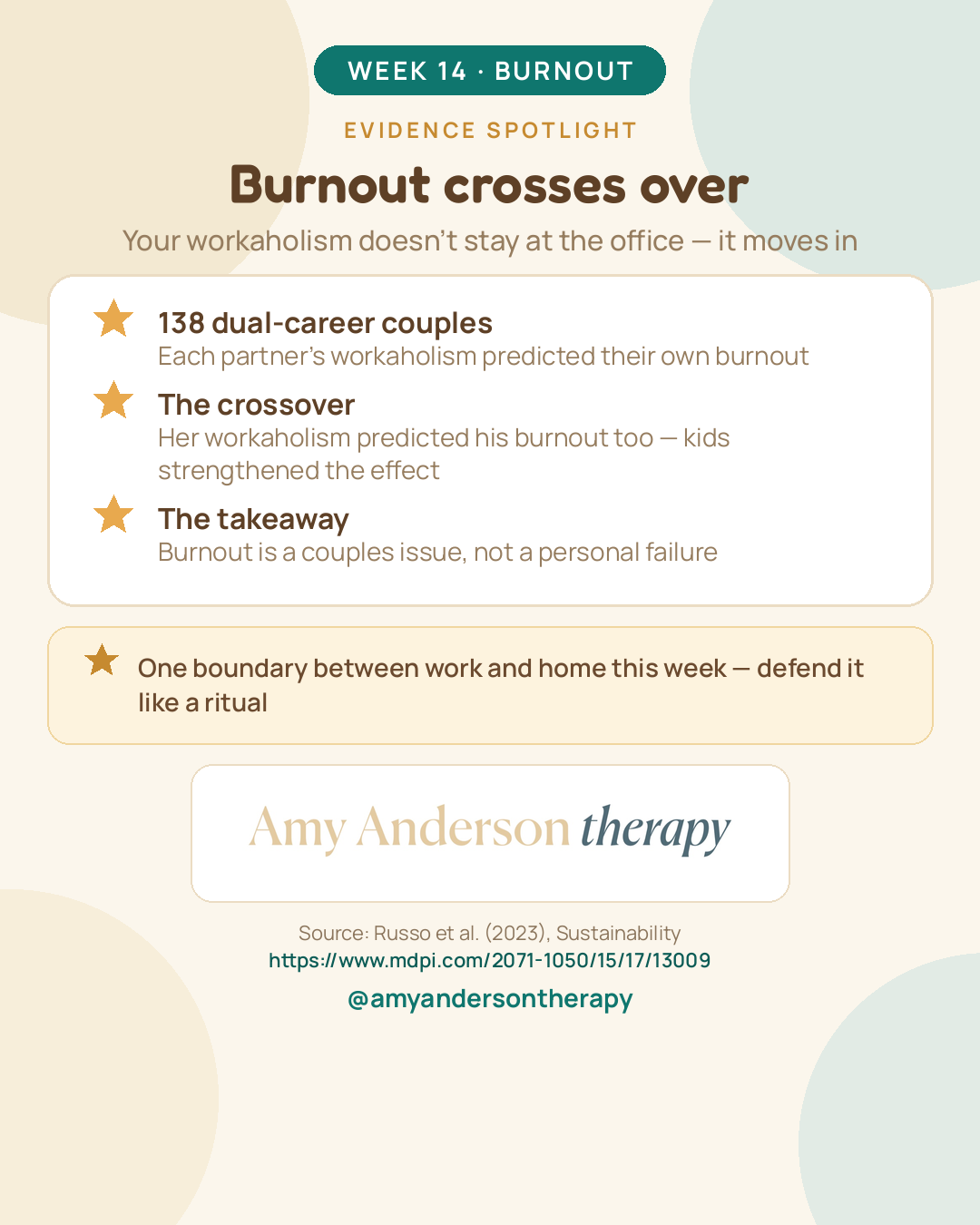
In 138 dual-career couples, each partner's workaholism predicted their own burnout — and the crossover was real too: one partner's overwork could spill into the other's burnout, especially once kids were in the picture (Russo et al., 2023). Your burnout isn't just your employer's problem. It lives in your house.
In 121 mothers, relationship dissatisfaction helped explain the path from partner-related strain to parental burnout (Prandstetter et al., 2022). The relationship isn't separate from the burnout equation — it's part of it.
In a cross-sectional study of married individuals, demand–withdraw communication (one pursues, one withdraws) tracked with lower differentiation of self — the shakier your sense of self inside the marriage, the more the pursue-withdraw loop runs the show. It's not a personality clash. It's two people disappearing in opposite directions (Meghana & Simon, 2024).
Full references live in your course research companion. These aren't here to impress you — they're here so you know this isn't just my opinion.
Go deeper
From Amy's blog — the free posts this week builds on:
The Optimized Life Is Lying to You (And So Is Your August To-Do List)
Summer Burnout Blues: Why High-Achieving Parents Are Running on Fumes
Let's Ditch the Control Freak Label and Heal Your Trauma, Instead
The Price of a False Peace: How Trauma Fuels People-Pleasing and Burnout
The blogs name the cultural water you're swimming in. This week, you audited where your values actually went, practiced deliberate imperfection, and started translating control back into trust. Next week: the conversations you've been avoiding — politics, race, faith, family — and how to have them without detonating the relationship.
Your homework this week
Keep the weekly check-in ritual (20 min, same day/time). 5 minutes states check (green/yellow/red — separately, then compare) · 10 minutes on one of this week's exercises · 5 minutes journaling the reflection prompt below. The ritual is the practice.
Do the Values Audit (30 min, together or solo). Download the Burnout, Boundaries & Values handout: name your top 5 values, reconstruct where last week actually went, circle one gap — and make one small values-aligned change this week. Put it on the calendar. Then complete the Week 14 chapter worksheets in the companion workbook.
Run the Good-Enough Experiment once (plus 15 min journaling). Download The Good-Enough Experiment worksheet. One deliberately imperfect shared experience — messy date night, unoptimized Saturday, a dinner where "edible" is the only standard. Nobody fixes it, optimizes it, or apologizes for it. Journal: What did my critic say? What did my body do? What was enjoyable anyway?
Do the control-to-trust translation all week. Pick ONE thing to delegate and hand it over completely — no instructions, no checking, no redoing. When the surge to intervene hits, urge surf it. Journal the translation in real time: what I wanted to do / what was underneath / what I did instead / what happened in my body / what actually happened.
Walk the five-domain audit (10 min). Emotional · social · financial · sexual · intellectual. Where are you giving from fear — and where are you taking too little? Start with the domain that stung most. Answer: "What would it take to receive a little more here?"
Body rep, twice daily (90 seconds). Shake it out — hands, shoulders, whole body — then three slow exhales, out longer than in. You can't think your way out of a body that's been bracing for a decade.
Journal the prompt (5 min). "If I stopped optimizing my relationship and started actually living in it, the first thing I'd do differently is ___. What am I afraid I'd feel if I stopped managing everything — and whose voice taught me that feeling was dangerous?"
Week 14 of 16 · Too Busy or Too Broke for Trauma Therapy · © Amy Anderson, LCSW. This material is psychoeducational and is not a substitute for therapy, diagnosis, or treatment.