
Week 15 — Hard Conversations: Politics, Race, Faith & Family
Too Busy or Too Broke for Trauma Therapy: A 16-Week Trauma-Informed Course for Couples & Individuals · Amy Anderson, LCSW
Theme: Hard Conversations: Politics, Race, Faith & Family
What this is: Psychoeducation — evidence-informed information, frameworks, and practice exercises to help you understand your relationship patterns and build skills. It is not psychotherapy, couples therapy, or a clinical relationship. Nothing here diagnoses or treats a mental health condition. If you need clinical support — especially around trauma, addiction, or safety — work with a licensed professional in your state.
If you're in crisis: call or text 988 (US Suicide & Crisis Lifeline) · National Domestic Violence Hotline: 1-800-799-7233 or text START to 88788.
Who this week is not for (yet): If there is ongoing physical violence, coercion, or fear in your relationship — or an undisclosed affair or active addiction without outside support — pause here and reach out for individual support first. Stabilization comes before coursework. That's not failure. That's sequencing.
Welcome to Week 15
Fourteen weeks of inner work, and now we walk straight into the room most couples avoid: the conversations about the world outside your relationship that keep detonating inside it.
Politics. Race. Faith. Family. The topics you agreed not to discuss at Thanksgiving — except you can't avoid them at home, because they live in your news feed, your family group chat, your holiday plans, and the pit of your stomach every election cycle, every family visit, every headline that hits one of you harder than the other.
Here's what most couples get wrong about these fights: you think you're fighting about the topic. You're not. You're fighting about what the topic activates — old attachment wounds, identity, belonging, safety, grief. The political disagreement is rarely about policy. It's about "do you see the world I live in?" The faith difference isn't about theology. It's about "will you still be my person if we don't believe the same things?" The family estrangement fight isn't about the holiday plan. It's about "whose pain gets priority here?"
This week gives you a framework for the conversations you've been avoiding until they explode. Not to make you agree — agreement isn't the goal and often isn't possible — but to make you a team facing the stressor instead of opponents using it against each other.
One note before we start: this week's exercises involve real, live topics. Use everything you've built. Do the values work in green, not mid-spiral. Keep the Pause-and-Return Protocol from Week 1 within arm's reach — the moment either of you hits yellow or red, you pause, regulate separately for 20–30 minutes, and return at a set time. Hard conversations done dysregulated aren't brave. They're just loud.
The lesson
External stress lands inside the relationship
Your relationship doesn't exist in a vacuum. It exists in a country, a culture, a racial reality, a faith tradition (or the absence of one), and a family system — and all of that comes home with you every night.
Researchers tracked 98 Black couples across 21 days and found something every interracial couple and every couple living through turbulent times already knows in their bones: on days when a partner reacted strongly to a racist incident, relationship quality dipped — less passion, less intimacy. The anger and humiliation from out there didn't stay out there. It came through the front door and sat down at the dinner table.
This is true for every external stressor, not just racial ones. The political climate. The faith community's judgment. The parent who won't speak to you. The headline that guts one of you while the other scrolls past. External stress doesn't knock politely and ask if this is a good time. It activates the attachment system directly — because attachment is, at its core, the question "are we safe, and are we in this together?" — and nothing threatens "together" like discovering you experience the world fundamentally differently from the person sleeping next to you.
So the first reframe of the week: when a hard topic explodes, the explosion isn't the problem. The explosion is information. It's telling you where the attachment wound is. "You don't understand what it's like" means I feel alone in this. "You always take their side" means I'm afraid I come second. "Can't we just not talk about this" means I'm scared this topic is bigger than us. Listen for the sentence underneath the sentence. That's where the actual conversation lives.
The High-Stakes Conversation Protocol
This is the week's core framework — a structured format for topics where you fundamentally disagree, or where the topic itself is bigger than either of you. It has five moves. In order.
Move 1 — Regulate first, talk second. Non-negotiable. Check your states out loud: "Where am I — green, yellow, red?" If either of you isn't green, you don't start. You regulate, then begin. Starting a high-stakes conversation already activated is like doing surgery with shaking hands — technically possible, inadvisable.
Move 2 — Shared values first. Before anyone states a position, name what you share. "Whatever we disagree about here, we both value ___." Safety. Honesty. Family. Dignity. This isn't throat-clearing — it's building the container. You're reminding your nervous systems that you're on the same team before you discuss the thing that makes you feel like opponents. (Exercise 1 is the deep version of this.)
Move 3 — Curiosity before persuasion. Each person gets uninterrupted time to explain not just what they believe but why it matters to them — the lived experience underneath the position. This is Gottman's Dreams within Conflict exercise, in my words: every position has a dream inside it — a life experience, a value, a story about what matters. You're not just reflecting the position back. You're asking: what's the dream inside this position for you? When both dreams are on the table, gridlock softens — not because anyone conceded, but because you're finally talking about what's actually at stake. The listener's only job: understand well enough to repeat it back. "What I hear you saying is ___." No rebuttal. No "but." You're not agreeing — you're demonstrating that their inner world is legible to you. Most couples skip this step entirely and go straight to debate club. Debate club has never saved a marriage.
Three tools live inside this one move — you don't need to memorize the names, just the shape:
Speaker-listener: one person speaks, the other reflects back until the speaker feels heard — then you switch. (From cognitive-behavioral couples work — CBCT, which I'm trained in. Gottman's version, the Gottman-Rapoport exercise, runs the same discipline: no one responds until the speaker says "yes, that's it.")
Reflection before response, every time. That's the whole rule.
The grammar — Nonviolent Communication: Marshall Rosenberg's framework. Observations (what happened, no verdict), feelings (yours, owned), needs (the universal need underneath — safety, respect, belonging, autonomy), requests (concrete and doable, not demands). "When you [observation], I feel [feeling] because I need [need]. Would you be willing to [request]?" Feels mechanical the first three times. Then it becomes the cleanest way you've ever asked for anything.
Move 4 — Name what's on the table and what's off it. Some things can be discussed productively. Some can't — not now, maybe not ever — and naming that honestly is healthier than pretending everything's discussable while someone silently bleeds. Agree explicitly: "We can talk about how this affects our family decisions. We won't debate each other's core identity/beliefs — that's not up for a vote." The off-limits list isn't avoidance. It's respect with boundaries. Put the off-limits items in a container — the EMDR resourcing tool from Week 2: mentally shelved, lidded, with a return date. "We're not discussing this now; we'll revisit at the monthly check-in." A container has a lid and a calendar. That's what makes it respect instead of avoidance.
Move 5 — End as a team facing it. Close every high-stakes conversation by naming, together, how you'll face this stressor as a unit — even if you see it differently. "We disagree about ___, and here's what we're doing about it together: ___." The disagreement can remain. The aloneness doesn't have to.
The Great Listener upgrade: attune, reflect back, validate
Move 3 runs on a deeper skill — from the Gottman tradition I'm trained in (their "great listener" framework, in my words). Three layers, in order:
Attune — tune in before you tune up your rebuttal. While your partner speaks, your job is their inner world, not your counterargument. Ask the attunement questions: "What's the hardest part of this for you?" "What are you most afraid I'll miss?" You're listening for the feeling under the position — because the position is negotiable and the feeling is the actual conversation.
Reflect back — prove you got it. Say back what you heard, in your own words, until your partner says "yes, that's it." Not parroting — digesting. "So what I'm hearing is that this isn't really about the policy — it's about feeling like I don't see the world you live in. Did I get that right?" Reflection before response, every time. If they correct you, that's not failure — that's the map getting more accurate.
Validate — find the understandable piece. "It makes sense you'd feel that way, given what you've lived." Validation is not agreement. You can validate the feeling completely while disagreeing with the position entirely. Most people skip validation because they think it means conceding. It doesn't. It means: your inner world is legible to me, and I can see how a reasonable person gets there. Nothing disarms a hard conversation faster.
The asking half: clear, kind, willing to hear no
Move 3's NVC grammar gave you the shape — observation, feeling, need, request. DBT's interpersonal effectiveness adds the stance that makes the shape work:
Ask, don't hint. Hints are tests your partner will fail. One clear, concrete request beats ten sighs.
Stay regulated while you ask. The request lands differently from green than from yellow. Spiking? Pause first.
Hear no without collapsing. A no to the request isn't a no to you. Negotiate — "what would work instead?" — without abandoning the need or torching the relationship.
Reinforce the yes. When your partner meets the request, name it: "Thank you — that helped." People repeat what gets noticed.
Effectiveness isn't getting your way. It's asking clearly, staying in your skin, and keeping the relationship intact — whether the answer is yes, no, or not-yet.
And the ACT layer underneath all of it: willingness. Hard conversations feel bad in the body — heat, tightness, the urge to flee or fight. Willingness is deciding to have those sensations without obeying them: "I feel awful right now, and I'm staying in this conversation." You're not waiting for comfort to start. Comfort isn't coming. The conversation is the point.
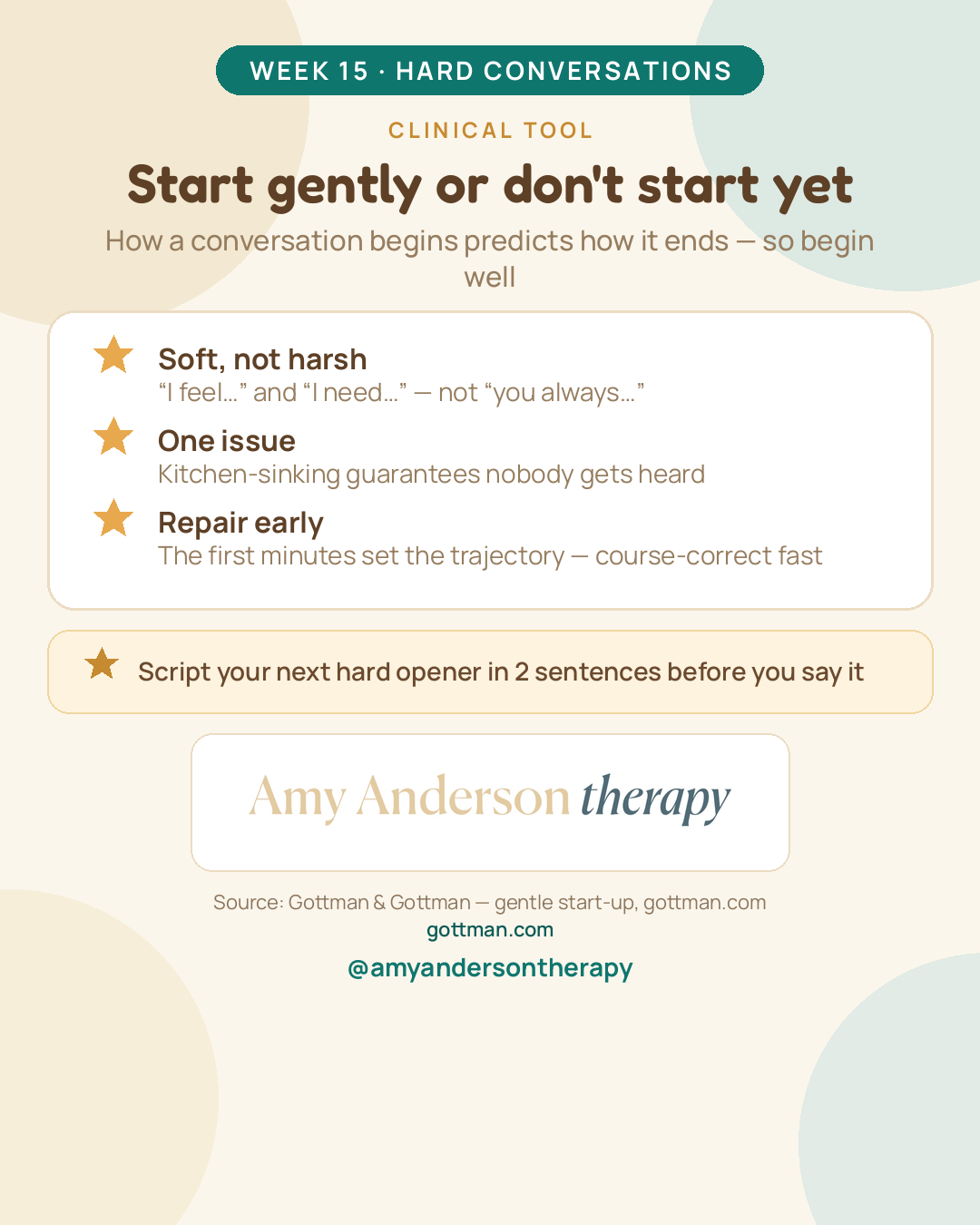
A note on how you open (Gottman): how a conversation starts largely predicts how it ends — harsh startups (criticism, contempt, "you always") reliably spiral. For high-stakes topics, open with a softened startup: start with "I feel," describe the situation (not the person), and state a positive need. "I feel scared and alone when the news is on all night. I'd love it if we could talk about how we're handling it — not debate the politics." The topic is the same. The doorway is different.
Repair attempts: the actual secret weapon
Here's what Gottman's lab found that most couples miss: it's not whether you fight — it's whether your repair attempts land. A repair attempt is anything that prevents negativity from spiraling: humor in the tension ("are we really fighting about the dishwasher again?"), a hand on the knee mid-argument, "I think we're doing opponents right now — can we restart?", even "I'm flooding, I need 20 minutes."
Couples who last aren't better at avoiding ruptures. They're better at catching them early, repairing mid-flight — and crucially, better at accepting the repair when it's offered. Most failed repairs don't fail because the attempt was bad. They fail because the receiving partner was too flooded to take it in.
Practice both directions this week. Offering: when the temperature rises, try one repair attempt before your next point. Name it if you have to: "repair attempt — I think we're on the same team and I'm losing the thread." Receiving: when your partner offers one — the joke, the touch, the pause — take it. Even imperfectly timed. Especially then. A repair accepted is a rupture that didn't happen.
A horsemen watch for the whole protocol. Gottman's Four Horsemen — criticism, contempt, defensiveness, stonewalling — love high-stakes topics. Contempt is the one to watch hardest: the eye roll, the sneer, the oh, here we go. If contempt enters, pause the conversation — not the relationship. In Gottman's research it's the single strongest predictor of trouble, and it has no place in a team stance. Name it, pause, return.
Politics: the disagreement isn't the danger
Let's be direct: political difference in a relationship is common, and the research is more hopeful than the discourse suggests. Across 11 large datasets with over 4,000 people, politically dissimilar partners reported slightly lower day-to-day relationship quality — slightly, not catastrophically. And here's the part that matters: appreciation and perspective-taking buffered the effect. Couples who actively appreciated each other and genuinely tried to see the other's perspective held steady.
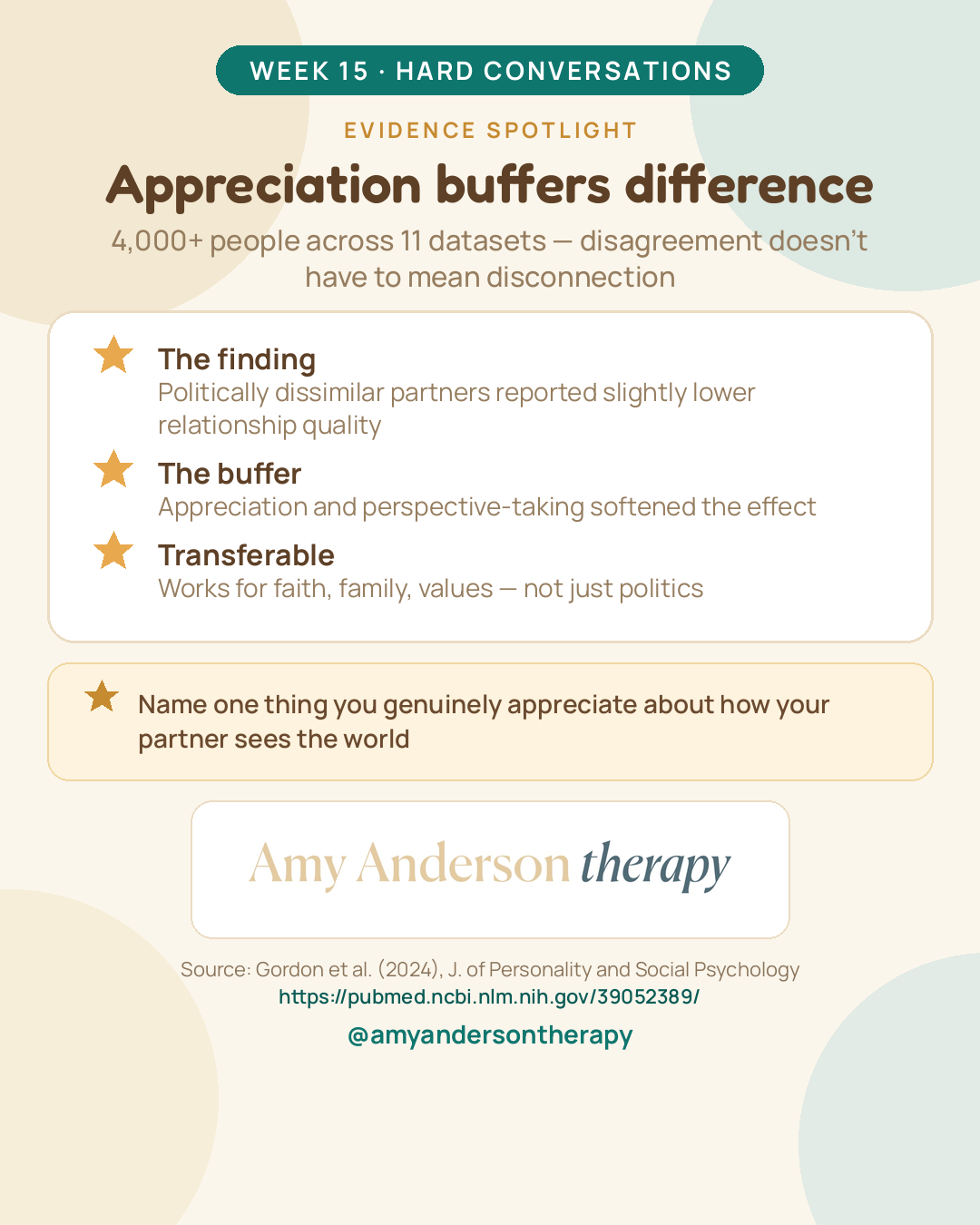
Read that again. The buffer wasn't agreement. It was appreciation and perspective-taking. You don't have to vote the same way. You have to remain curious about the human you married.
The danger isn't the disagreement — it's what the disagreement gets used for. Politics becomes a proxy weapon: "You'd agree with me if you actually loved me." "Your vote proves you don't care about people like me." The moment a political position becomes a loyalty test, you've left the topic and entered the attachment wound. Name it when it happens: "I think we're not talking about the election anymore. I think we're talking about whether I see you." That sentence has ended more political fights than any argument ever has.
Practical ground rules that actually help: no political processing after 9 PM (tired brains don't do nuance). No ambushing — "we need to talk about what you posted" is not a conversation opener, it's an indictment. And separate the civic from the relational: you can fiercely disagree about the world and still be fiercely on the same team about your family. Most couples never make that separation explicit. Make it explicit.
Race and lived experience: believe the nervous system
For interracial couples — and for any couple where one partner moves through the world with a target on them that the other doesn't share — there's a specific pain that needs naming: the loneliness of unshared threat.
When your partner experiences racism and you don't, there are two failures available, and most well-meaning partners commit one of them. Failure one: minimizing — "are you sure that's what they meant?" — which tells your partner their alarm system is broken. (It's not. It's calibrated to a reality you don't live in.) Failure two: performing allyship so anxiously that your partner has to manage your feelings about their pain. Now they're comforting you about their wound. That's backwards.
What actually helps, per the research and per every couple I've watched navigate this well: name it together. "That incident today — that was racial stress, and it's landing in our relationship tonight. I'm here. Tell me what you need." You don't have to fully understand an experience you haven't lived. You have to believe it, make room for it, and not make your partner audition their pain for your comprehension. Perspective-taking — the buffer from the political research — applies here with even more weight. Curiosity, not cross-examination.
And if you're the partner carrying the threat: it is not your job to educate your partner into empathy on demand, especially when you're depleted. Name what you need concretely — "I don't need you to fix it, I need you to sit with me in it" — because most partners genuinely want to help and genuinely don't know how.
Faith: when belief becomes a fault line
Faith differences — different religions, different levels of observance, one partner's deconstruction while the other stays — can feel like discovering you're building on different bedrock. The grief is real: we imagined raising kids in this tradition, praying together, growing old in this community — and now what?
Two truths at once. First: you married a person, not a theology. The relationship predates the current belief configuration for most couples (people change; faith journeys aren't linear), and the vows were to the human. Second: faith isn't just ideas — it's identity, community, ritual, mortality, meaning. Dismissing it as "just beliefs" is its own kind of contempt.
The protocol applies directly: shared values first ("we both want our kids to have a moral compass and a sense of wonder"), curiosity before persuasion ("tell me what your faith actually gives you, day to day" — not the apologetics, the lived experience), and explicit agreements about what's on the table (holiday practices, kids' exposure, community involvement) and what's off it (no one's soul is up for debate).
Watch for the hidden grief. Often the fiercest faith fights are mourning in disguise — grief for the shared spiritual life you imagined, grief for the community approval you've lost, grief for the simplicity of before. Name the grief and the fight often softens. You're not opponents. You're two people who lost the same map.
Family estrangement: conscious decisions, not inherited scripts
Family estrangement — from a parent, a sibling, an entire side — is one of the heaviest external stressors a couple carries, and one of the least discussed. There's the grief, the guilt, the holidays with an empty chair (or a full chair you'd rather were empty), and the constant background question: are we doing the right thing?
Here's what makes it a couples issue: estrangement decisions are rarely symmetric. One partner is usually more "done" than the other. One feels relief where the other feels guilt. One's family is the problem; the other's family is the audience judging the problem. And without conscious decisions, couples default to inherited scripts — avoiding the topic, fighting about holidays every single year, one partner secretly managing contact the other doesn't know about.
The framework: make the decisions together, explicitly, in advance. That's Exercise 2 — but the principle is: boundaries decided in green, during a calm week, beat boundaries improvised in yellow at Thanksgiving. Three domains, decided as a team:
Holidays and gatherings — which events, what duration, what exit plan. ("We'll attend for two hours and leave after dessert. If X happens, we leave early — no discussion needed in the moment.")
Visits and ongoing contact — frequency, format, who's present. ("Phone calls monthly, no overnights until things change.")
Communication channels — who talks to whom about what. ("You handle your mother; I don't engage with the group chat.")
Write them down. Literally. Couples who write boundaries down follow them; couples who "just know" renegotiate them under pressure every time.
And name the grief — because estrangement always includes it, even when the estrangement was necessary and right. You can be at peace with a boundary and still mourn what the relationship was supposed to be. Both. That's not ambivalence. That's honesty. If addiction or active harm is in the family picture, the boundary isn't cruelty — it's the same sequencing from Week 1: stabilization before reconnection. And if you're unsure whether distance or repair is right, that's worth exploring with a professional, not deciding from a worksheet.
Talking about touch when sexual trauma is in the story
Some of you carry sexual trauma — your own or your partner's — and it lives in the body right where intimacy is supposed to. This section isn't treatment. It's about the conversation, because most couples with a trauma history don't have a touch problem nearly as big as their touch-conversation problem. Nobody knows what's okay, so everything becomes avoided or endured. Both are lonely.
Invitational principles — not prescriptions:
Consent is continuous, not a one-time contract. "Yes" last month isn't yes tonight. Checking in isn't unsexy — it's what makes touch safe enough to enjoy. "Is this okay? More of this, or something different?" — asked genuinely — is care.
The survivor sets the pace. Always. If you're the partner without the trauma history: your job isn't to heal them through touch. It's to be trustworthy with the pace they set — including stops, pauses, and no. Trustworthy pacing rebuilds the link between touch and safety.
Name the body stuff in green, before the moment. "Sometimes my body freezes even when I want this — old wiring, not rejection." Said beforehand, it's information. Discovered mid-moment, it detonates. The partner hearing it needs to know: it's data, not accusation.
Awareness before action. Where do I feel openness? Where do I brace? Body-based awareness — breath, grounding, slow attention to sensation — helps survivors tell then from now. Build the noticing first. Everything else follows.
The boundary, plainly: processing sexual trauma is clinical work. If touch consistently triggers flooding, shutdown, flashbacks, or dissociation — that's beyond a course and beyond a partner's job description. A trauma-trained therapist is the container for that work. What this course can give you is the conversation: honest, paced, and on the survivor's terms.
Team vs. opponents: the reframe that holds it all
Every section of this week reduces to one move: turn and face the stressor together.
Opponents stance: "Your politics / your family / your faith is the problem." The stressor becomes a weapon in the relationship's existing arsenal.
Team stance: "The world is throwing X at us. How do we want to handle it — us?" The stressor stays outside, and the relationship becomes the shelter you build together against it.
You'll slip into opponents stance. Everyone does. The skill isn't never slipping — it's noticing the slip and naming it: "We're doing opponents right now. I want to be a team about this. Can we restart?" That sentence is worth more than winning any argument.
That's the top of the Sound Relationship House, by the way — making life dreams come true, honoring each other's inner world even when you don't share it. The team stance isn't a tactic. It's the house.
A note on psychedelic-assisted work
Some of you may be exploring legal psychedelic-assisted therapy with a trained provider — for trauma, for the relationship, or both. If so: the integration conversations afterward are high-stakes conversations, and this week's protocol was built for them. Preparation and integration happen with your trained provider, in a legal context — never solo, never from a course. But when you come home with insights that feel huge and fragile, Moves 1 through 5 are how you bring them to your partner without losing them in the telling. I've completed training in psychedelic-assisted therapy for couples and trauma, so I'll say it plainly: the medicine can open the door, but the relationship work walks through it.
Why it matters for trauma
External stressors don't just cause conflict — they activate attachment wounds, and attachment wounds are where early trauma lives.
Here's the mechanism: your attachment system is always scanning for the answer to "are we okay?" When a political fight, a racist incident, a faith rupture, or a family crisis hits, the system hears a threat to togetherness itself — and for trauma survivors, togetherness-threat doesn't register as a disagreement. It registers as danger. The body responds the way it learned to respond to danger: fight (escalate, persuade, dominate the conversation), flight (shut down, leave, "I can't talk about this"), or freeze (numb compliance, "fine, whatever you want").
That's why these conversations go from zero to existential so fast. You're not actually fighting about the topic anymore — you're in a trauma response about the topic. The content is the trigger; the state is the problem. (Week 1's map, still the foundation: you cannot have a high-stakes conversation from yellow or red. Full stop.)
There's a second trauma thread, specific to estrangement and faith: these topics often touch the original wound. The parent you're estranged from may be the source of the trauma this whole course has been circling. The faith community may be where you first learned that love is conditional. So a "simple" boundary conversation can detonate a decades-old file. If that happens — if you go from discussing holiday plans to shaking, sobbing, or blank — that's not weakness and it's not "overreacting." That's the old file opening in real time. Pause. Regulate. Return. And consider: some files are too big for a worksheet. That's what the "call a professional when..." list in next week's Maintenance Plan is for.
One more: for partners who don't share the threat — the one who doesn't experience the racism, didn't grow up in the faith, isn't estranged — your steadiness is the intervention. Not fixing, not explaining, not optimizing (Week 14 called, it wants its habits back). Just: regulated presence, belief, and the explicit statement "we're a team about this." For a nervous system scanning for aloneness, that sentence is regulation.
Try this
Exercise 1 — Together: The Values-Underneath Exercise
Purpose: find the shared human value underneath a divisive position — and face the topic as a team. Time: 30 minutes.
Pick ONE hot topic — the one that's most alive right now, or the one you most avoid. Do this in green, with the Protocol's moves in order. Keep Pause-and-Return within reach.
Step 1 — State positions. Each partner states their position on the topic in two sentences or less. No preamble, no persuasion. Just: "My position is ___." The other listens without responding.
Step 2 — Name the value underneath. Each partner completes, out loud: "The value underneath my position is ___." (Safety. Dignity. Freedom. Family. Truth. Belonging. Justice. Peace.) Then: "What I've lived that makes this value so important to me is ___." This is the step most couples never take — and it's where the humanity lives. (This is the Dreams within Conflict exercise from Gottman Method Couples Therapy, in my words — the dream inside the position, named out loud.)
Step 3 — Find the shared value. Look at the two values. Find the overlap — there's almost always one, sometimes wearing different clothes. ("Your 'safety' and my 'freedom' are both about not being controlled.") Name it together: "The value we share underneath this disagreement is ___."
Step 4 — Team statement. Close with: "We disagree about ___. The value we share is ___. As a team, what we'll do about this is ___." Write it down.
Solo version: Take your own two strongest positions — on two different topics, or the two sides of one internal conflict — and run the same steps on yourself. "My position is ___. The value underneath it is ___." Then look for your own shared value underneath the contradiction. Most internal gridlock is two real values in tension, not one right answer and one wrong one. Name them both. That's self-knowledge most people never get.
Why this works: gridlock is rarely a position problem — it's a dreams-underneath problem. When both partners name the value and the lived experience under their position, the topic stops being a loyalty test.
How you'll know it worked: you found one genuine shared value underneath the disagreement — and said the team statement out loud. You don't have to agree. You have to be on the same team about disagreeing.
Exercise 2 — Together: The Estrangement Boundary Conversation
Purpose: decide boundaries in green, in advance — so you don't improvise them in yellow at Thanksgiving. Time: 30 minutes.
If family estrangement or difficult family dynamics affect you. If they don't, use this exercise for any recurring external stressor (the in-laws, the family group chat, the annual event everyone dreads).
In green, together, write down your answers to all three:
Holidays & gatherings: Which events will we attend, for how long, and what's our exit plan? ("We attend Christmas Eve for two hours. If [specific behavior] happens, we leave — no debate in the moment.")
Visits & ongoing contact: What frequency, what format, who's present? ("Monthly phone calls, no overnights, kids' visits only with us present.")
Communication: Who talks to whom about what? ("You handle your parents; I stay out of the group chat. We don't discuss our boundaries with extended family — they're ours, not a negotiation.")
Then add the grief line. Each partner completes: "What I grieve about this family situation is ___." Say it out loud. Witness it. The boundary can be right and the grief can be real. Both.
Sign it, date it, put it where you'll find it before the next holiday season. Revisit yearly — boundaries can evolve as situations change.
Solo version: Answer the same three questions for yourself — which holidays and gatherings you attend (for how long, with what exit plan), what ongoing contact looks like (frequency, format), and communication (who talks to whom about what). Write them, date them, add your grief line: "What I grieve about this family situation is ___." Then clarify your non-negotiables for a future partner: "On politics/faith/family, my non-negotiables are ___. What I'm flexible on is ___." This isn't a checklist for judging dates — it's clarity about what you need to feel like a team. Bring it to dating like a compass, not a weapon.
Why this works: boundaries decided in green, in advance, hold — boundaries improvised in yellow at Thanksgiving don't. The writing is the commitment device.
How you'll know it worked: the boundaries are written, dated, and findable — and include the grief line. A boundary without the grief named is just armor; with it, it's a choice.
Exercise 3 — Together & Solo: The Same-Team Debrief
Purpose: turn every hard-topic fight — good or bad — into data for the playbook. Time: 10 minutes, within 24 hours.
For after a hard topic comes up in real life — because it will. This is the repair ritual for external-stressor fights.
Together: After any conversation about a hot topic — whether it went well or went sideways — take 10 minutes within 24 hours and answer these three questions together (in green; if you're still activated, Pause-and-Return first):
"When did we slip into opponents stance?" (Name the moment. No blame — just locate it.)
"What was each of us actually feeling underneath?" (The attachment sentence: I felt alone / unseen / unsafe when ___.)
"What's our team statement for next time?" ("Next time this comes up, we'll ___.")
Write the team statement down. Over time, you build a playbook — your couple's specific, tested way of facing each hard topic as a unit. That's not avoidance. That's mastery.
Solo: After a hard conversation with anyone — a date, a family member, a friend — debrief yourself with the same three questions, turned inward: When did I slip into opponents stance? What was I feeling underneath? What do I want to do differently next time? Then the team question, aimed at your future: "What would it look like to be on the same team as a future partner about this?" You're rehearsing the stance now so it's available later.
Why this works: couples who debrief build a playbook — and a playbook turns the same fight from a recurring rupture into a solved problem.
How you'll know it worked: you have one written team statement for next time — specific to a real topic. The playbook grows one debrief at a time.
Bonus — the mindful listening rep (10 minutes, today if possible). One conversation — about anything, not necessarily a hard topic — where your only job is the Great Listener upgrade: attune, reflect back, validate. No rebuttal prepared. No point to make. When you catch yourself composing your response while they're talking (everyone does), notice it without judgment, let it go, and come back to their words. That's the mindfulness rep: returning, again and again, to listening. Tell your partner afterward what you heard — the reflection is the proof it worked.
Reflect
Your 20-minute weekly check-in ritual — the only "homework" in this course: 5 minutes on a states check (green/yellow/red — separately, then compare if you're a couple) · 10 minutes on this week's exercise · 5 minutes on the reflection prompt below. Same day, same time, every week. The ritual is the practice.
Journal on this — a few honest lines, not an essay:
"The external stressor that most affects our relationship is ___. When we're on the same team about it, it looks like ___. When we're not, it looks like ___."
Then: What's one hard conversation we've been avoiding until it explodes — and what's the smallest honest step toward having it on purpose?
And grief, because this week's fights are so often grief in disguise: What's one hard-topic fight that was actually grief — and what was the grief? The faith you lost. The family that isn't what you needed. The country that feels unrecognizable. The parent you wish you had. Name it. A fight about the topic goes in circles; grief, once named, can actually be held — by you, by your partner, by the team you're building.
Evidence spotlight
Across 11 datasets with 4,000+ people, politically dissimilar partners reported slightly lower day-to-day relationship quality — but appreciation and perspective-taking buffered the effect (Gordon et al., 2024). The buffer isn't agreement. It's curiosity about the human you married.
In 98 Black couples tracked across 21 days, relationship quality dipped on days a partner reacted strongly to a racist incident — external stress lands inside the relationship (Ong et al., 2022). Naming it together is the intervention.
In a 2024 randomized pilot trial with 49 couples recovering from infidelity, Gottman Method Couples Therapy outperformed treatment-as-usual on trust, conflict management, relational satisfaction, and quality of sex (Irvine et al., 2024). The method behind this week's protocol is tested, not just theorized.
Full references live in your course research companion. These aren't here to impress you — they're here so you know this isn't just my opinion.
Go deeper
From Amy's blog — the free posts this week builds on:
When Faith Becomes a Fault Line: Healing Religious Divides in Relationships
Mental Health, Personality Development & Parent-Child Estrangement
The blogs bring the research and the validation for what's landing in your relationship from the outside world. This week, you built the protocol for facing it as a team. Next week — the last week: integration. Reviewing how far you've come, naming what changed, and designing the relationship you're actually proud of, on purpose.
Your homework this week
Short on time? Do items 1–3 — the check-in, one real protocol run, one listening rep. That's the week working. The rest is there when you have the bandwidth.
Keep the weekly check-in ritual (20 min, same day/time). 5 minutes states check (green/yellow/red — separately, then compare) · 10 minutes on one of this week's exercises · 5 minutes journaling the reflection prompt below. The ritual is the practice.
Run the Protocol once for real (30–45 min, green). Download The High-Stakes Conversation Protocol and The Softened Startup Script. Pick ONE hot topic, regulate first, and walk all five moves. Script your opener in 2 sentences before you say it — "I feel," the situation, the positive need. Then complete the Week 15 chapter worksheets in the companion workbook.
Do one mindful-listening rep (10 min, today if possible). Your only job: attune, reflect back, validate. Download The Great Listener Upgrade as your cheat sheet. No rebuttal prepared. When you catch yourself composing your response mid-sentence, let it go and come back to their words. Tell your partner afterward what you heard.
Practice the appreciation buffer daily. Download The Appreciation Checklist — check at least 3 a day, small things, often. Name one thing you genuinely appreciate about how your partner sees the world.
Do the Values-Underneath Exercise (30 min). Download the Dreams within Conflict handout: state positions (2 sentences each), name the value underneath, find the shared value, close with the team statement. Write it down.
Write your estrangement boundaries in green (30 min). Holidays & gatherings · visits & ongoing contact · communication channels — written, dated, findable. Add the grief line: "What I grieve about this family situation is ___."
Debrief one real hard-topic moment within 24 hours (10 min). When did we slip into opponents stance? What was each of us feeling underneath? What's our team statement for next time? Write the team statement down — that's your playbook.
Journal the prompt (5 min). "The external stressor that most affects our relationship is ___. When we're on the same team about it, it looks like ___. When we're not, it looks like ___. What's one hard conversation we've been avoiding until it explodes — and what's the smallest honest step toward having it on purpose?"
Week 15 of 16 · Too Busy or Too Broke for Trauma Therapy · © Amy Anderson, LCSW. This material is psychoeducational and is not a substitute for therapy, diagnosis, or treatment.