
Week 16 — The Relationship You're Proud Of: Integration & What's Next
Too Busy or Too Broke for Trauma Therapy: A 16-Week Trauma-Informed Course for Couples & Individuals · Amy Anderson, LCSW
Theme: The Relationship You're Proud Of: Integration & What's Next
What this is: Psychoeducation — evidence-informed information, frameworks, and practice exercises to help you understand your relationship patterns and build skills. It is not psychotherapy, couples therapy, or a clinical relationship. Nothing here diagnoses or treats a mental health condition. If you need clinical support — especially around trauma, addiction, or safety — work with a licensed professional in your state.
If you're in crisis: call or text 988 (US Suicide & Crisis Lifeline) · National Domestic Violence Hotline: 1-800-799-7233 or text START to 88788.
Who this week is not for (yet): If there is ongoing physical violence, coercion, or fear in your relationship — or an undisclosed affair or active addiction without outside support — pause here and reach out for individual support first. Stabilization comes before coursework. That's not failure. That's sequencing.
Welcome to Week 16
You made it. Sixteen weeks.
Think about where you started. Week 1, you built a map of your nervous system — green, yellow, red — and learned the Pause-and-Return Protocol. Maybe the idea that you can't have a productive conversation from yellow or red was new. Maybe it explained every circular fight you'd ever had.
Then you went deeper: two nervous systems colliding, attachment patterns, the family history you brought into the room, the inner child who shows up mid-argument. You named your patterns — the pursue-withdraw dance, the money fights that were never about money, the over-functioning, the ADHD dynamics. You did repair work — trust, betrayal, the long road back. You talked about desire, about the small daily turnings-toward that actually build a relationship. You met your inner critic and negotiated it a new job. You audited your values against your calendar. You built a protocol for the hardest conversations — politics, race, faith, family.
That is an enormous amount of work. Sit with that for a second before you read on. Most people never do any of it.
This week isn't a new topic. It's the integration capstone — the week where 15 weeks of understanding, naming, repairing, and practicing get woven into something you actually live. You'll review how far you've come, name what changed, write the vision for what you're building, and make a maintenance plan for keeping it alive. Including the honest part: when the tools aren't enough, and what to do then.
No new skills this week. Just the ones that are yours now — and a decision about what you do with them.
The lesson
What integration actually is (and isn't)
Integration isn't a finish line. You're not "done" — there's no done. Relationships aren't projects you complete; they're places you live, and living things need tending.
Integration is quieter than that. It's the moment the tools stop feeling like homework and start feeling like yours. When you notice yellow rising and name it without thinking. When the pause happens naturally instead of heroically. When you catch the critic mid-sentence and almost smile, because you know that voice now. When a hard conversation starts and some part of you thinks, "we have a protocol for this" — and you trust it.
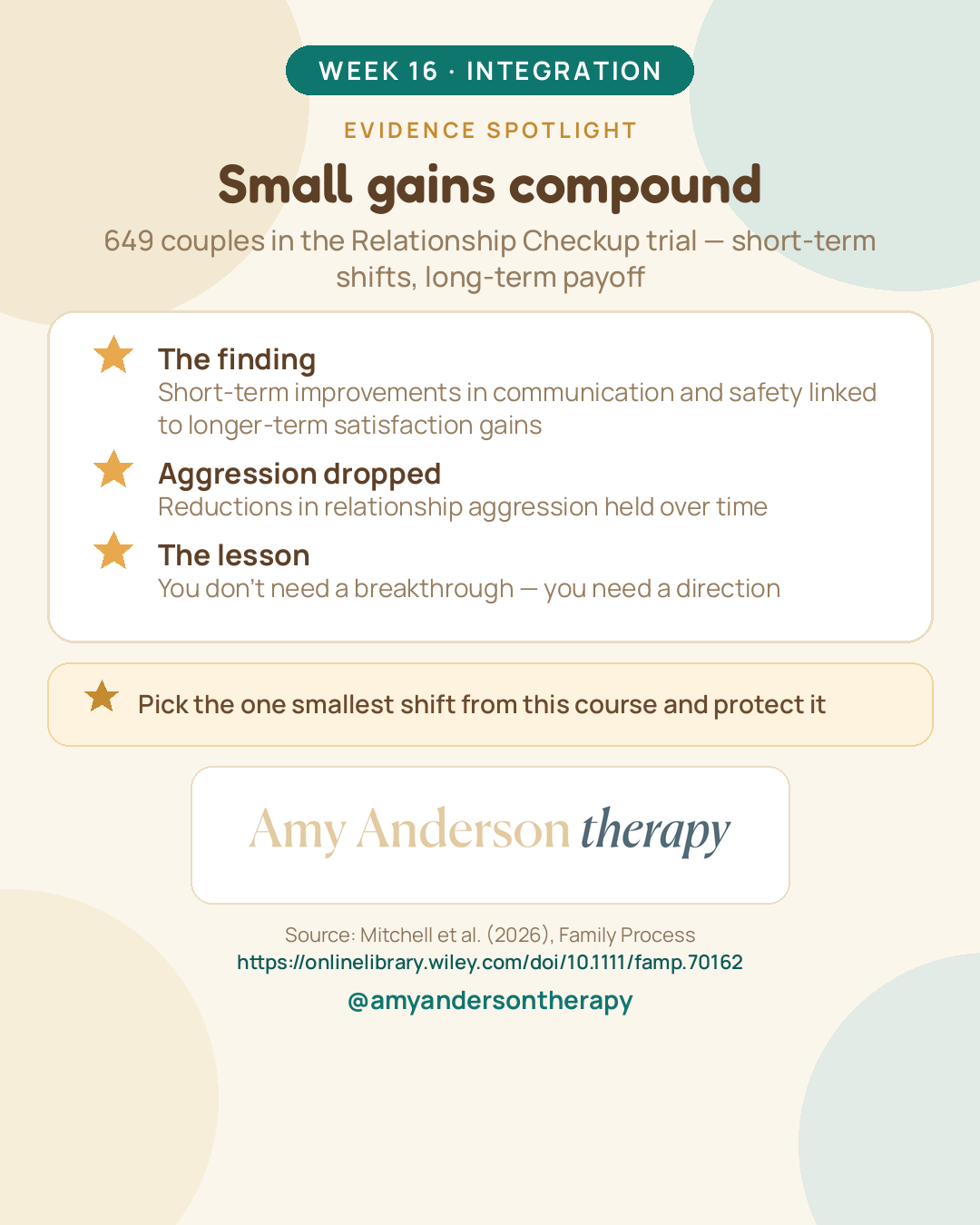
Here's what the research says about this phase, and it's encouraging: in a large Relationship Checkup trial with 649 couples, short-term improvements in communication, intimate safety, and reduced aggression were linked to longer-term gains in satisfaction — and those gains held over time (Mitchell et al., 2026). Translation: small improvements compound. You don't need a transformation. You need the small things, repeated, until they're just how you live.
And one more finding worth carrying forward: in 192 married couples, partners who used different, complementary maintenance strategies showed stronger commitment than couples who maintained the relationship identically (Hu et al., 2023). You don't have to do this the same way. Maybe one of you is the check-in initiator and the other is the one who plans the good-enough date nights. Different styles, same team. That's not a mismatch. That's coverage.
The arc: look how far this goes
Before the worksheets, take the wide view. Here's the ground you covered — and what each phase was actually for:
Weeks 1–4 — Safety & Understanding. You learned that trauma moves through relationships like weather through an open house, mapped your nervous system states, explored attachment and co-regulation, and traced the family history and inner-child patterns you brought into the room. The point: you can't change what you can't name, and you can't connect from a dysregulated body.
Weeks 5–8 — Patterns. You named the pursue-withdraw dance, unpacked the money fights, faced over-functioning and the false peace of people-pleasing, and looked honestly at how ADHD shapes a relationship. The point: it's the pattern, not the person. Every cycle has two dancers.
Weeks 9–12 — Repair & Intimacy. You did the trust work — rebuilding after betrayal, understanding what repair actually requires — then turned toward desire, physical intimacy, and the small daily bids that build secure love over time. The point: repair is a practice, not an event, and intimacy is built in inches.
Weeks 13–15 — Becoming. You met the inner critic and gave it a new job, practiced radical acceptance of what won't change, dismantled the optimization lie and rebuilt around values, and built a protocol for facing the world's hardest topics as a team. The point: who you're becoming matters as much as what you're fixing.
Read that arc again. That's not a course syllabus. That's a relationship, rebuilt from the nervous system up.
Maintenance is the relationship
Here's the reframe for everything after this week: maintenance isn't the boring part after the real work. Maintenance IS the real work. The 15 weeks were training. What you do with Tuesday evenings from here on — that's the relationship.
As I wrote from my blog, Trauma Recovery Is a Capacity You Maintain: "The body keeps receipts, and it also keeps score on whether you keep showing up."
This doesn't mean scheduling your love into oblivion (Week 14 called — it wants its warning back). It means choosing, on purpose, the small things that keep you connected: the check-ins, the rituals, the repair attempts, the good-enough date nights, the values underneath the positions. Not perfectly. Not every day. Just often enough that the default is connection, not drift. And, from the same post: "You don't get strong and then stop going to the gym." You don't build a practice for 16 weeks and then retire it. Booster sessions, ongoing repair work, a relationship practice that outlasts the course — that's not failure. That's the design.
The emotional bank account doesn't close when the course ends, either. It just stops getting course-sized deposits — which is fine, because it was always the small ones that compounded.
And it means watching for the drift — because drift is normal, not failure. Stress will spike. Old cycles will knock. The critic will apply for its old job back. The difference between now and 16 weeks ago isn't that those things won't happen. It's that you'll recognize them, you'll have names for them, and you'll know what to do. That's what all of this was for.
The maintenance backbone: small things, often. If the plan needs a spine, it's this — the phrase that's run underneath this whole course. The rituals that keep a relationship alive aren't the grand ones. They're the bids you catch (Week 12), the 6-second kiss, the daily appreciation, the weekly check-in, the repair attempt offered and received (Week 15). When you write your 3 rituals below, pull from that shelf first. Maintenance isn't a new system to build. It's the small things you've already practiced — kept on purpose.
Integration: the phase that makes it last
This week's title isn't an accident — and neither is the course's arc. In my psychedelic-assisted therapy practice (18+ CE credits in psychedelic-assisted therapy for couples and trauma; 2-day MDMA couples intensive with MAPS, 2023), the work runs in three phases: preparation (safety, intention, mapping), the experience (the deep work itself), and integration (turning what happened into how you live).
This course was built on the same arc. Weeks 1–8 were preparation: mapping your nervous system, your patterns, your history. Weeks 9–12 were the experience: repair, betrayal, desire — the deep water. Weeks 13–16 are integration: becoming, maintenance, and this capstone.
And here's what integration work teaches, in every context: the insight isn't the change. A powerful realization — in a medicine session, in a therapy room, in Week 9's repair conversation — changes nothing by itself. What changes things is what you do on ordinary Tuesdays afterward: the check-in you keep, the bid you catch, the pause you take instead of the fight you start. Integration is unglamorous and it's everything.
Three rules from integration work that apply directly to your maintenance plan:
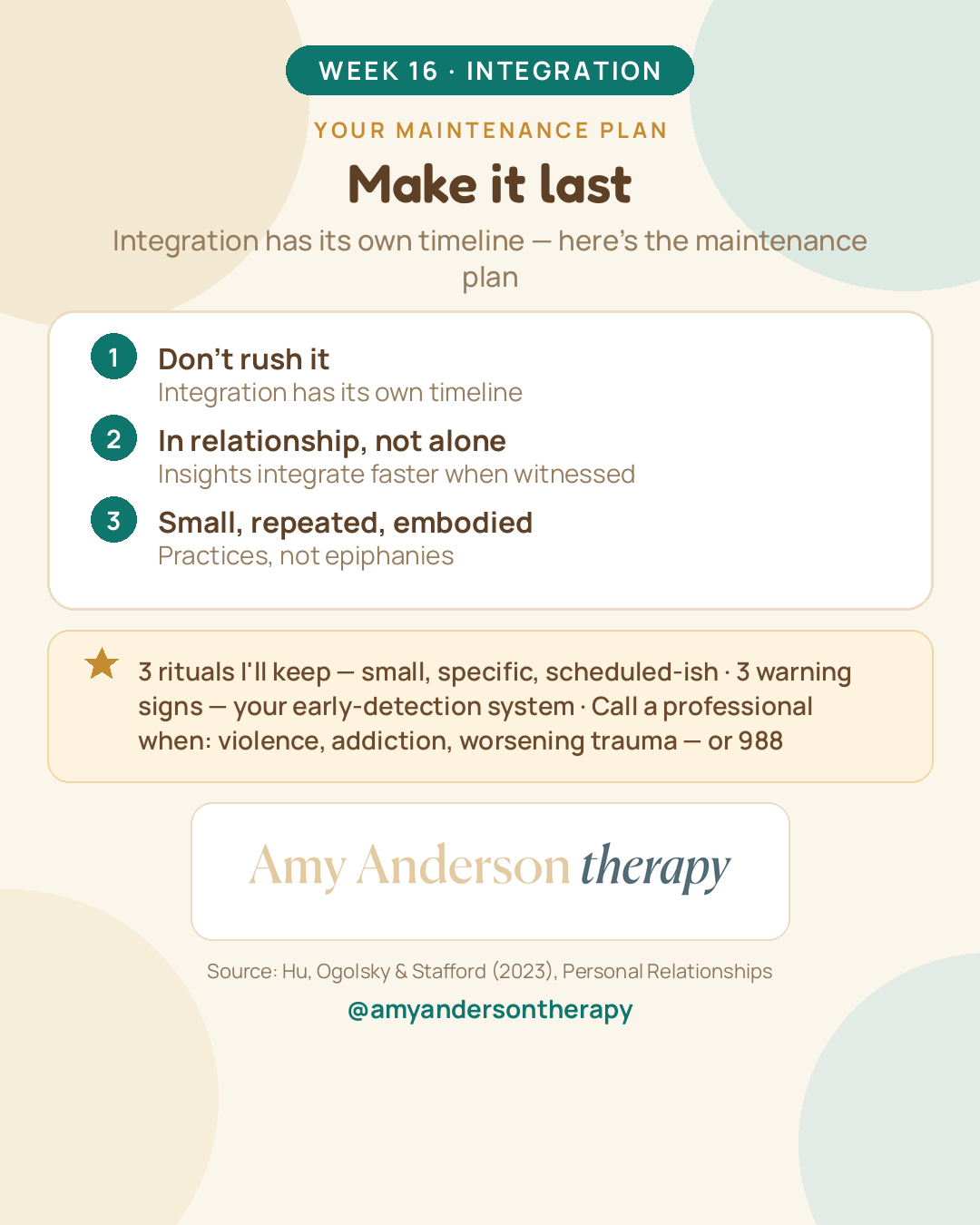
Don't rush it. Integration has its own timeline. The urge to "be done" is the old optimization habit (Week 14) wearing a spiritual costume.
It happens in relationship, not alone. Insights integrate faster when they're witnessed — by a partner, a friend, a community, a professional. That's what the shared review and the letter are for.
Small, repeated, embodied. Integration lives in practices, not epiphanies. The rituals you picked above are integration.
And here's the full inventory of what you're integrating — the toolkit, in plain language: the nervous-system map and Pause-and-Return. The Gottman practices — bids and turning toward, the emotional bank account, gentle startups, repair attempts, the speaker-listener structure, Dreams within Conflict for the gridlocked stuff. The EMDR resourcing tools — safe place, container, the cognition map (the belief you'd rather carry). The parts work — interviewing the critic instead of obeying it. The DBT-informed skills — opposite action, TIPP, urge surfing. The ACT-inspired moves — defusion, willingness, values. The Inner Bonding lens — giving from fullness, not fear. That's not a syllabus anymore. That's a practice. Yours.
One boundary, stated clearly: psychedelics remain illegal in most contexts, and nothing in this course is guidance for using them. If you've had a legal psychedelic experience — a clinical trial, ketamine therapy where it's legal — and want support integrating it into your life and relationship, that's work for a trained provider in a legal context, not a DIY project. (Integration support in legal contexts is part of my practice.) The principle, though, belongs to everyone: preparation makes deep work possible; integration makes it last.
Try this
Exercise 1 — Together & Solo: The 16-Week Review Worksheet
Purpose: name what's actually different — specifically — before you design what's next. Time: 45 minutes, unhurried.
Do this with your journal — and with the Week 16 chapter worksheets in the companion workbook. This is the capstone's foundation — don't skip to the vision before you've done the review.
What shifted. Write 3–5 sentences on each:
Something I understand about myself now that I didn't 16 weeks ago: ___
Something I understand about my partner (or my patterns in relationships) now: ___
A moment during this course when I felt something actually change: ___
What's still tender. Honesty, not perfection:
The pattern we still fall into: ___
The topic we still avoid: ___
The tool I still forget to use when I need it most: ___
What I most want to keep working on: ___
Which tools stuck. Go phase by phase and circle what's actually in your life now:
From Weeks 1–4 (safety & understanding): ___ (e.g., naming my state, the Pause-and-Return Protocol, the body map)
From Weeks 5–8 (patterns): ___ (e.g., naming the cycle instead of blaming, the money conversation framework)
From Weeks 9–12 (repair & intimacy): ___ (e.g., repair attempts, turning toward bids, desire conversations)
From Weeks 13–15 (becoming): ___ (e.g., the critic interview, the values audit, the high-stakes protocol)
Star the two you'll commit to keeping. Those go in your Maintenance Plan.
The scaling question (borrowed from Motivational Interviewing): "On a scale of 1–10, how confident am I that I'll still be using these two tools in three months? Why that number — and not one lower?" Answering the second question makes you argue for your own follow-through, in your own words. If the number is low, that's useful data: pick smaller tools, or add a support (a reminder, a partner check-in, a therapist) that raises it.
Together: Share your worksheets with each other. Notice what your partner circled that you didn't — that's information about what landed for them. Thank each other for one specific thing the other did during these 16 weeks. Be concrete: "When you ___, it changed ___ for me."
Solo: Do the full review for yourself, then add: "The pattern I'm least likely to repeat in my next relationship is ___. The quality I'm most intentionally bringing to my next relationship is ___. The person I'm becoming through this work is ___."
Why this works: you can't design what's next from a vague sense of "better" — specificity about what actually changed is what makes the maintenance plan stick.
How you'll know it worked: you can name three specific things that changed — not "I communicate better" but "I pause instead of pursuing, we do the check-in Sundays, I caught the Hamster Wheel twice." Specificity is the proof.
Exercise 2 — Together: The Relationship Vision
Purpose: write the relationship you're building — in your words, on one page — so future-you has a compass. Time: 30 minutes.
One page. Your words — not aspirational fluff, not what a good couple is supposed to say. What's true and what you're building toward.
Write it together — out loud, taking turns, one person scribing. Use these prompts as your skeleton:
The relationship we're building is ___.
What makes us proud is ___.
What we're still working on is ___.
What we want to feel more of is ___.
What we refuse to go back to is ___.
Five years from now, we want to be able to say ___.
Keep it to one page. Concrete beats poetic — "we want to be the couple that repairs within a day, laughs at dinner, and actually likes each other" beats "we envision a harmonious union of souls." (Unless harmonious unions of souls is genuinely your thing. You do you.)
Sign it. Date it. Put a calendar reminder for 6 months from now to read it together. The vision isn't a monument — it's a living document. You'll revise it as you grow. The 6-month revisit is where the magic is: you'll be stunned by what came true and honest about what didn't.
Solo version: Write your vision for the relationship you want to build or choose next — and the person you're becoming to meet it:
The relationship I want to build is ___.
The relationship I'm proud of in how I love is ___.
What I'm still working on in myself is ___.
The partner I'm becoming — the one I'd want to meet — is someone who ___.
What I refuse to repeat is ___.
Date it. Revisit in 6 months. Watch how your clarity sharpens your choices.
Why this works: I love this exercise — it's a dream within the conflict in so many ways. Narrative therapy helps you share the story of the dream: what you hope to see happen between you is where the real change lives. Honestly reflecting where the relationship is today, from both of your perspectives, and naming what you envision changing — through an image, a feeling, an articulation of steps — is so healing and loving for both of you as you share it with one another.
How you'll know it worked: the 6-month calendar reminder is actually set — and the vision fits on one page without squinting. A vision you revisit beats a vision you frame.
Exercise 3 — Together & Solo: The Maintenance Plan
Purpose: leave this course with a written plan for the Tuesdays after it ends. Time: 30 minutes.
This is the practical heart of the capstone. Three lists. Written down. Where you'll find them.
3 rituals you'll keep. Small, specific, scheduled-ish. (The weekly check-in. The good-enough date night monthly. The same-team debrief after hard topics. Phones-down dinners. Whatever stuck from your review — pick the ones with the highest return for the lowest effort.)
Run each candidate through the Week 14 values filter: does this serve the relationship I actually want — or is it a should? Keep the ones that light you up. And make at least one of the three a small-things-often practice — a bid ritual, a daily appreciation, the check-in. This week's research backs it: small improvements, repeated, are what compound into lasting satisfaction.
___
___
___
3 warning signs you'll watch for. Your personal early-detection system — the specific, recognizable signs that the old cycle is knocking. (Not generic "we fight more." Yours: "When I start managing everything again." "When we go three days without really talking." "When the critic gets loud about them.")
___
___
___
What you'll do when the old cycle returns. Because it will — that's not failure, that's being human. Write the plan now, in green, so it's there when you're not:
First, we ___ (name it out loud — "we're in the cycle").
Then we ___ (pause? regulate? pull out the protocol for this specific pattern?).
If we're stuck for more than ___ (two weeks? a month?), we ___.
"Call a professional when..." — write this list together, honestly, now. Not as a threat — as a caring plan:
There's any physical violence, coercion, or fear — individual support first, immediately.
Active addiction is in the picture without outside support.
A betrayal comes to light and you don't know how to navigate repair safely.
Trauma symptoms are worsening — flashbacks, dissociation, or shutdown interfering with daily life.
Either of you is having thoughts of suicide or self-harm — call or text 988 right away.
You've been stuck in the same cycle for months despite using the tools — that's not failure, that's information that you need a guide.
One of you wants professional support and the other doesn't — individual support is still worth pursuing.
Solo version: Write the same three lists framed for your life and your next relationship: 3 practices I'll keep for myself. 3 warning signs in my own patterns. What I'll do when I notice them — including when I'll seek professional support. Your maintenance plan is portable. It goes with you.
Finding the right professional: fit matters — including cultural fit. A few directories worth knowing: Therapy for Black Girls, Therapy for Black Men, Latinx Therapy, Inclusive Therapists (BIPOC, LGBTQ+, neurodivergent-affirming), and Psychology Today's therapist finder. My own curated referrals live at amyandersontherapy.com/tools-resources. The right therapist is the one you can tell the truth to — keep looking until the room feels like that.
Why this works: a plan written in green is a decision your future yellow self doesn't have to make — and the "call a professional when" list turns a crisis into a step instead of a freefall.
How you'll know it worked: all three lists are written somewhere you'll actually find them — and the "call a professional when" list has names and numbers, not just intentions. A plan with phone numbers is a plan.
The Closing Letter
Not an exercise to perform. A ritual to mean.
Together: Each partner writes a letter to the other — by hand if you can. Not long. Include three things:
Something I've watched change in you over these 16 weeks: ___
Something I'm grateful for about us: ___
Something I'm committed to, going forward: ___
Read them to each other — out loud, in green, phones away. Or seal them and open them together at your 6-month vision revisit. Either way: this is the moment the course becomes a memory you carry, not just material you consumed.
Solo: Write the letter to yourself — from the you who started Week 1 to the you finishing Week 16. What you've survived. What you've learned. What you're carrying forward. What you're proud of. Seal it. Open it in 6 months. Future you will need to hear from present you more than you think.

Your homework this week
Short on time? Do items 1–3 — the review, the vision, the maintenance plan. That's the course landing. The rest is there when you have the bandwidth.
Do the 16-Week Review (45 min, unhurried). Name what's actually different — specifically. Something I understand about myself now / about my partner / the moment something actually changed. Name what's still tender. Circle which tools stuck, phase by phase, and star the two you'll commit to keeping. Then complete the Week 16 chapter worksheets in the companion workbook.
Write the Relationship Vision (30 min). One page, your words — the relationship you're building, what makes you proud, what you're still working on, what you refuse to go back to, five years from now. Sign it. Date it. Set a calendar reminder for 6 months from now to read it together.
Write the Maintenance Plan (30 min). 3 rituals you'll keep (small, specific, scheduled-ish — at least one small-things-often practice like bids, daily appreciation, or the check-in) · 3 warning signs you'll watch for · what you'll do when the old cycle returns · the "call a professional when..." list — with names and numbers, not just intentions. Use the Bid Tracker and Appreciation Checklist handouts to pick your rituals. Download them to your phone where you'll actually find them.
Write the Closing Letter (30 min). Three things: something I've watched change in you · something I'm grateful for about us · something I'm committed to. Read them out loud in green, phones away — or seal them and open them together at your 6-month vision revisit.
Build your booster plan (20 min). The fade is real: gains hold only if the practice continues. Schedule it now: a monthly 20-minute maintenance check-in (same day each month), a quarterly review of your vision, the 6-month revisit of this week's letters. Pick one handout to revisit monthly — bids, appreciation, critic interview — on rotation. As I wrote from my blog: "The body keeps receipts, and it also keeps score on whether you keep showing up." — from my blog post on maintaining trauma recovery. "You don't get strong and then stop going to the gym." Booster sessions and ongoing repair work aren't failure. They're the design.
Keep one daily practice going. The weekly 20-minute check-in ritual doesn't retire — it becomes the maintenance version of itself: states check, one tool rep, one honest line. Small things, often. That's the whole technology.
Journal the final prompt (5 min). "Sixteen weeks ago, I hoped ___. What's actually true now is ___. What I'm carrying forward is ___." Sit with that third blank the longest. That's the one that matters.
Week 16 of 16 · Too Busy or Too Broke for Trauma Therapy · © Amy Anderson, LCSW. This material is psychoeducational and is not a substitute for therapy, diagnosis, or treatment.
Keep walking it — together.
Reflect
Your 20-minute weekly check-in ritual — the only "homework" in this course: 5 minutes on a states check (green/yellow/red — separately, then compare if you're a couple) · 10 minutes on this week's exercise · 5 minutes on the reflection prompt below. Same day, same time, every week. The ritual is the practice.
Journal on this — the last prompt of the course:
"Sixteen weeks ago, I hoped ___. What's actually true now is ___. What I'm carrying forward is ___."
Sit with that third blank the longest. That's the one that matters.
And the last grief of the course: What are you still grieving — and can you let it belong to the integration instead of treating it as failure? The relationship that will never be what you imagined. The years that are gone. The parent who won't change. The desire, the ease, the innocence that got spent along the way. Integration isn't the absence of grief. It's grief with a place to live — named, witnessed, and no longer running the show from underneath. You don't finish grieving and then integrate. The grieving is part of the integrating.
Evidence spotlight
In 192 married couples, maintenance behaviors strengthened commitment mainly through satisfaction — and partners using different, complementary maintenance strategies showed stronger commitment than those using identical ones (Hu et al., 2023). You don't have to tend the relationship the same way. Different styles, same team.
In the Relationship Checkup trial (649 couples), short-term gains in communication, intimate safety, and reduced aggression were linked to longer-term satisfaction gains — and the gains held (Mitchell et al., 2026). Small improvements compound. That's what the last 16 weeks were.
Full references live in your course research companion. These aren't here to impress you — they're here so you know this isn't just my opinion.
Go deeper
From Amy's blog — the free posts this week builds on:
How to Build a Couples Relationship You're Actually Proud of and Inspired by Every Single Day
How to Spot an Authentic Partner: What the Research Says About Values, Energy, and Attachment Styles
How to Maintain a Healthy Secure Love in 2025?
Clarity Check-Ins and the Power of The Intentional Life
The blogs point at the relationship you're building. This week, you wrote it down — the vision, the plan, the letter. That's the difference between inspiration and integration.
A completion note
You did 16 weeks of some of the hardest, least glamorous, most important work a person can do: looking honestly at yourself, at your patterns, at the places you're still tender — and choosing, week after week, to stay in it.
I'm proud of you. Genuinely. Not in the performative way — in the way of someone who watches people do this work for a living and knows exactly how much courage the unsexy middle weeks take. The weeks nobody posts about. You did those.
Here's what's true now: you have a map, a protocol, a set of tools, a vision, and a plan. That's more than most couples ever build. And here's what's also true: the tools only work if you keep using them. The vision only matters if you revisit it. The rituals only hold if you protect them. Integration isn't something you finished this week — it's something you practice from here on. Small things, often. You know this by now.
What's next — an invitation, not a pitch.
Some of you will take these tools and run. You'll keep the rituals, revisit the vision in 6 months, and build the relationship you're proud of with what's in your hands right now. That's a complete outcome. You don't need anything else from me.
Some of you will hit the edge of what a course can do — and you'll know it, because your Maintenance Plan told you. The pattern that won't budge. The trauma file that's too big for a worksheet. The conversation you can't have without a guide in the room. If that's you, deeper work is available: therapy with a licensed professional in your state (I'm licensed in CA & PA), or coaching for the growth edge beyond it. Reach out if your struggling — spots are available. Reaching for support isn't a sign the course failed. It's a sign the course worked — you can now tell the difference between what you can carry and what you need help carrying. That's the whole point.
Either way: keep the practices alive. Revisit the vision. Reread the letter. When the old cycle knocks — and it will — you'll know what to do. You've done it before. You can do it again.
Thank you for trusting this process, and for trusting me with 16 weeks of your attention. That's not a small thing. Go build the relationship you're proud of — on purpose, in green, together.
I'll leave you with Charlie Mackesy, who wrote the gentlest summary of this entire course: "I think everyone is just trying to get home." And when the boy asks what keeps them going — "We all need a reason to keep going. What's yours?" "You three." "Getting home." You've named your reasons. You know the way home now. Keep walking it — together.
— Amy