

The Stories We Inherited:
Family of Origin & the Inner Child
Week 4
⚠️ This week's slow-down notice: This week touches on family wounds, childhood experiences, and addiction in families of origin. This material can activate strong emotions, feelings, and reactions — that's expected, not a sign you're doing it wrong or something is wrong with you.
Read the slow-down markers in this lesson before you start the exercises. If you flood, you stop, return to your Week 1 tools, and come back when you're Green. If you stay flooded, that's what professional support is for — use it.
You married (or keep dating) your unfinished childhood business. I don't mean that as an insult.
I mean it as the most useful sentence in this entire course.
Here's the pattern I see with partners: someone swears they'll never repeat their parents' marriage — and then finds themselves, at 38, having the exact fight their parents had at the kitchen table in 1998. Same roles. Same lines. Different kitchen.
This week, we trace the lines. Not to blame your parents — blame is a dead end that keeps you stuck in the story instead of changing it. To map the inheritance: which dynamics you absorbed, which roles you were assigned, and where your adult conflicts are actually childhood echoes wearing a trench coat.
Compassion is the operating system this week. For your parents, who were working with their own inheritance from their caregivers and for yourself as you uncover your patterns. For your partner, who's carrying theirs. And hardest of all — for the younger you, who shows up in your adult arguments more often than you'd like to admit.
“What this course is: Psychoeducation — evidence-informed information, frameworks, and practice exercises to help you understand your relationship with self in relation to others. We will review patterns and build skills. It is not psychotherapy, couples therapy, or a clinical relationship. Nothing here diagnoses or treats a mental health condition. If you need clinical support — especially around trauma, addiction, or safety — work with a licensed professional in your state.
If you’re in crisis: call or text 988 (US Suicide & Crisis Lifeline).
National Domestic Violence Hotline:
1-800-799-7233 or text START to 88788.
Who this week is not for (yet): If there is ongoing physical violence, coercion, or fear in your relationship — or an undisclosed affair or active addiction without outside support — pause here and reach out for individual support first. Stabilization comes before coursework. That’s not failure. That’s sequencing.”
The Lesson
The family echo: how dynamics get inherited
Every family has a choreography — unspoken rules about who does what when things get hard. Who pursues and who withdraws. Who repairs and who pretends nothing happened. Who gets loud, who goes silent, who makes the joke that defuses everything, who disappears into a bedroom or a bottle.
You learned the choreography by watching it thousands of times before you had language for it. Then you did the most human thing possible: you cast yourself in a role and took it into every relationship since.
The common roles:
The pursuer. Someone had to chase connection in your house, and it was you. Now you chase in every relationship — and read any distance as the beginning of the end.
The withdrawer. Someone went silent or left, and you learned that disappearing is how you survive conflict. Now you vanish mid-fight and call it "needing space."
The peacemaker. You managed everyone's feelings before you were ten. Now you're exhausted in relationships because you're still running emotional crowd control. Inner Bonding work — one of the frameworks I draw on — calls this the caretaker pattern: trading your needs for connection, managing everyone's feelings to earn love and safety.
The invisible one. Your needs were inconvenient, so you stopped having them (out loud). Now your partner says "just tell me what you need" and you genuinely don't know.
The parentified one. You raised your siblings, or your parent. Now you over-function in relationships and resent the partner you won't stop caretaking.
Here's the key insight: you didn't just learn a role — you learned what love looks like. If love in your house meant chaos followed by intense repair, calm feels boring and boring feels like something's wrong. If love meant walking on eggshells, you'll find partners whose moods you have to manage. You're not attracted to dysfunction. You're attracted to familiar. Your nervous system mistakes familiar for safe, even when familiar was never safe at all.
Stuck points: The Beliefs You Downloaded
Cognitive Processing Therapy — a trauma treatment I'm trained in — has a useful concept for this week: stuck points.
The conclusions your young brain drew from what happened, filed as facts:
"Needing people is dangerous."
"If I'm not useful, I'm not loved."
"Conflict means someone's leaving."
They're called stuck points because they stick — they keep running decades after the evidence expired. This week's mapping isn't just about roles; it's about catching the beliefs underneath them.
When you circle an echo on your Family Echo Map, ask:
"What belief did I download with this pattern?"
Write it next to the circle. Then ask the CPT question:
"Is this belief about then — or about now?"
You don't have to dismantle it this week (restructuring stuck points is deeper work, best done with a professional). Naming it is the first move. A stuck point you can see is a stuck point you can question.
EMDR therapy — which I'm trained in — sorts these stuck beliefs into three clusters, and you'll probably recognize yours instantly: responsibility/defectiveness ("I'm too much," "it's my fault"), safety/vulnerability ("needing people is dangerous," "I can't trust anyone"), and power/control ("I have to manage everything or it falls apart"). You don't need to memorize the clusters — just notice which neighborhood your stuck point lives in. That tells you where your alarm was built. The clinical boundary stands: sorting the belief is coursework; reprocessing it is therapy. The clusters just tell you what to take through the door.
And the skill that goes with it — radical acceptance (DBT-informed). Some things about your family cannot change tonight. Your parent is who they are. The past happened the way it happened. Radical acceptance doesn't mean approving, forgiving, or giving up — it means dropping the rope in the tug-of-war with reality for tonight, so your energy goes toward what you can actually change: your next move. Try the sentence: "I don't have to like what happened to accept that it happened — and I get to decide what I transmit from here."
🐢 Slow-down marker #1: naming the roles
Before you go further — check your state. Reading about your family system can spike you fast. Signs you're leaving your window of tolerance (the zone where you can feel hard things and stay present — instead of shutting down or blowing up):
Chest tightness, heat in your face, jaw clenching (heading toward Yellow)
Going numb, foggy, suddenly "fine" and wanting to skip this section (heading toward Red)
A surge of rage at a parent, or a wave of shame about your family
If any of that's happening: stop. Put the lesson down. Use your Week 1 tools — the Pause-and-Return Protocol, your Green/Yellow/Red map — and your Week 2 co-regulation menu. Come back when you're Green. The material will wait. It has waited decades; it can wait an hour.
If you flood and stay flooded — can't settle after 30 minutes, intrusive memories won't stop, you feel unsafe with yourself — that's a signal to reach out: your therapist, a trusted person, or 988. Flooding that won't clear is what professional support exists for, not a failure of the coursework.
When addiction or mental illness was in the house
Some of you grew up with a parent's substance use or untreated mental illness. That deserves its own section, because it writes specific rules into a kid's operating system:
Don't feel. Feelings were dangerous or inconvenient, so you learned to go numb on command. Now your partner says "you're shutting me out" and they're right — it's just that shutting down once kept you safe.
Don't talk. The family secret stayed secret. Now direct conversations feel disloyal or terrifying, even about small things.
Don't trust. Promises were broken routinely. Now you test your partner's reliability constantly, or you trust no one and call it independence.
Be hyper-responsible. You managed the household, the siblings, the parent's moods. Now you can't not over-function — and you're furious about it.
If this is your story: the adult child of addiction or mental illness often enters relationships with a profound competence at managing crisis and a profound inability to receive care. You can hold everyone. You cannot be held. That asymmetry will run every relationship you have until you name it.
If these rules feel like home, know that CoDA — Codependents Anonymous, at coda.org — is a free recovery program built exactly for these patterns: the people-pleasing, the caretaking, the terror of abandonment. This course maps the pattern; CoDA works it with other people who live it. (I'm not reprinting their Twelve Steps here — go read them in CoDA's own words.)
And a boundary that matters: understanding your parent's struggle is not the same as excusing harm. You can hold both — "they were suffering" and "it damaged me." Compassion for them doesn't require minimizing what it cost you.
🐢 Slow-down marker #2: the addiction and mental-illness section
This is the heaviest part of the lesson. If reading it brought up grief, rage, shame, or a shutdown — pause here. Seriously. Stand up, get water, step outside. Use your Week 1 map: name your state out loud. If you're Yellow or Red, the exercises below can wait until tomorrow. There is no behind in this course. There's only regulated or not.
The Inner Child in Adult Conflict: The Age Check
Here's the technique that changes fights: the age check.
When you're flooded in a conflict — reaction ten sizes too big for the situation, rage or tears or shutdown that doesn't match what's actually happening — pause and ask yourself one question:
"How old do I feel right now?"
Not "how old am I." How old do I feel. The answer is often startlingly specific: seven. Twelve. Fifteen. You're not having an adult disagreement about the dishes anymore. You're seven years old, and someone's tone just put you back at a table where you were powerless.
That's an inner-child moment: your adult body, your child's alarm. The reaction makes complete sense for the age you feel — it just doesn't fit the situation you're in.
So what do you do with the answer? Three steps:
Name it internally. "I'm thirty-four, but I feel nine right now." That single sentence creates a sliver of distance between you and the flood. You're observing the state, not just drowning in it.
Give the younger part what it needed. Not by acting from it — by responding to it. Silently, internally: "Hey. You're okay. The adult me is here. This isn't that table." It feels strange the first dozen times. It works anyway.
Tell your partner (when Green). "When you raised your voice, I felt about eight years old." That's not blame — it's the most honest thing you can say. And it gives your partner something real to work with instead of a reaction they can't decode.
The couples version: agree on a gentle mid-conflict phrase — "How old do you feel right now?" — and a rule that the answer gets curiosity, never mockery. If your partner says "six," you do not laugh, fix, or analyze. You say: "Okay. What does six need right now?" That question has ended more fights in my office than any communication technique I know.
The Compassionate Witness Minute (before you map)
One small practice before the pencils come out. Feet on the floor, eyes open or closed — your choice. Think of the youngest age that showed up in this lesson for you, and picture them in that house. Breathe, and silently say: "I see you in that house. You did what you had to do." Sixty seconds. You're not fixing anything or forgiving anyone — you're practicing looking at the kid with the compassion this week runs on, instead of the criticism that usually shows up first. Trauma-sensitive rules, always: skip it if it spikes you, stop anytime, try again another day. The map works better when the mapper isn't at war with the kid.
Mapping it: the Family Echo Map
The paid tool this week is the Family Echo Map — a structured genogram-lite. Not a full family therapy genogram (that's clinical work). A simple, powerful visual:
Draw your family system. However it was growing up — parents, siblings, stepparents, grandparents who raised you, whoever was in the house. Next to each person, note their conflict role: pursuer, withdrawer, peacemaker, invisible one, the loud one, the silent one, the one who repaired, the one who never did.
Draw your current relationship next to it. Just the two of you (or, solo track: you and your most significant past relationship). Note the roles you both play in conflict.
Circle the echoes. Draw literal circles around the matches. "My mother pursued, my father withdrew — and now I pursue and my partner withdraws." "Nobody repaired in my house — and we don't repair either; we just wait until it's awkward and then pretend."
The circles are the point. You're not looking for blame. You're looking for the transmission — the specific dynamics that traveled from that house to this relationship. Once you can see the echo, you can choose whether to keep transmitting it. What gets mapped can get changed. What stays invisible just keeps running.
A boundary for this exercise: mapping is not processing. If the map opens memories that flood you — intrusive images, body memories, grief that won't close — put the map down, use your Week 2 container to shelve it, and bring what surfaced to a trained professional. The course maps the pattern; a therapist helps you work through what the map reveals. That's sequencing, not failure.
The values question + the opposite-action experiment
Two moves for the week, borrowed from ACT and DBT:
The values question (ACT-inspired): Who do you want to be in your family now — not who the role assigned you to be? Not "the peacemaker" or "the invisible one" because that's what the choreography required. You, choosing: what kind of partner, parent, sibling, adult child do you want to be? Write one sentence. That's your compass for the experiment below — values tell you which different to do.
The opposite-action experiment (DBT-informed): pick ONE echo from your map and do the opposite of the role for one week. The peacemaker doesn't smooth over one conflict — lets the discomfort sit. The invisible one states one need out loud. The pursuer waits 24 hours before chasing. The withdrawer stays in the room for five more minutes. Small, deliberate, and only when Green. You're running a behavioral experiment: if I don't play the role, does the catastrophe the role was preventing actually happen? Usually, it doesn't. That's how a default setting starts to loosen. small things, often — one experiment a week compounds into a new default.
Why it Matters for Trauma
Family-of-origin work is trauma work for many people — not because every childhood was catastrophic, but because the nervous system doesn't grade on a curve. It just records: this is what closeness costs, this is what conflict does, this is who I have to be to stay safe.
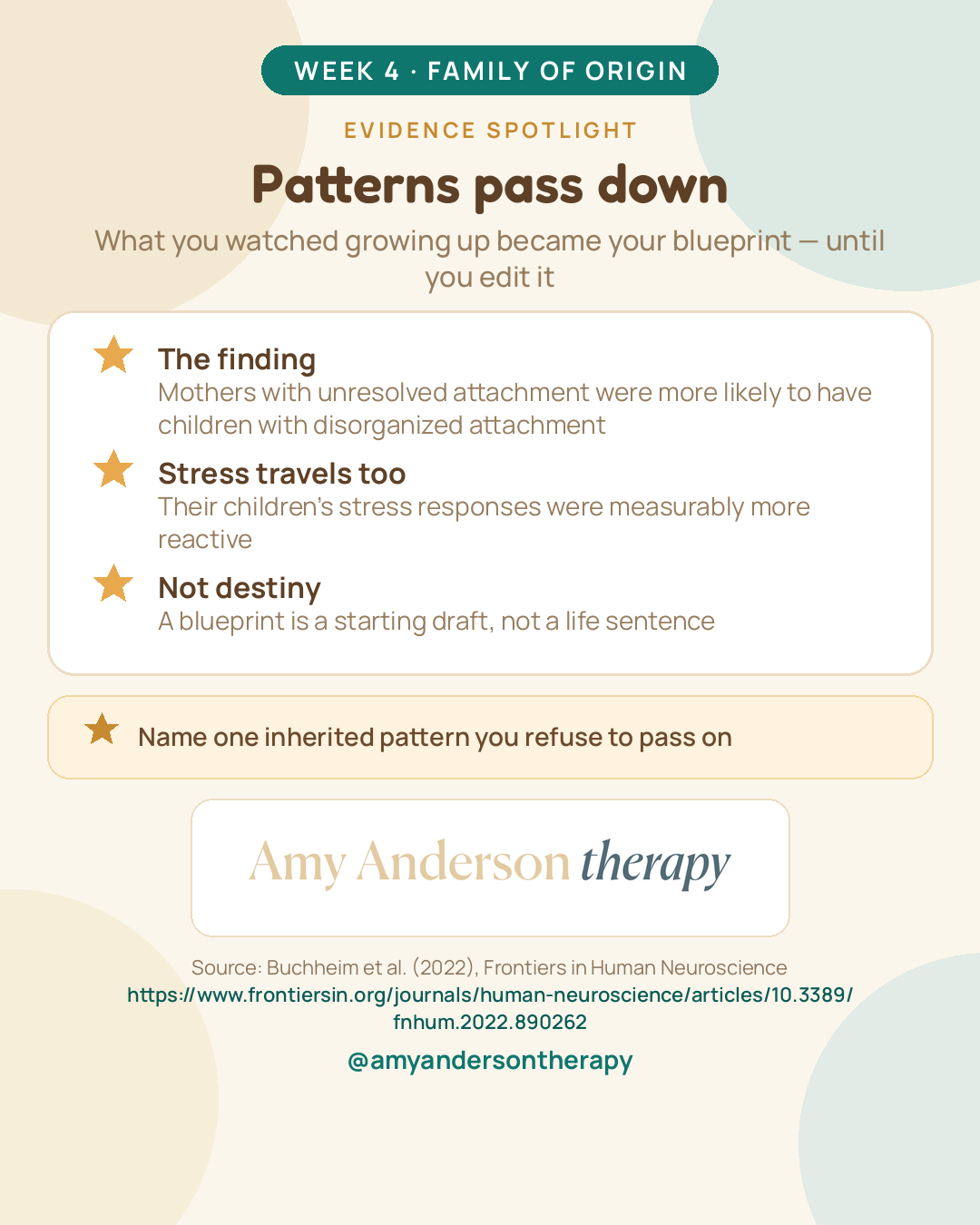
The research backs the transmission — and the hope. In 158 mother–infant pairs, mothers with unresolved attachment were more likely to have children with disorganized attachment and stress-sensitive responses (Buchheim et al., 2022). Patterns pass down. But the same study found that social support buffered the negative effects of the mothers' own childhood maltreatment. Read that again: support interrupted the transmission. The pattern is not destiny. It's a default setting — and defaults can be changed, especially with support around you.
That's what this course is trying to be, in part:
one of the supports that interrupts the pattern.
Not the only one. But one of them.
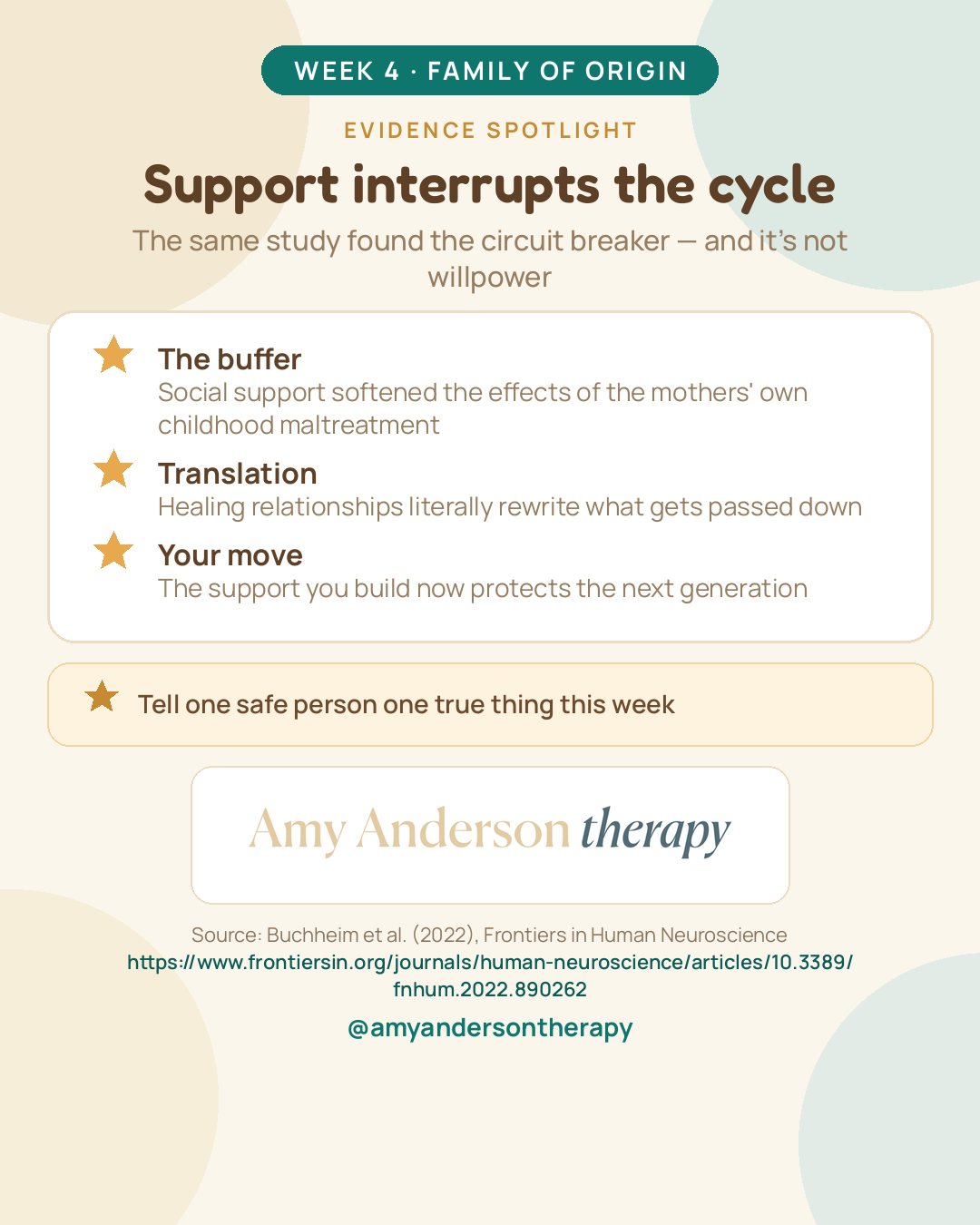
[IMAGE: course-infographics-v2/w04-support-interrupts-v2.png — Infographic titled "Support interrupts the cycle": the same study found the circuit breaker — and it's not willpower. The buffer: social support softened the effects of the mothers' own childhood maltreatment. Translation: healing relationships literally rewrite what gets passed down. Your move: the support you build now protects the next generation. Prompt: tell one safe person one true thing this week.]
Reflect
Your 20-minute weekly check-in ritual — the only "homework" in this course: 5 minutes on a states check (Green/Yellow/Red — separately, then compare if you're a couple) · 10 minutes on this week's exercise · 5 minutes on the reflection prompt below. Same day, same time, every week. The ritual is the practice.
Journal on this — a few honest lines, not an essay:
"The thing I swore I'd never repeat from my family is ___.
“The way it still shows up is ___.”
What I'd do differently starts with ___."
Then answer one more:
What age shows up most in your conflicts — and what did that age need that they didn't get?
This week's permission ritual — grieving the family you wished for.
Light a candle
make some tea
sit somewhere quiet — anywhere that is a some small deliberate container.
Then finish this sentence, out loud or on paper:
"I wish my family had been ___."
Let whatever comes be true without editing it. You can grieve a family that loved you imperfectly and still grieve what was missing — grief isn't disloyalty.
Blow out the candle (or finish the tea) when you're done.
That's the ritual: a beginning, a middle, an end.
Grief with edges doesn't swallow the week.
Evidence Spotlight
In 158 mother–infant pairs, mothers with unresolved attachment were more likely to have children with disorganized attachment and stress-sensitive responses — but social support buffered the negative effects of the mothers' own childhood maltreatment (Buchheim et al., 2022). Plain language: patterns pass down, but support interrupts them.
Full references live in your course research companion. This isn't here to impress you — it's here so you know this isn't just my opinion.
Go Deeper
From Amy's blog — the free posts this week builds on:
How Your Inner Child Shows Up in Arguments With Your Partner
Father Wounds, Father's Day & the Relationships We Build: A Healing Guide for Couples
Out of the Shadows: Reclaiming Your Power After Childhood Trauma
The blogs trace the inheritance.
This week, you mapped yours.
Next week: the pattern that runs the fights — pursue and withdraw, and how to step out of the dance pattern.
Try this
One thing today: circle one echo on your map. Just one. The rest of the map can wait for a Green day.
Exercise 1
Together & Solo: The Family Echo Map
Purpose: make the inherited choreography visible so you can choose what to keep transmitting. Time: 30 minutes to draw, 20 to share.
Together: Each partner draws their own Family Echo Map separately first (family system with conflict roles → current relationship with conflict roles → circle the echoes). Then share. Rules for sharing: the person who grew up in that family is the expert on it. The other partner asks questions with curiosity only — no "well my family was worse," no diagnosing your partner's parents. End by each naming one echo you want to stop transmitting — and one small, concrete thing you'll do differently this week.
If either partner floods during this exercise: stop. That's the slow-down marker doing its job. Use the Pause-and-Return Protocol from Week 1 — name the state, separate for 20–30 minutes, regulate, don't ruminate, return at a set time. Come back to the maps when you're both Green. Unfinished is fine. Flooded is not. Protocol handout refresher.
Then one more round, and don't skip it: each partner names one thing they admire about how the other survived their family. "You learned to read a room at seven — and now you notice when I'm off before I do." The map shows the wounds; admiration keeps the map from becoming an indictment. Gottman research is blunt about this: couples who maintain a culture of appreciation survive the hard conversations. Start building it here, in the hardest chapter.
Solo version: Draw your Family Echo Map for your family growing up → your most significant past relationship (or the pattern across your dating history). Circle the echoes. Then write one paragraph: the echo I'm most determined not to transmit, and the first concrete thing I'll do differently. If this brings up material that feels too big for journaling — grief, rage, memories you can't shake — that's information. Bring it to your therapist or a trusted support person. The course maps the pattern; a professional helps you work through what the map reveals.
Why this works: drawing the system moves it from felt-sense to visible pattern. Inside the dynamic you are the role; on paper you can see the role — and you can't choose about something you can't see.
How you'll know it worked: you've circled at least one echo and named one concrete thing you'll do differently this week. One echo, one change — that's a complete outcome.
Exercise 2
Together: The Age Check Practice / Solo: Letter to the Younger Part
Purpose: build muscle memory for catching inner-child moments before they run the fight. Time: 15 minutes together.
Together: Agree on your gentle mid-conflict phrase —
"How old do you feel right now?" — and the rule: the answer gets curiosity, never mockery. Then practice while calm. Take turns: one person recalls a recent moment they felt disproportionately activated, names the age they felt ("I felt about ten"), and the other practices the response: "Okay. What does ten need right now?" Just practice the shape of it. You're building muscle memory for the moment you'll actually need it.
Solo version: Journal a letter from your adult self to the age that shows up most in your conflicts. Not a long one — a real one. Tell them what you know now that they didn't know then. Tell them what you're doing differently. End with one sentence about what you'll do the next time that age shows up mid-conflict. If the letter opens grief you can't close on your own, pause and reach out — your therapist, a support person, 988. Some doors are better opened with someone beside you.
Why this works: naming the age separates the adult from the alarm. The child's alarm can't reason — but your adult brain can respond to it instead of obeying it.
How you'll know it worked: you've asked "how old do I feel right now?" once in real time this week — and answered honestly. The question working is the practice working.
Your homework this week
Read the slow-down markers before you start anything. Check your state. If you're Yellow or Red, the exercises wait for a Green day. There is no behind in this course.
Do the compassionate witness minute (60 seconds), then draw your Family Echo Map (30 minutes). Family system with conflict roles → current relationship with conflict roles → circle the echoes. One echo is a complete outcome.
Name one echo you want to stop transmitting — and one concrete thing you'll do differently this week. Couples: share maps with curiosity only, then name one thing you admire about how the other survived their family.
Download the journal prompts — The Family Echo — and write a few honest lines on each across the week.
Practice the age check once in real time. When you're flooded, ask yourself "how old do I feel right now?" — and answer honestly. Couples: rehearse the mid-conflict phrase ("How old do you feel right now?") while calm, 15 minutes.
Run one opposite-action experiment. Pick one echo from your map and do the opposite of the role for one week — when Green. One week, one experiment, small things, often.
Hold your 20-minute weekly check-in ritual (states check, this week's exercise, reflection prompt), plus this week's permission ritual: finish the sentence "I wish my family had been ___."
Companion workbook: complete the Week 4 worksheets — your Family Echo Map, your stuck points, your values sentence, your opposite-action experiment.
Week 4 of 16 · Too Busy or Too Broke for Trauma Therapy · © Amy Anderson, LCSW
This material is psychoeducational and is not a substitute for therapy, diagnosis, or treatment.