

Money:
The Fight That’s
Never About
Money
Week 6
Welcome to Week 6
Money is the most common recurring fight in relationships. And it almost never gets resolved. Not because couples are bad at math — but because the fight is never about money.
Money is an emotion delivery system. The spreadsheet is packaging. Underneath: safety, trust, control, shame, worthiness, and whatever money meant in the house you grew up in. Two people sit down to talk about a budget and end up reliving their childhoods. No wonder it goes sideways.
This week: separate the topic from the terror.
“What this is: Psychoeducation — evidence-informed information, frameworks, and practice exercises to help you understand your relationship patterns and build skills. It is not psychotherapy, couples therapy, or a clinical relationship. Nothing here diagnoses or treats a mental health condition. If you need clinical support — especially around trauma, addiction, or safety — work with a licensed professional in your state.
If you’re in crisis: call or text 988 (US Suicide & Crisis Lifeline) · National Domestic Violence Hotline: 1-800-799-7233 or text START to 88788.
Who this week is not for (yet): If there is ongoing physical violence, coercion, or fear in your relationship — or an undisclosed affair or active addiction without outside support — pause here and reach out for individual support first. Stabilization comes before coursework. That’s not failure. That’s sequencing.
A note on financial coercion: If a partner controls all the money, monitors your spending, blocks your access to accounts, or uses money to trap or threaten you, that’s financial abuse — not a communication problem. Exercises about money should never be done in a coercive dynamic. Trust that distinction.”
The lesson
Money means something. Figure out what.
Ask ten people what money represents. Ten answers. For one partner, money is safety — the emergency fund is emotional armor, and spending feels like leaving the door unlocked at night. For the other, money is freedom — cash is the ability to breathe, say yes, live a little, and budgeting feels like a cage.
Neither is wrong. Put them in a marriage and watch: the safety partner sees the freedom partner’s spending as recklessness. The freedom partner sees the safety partner’s saving as control. They’re not arguing about the vacation. They’re arguing about whether the world is a dangerous place.
The usual cast of meanings: safety (I need a cushion to feel okay), freedom (I need to spend to feel alive), love (money is how I show care — gifts, providing, treating), control (whoever holds the money holds the power), status (money proves I made it / I’m not falling behind), shame (money is proof of every bad decision I’ve ever made).
Here’s the kicker: most people have never named theirs. They just assume their way of relating to money is the way — rational, obvious — and their partner’s way is irrational. You’re not two adults discussing finances. You’re two nervous systems defending their survival strategies.
The family money script
Everybody walked into their relationship carrying a money script — the unwritten rules absorbed from family growing up. A few classics:
“We don’t talk about money.” → You avoid money conversations entirely, then panic when a bill arrives.
“Money is always running out.” → You catastrophize every expense, no matter the income. Scarcity is a feeling, not a number.
“Spending is love.” → Gifts, vacations, saying yes to the kids — affection expressed through the credit card.
“Rich people are corrupt / poor people are lazy.” → Morality got tangled up with money, and now every financial decision feels like a character test.
“You have to earn rest / you can’t trust anyone with money.” → Hyper-independence dressed as virtue.
Your script isn’t your fault — you downloaded it before you could read. But it is your responsibility now, because you’re running it in your relationship whether you know it or not. Two people, two scripts, one bank account: that’s the setup for the fight.
How ADHD, anxiety, addiction history, and burnout warp the money conversation
Money fights get an extra layer in trauma-affected couples, because the conditions that shape trauma also shape money behavior:
ADHD. Impulsivity meets dopamine meets one-click checkout. The ADHD partner isn’t “irresponsible” — their brain discounts future consequences and chases present reward. Late fees, forgotten bills, surprise purchases: executive-function failures, not character failures. Meanwhile the non-ADHD partner becomes the money police. Which poisons everything. (Week 8 goes deep here.)
Anxiety. Money anxiety makes every number feel bigger than it is. The anxious partner checks the account three times a day, needs certainty the future can’t provide, treats saving as the only acceptable emotion-regulation strategy. Their partner feels controlled — and the anxious partner feels crazy for caring.
Addiction history — including financial rupture. If addiction (substance, gambling, shopping) has damaged the finances, money talks carry the whole weight of the betrayal. The injured partner audits. The recovering partner feels surveilled forever. Scripts at the end of this section address this specifically — because rebuilding financial trust is its own repair process, not just “better budgeting.”
Burnout. Burned-out people can’t do executive function tasks — budgeting, planning, even opening mail — because the tank is empty. Money avoidance isn’t laziness; it’s a depleted system. And avoidance compounds: the longer you don’t look, the scarier it gets, the longer you don’t look.
Notice the pattern: in every case, the behavior that looks like the problem is a symptom. The spending, the checking, the avoiding — all regulation strategies. Yours, your partner’s. The fight can’t resolve until you stop fighting the symptom and start talking about the fear underneath it.
Tone-first, not truth-first
Here’s the framework that makes money conversations survivable: tone first, truth second.
Most couples try to lead with the truth — the numbers, the facts, the “right” answer. But when money means safety and the conversation sounds like danger, nobody can hear the truth. The nervous system votes first. So before any money content, establish the tone:
We’re on the same team. Say it out loud: “This is us vs. the problem, not me vs. you.” Corny. Effective.
Regulated bodies only. Green-state rule from Week 1 applies double here. Either person in yellow or red? Pause. Money talks started in survival mode end in survival mode.
Curiosity before conclusions. “Help me understand what this expense meant to you” lands differently than “Why did you spend that?” One is a question. The other is an interrogation wearing a question costume.
Name the meaning, not just the money. “I think this isn’t about the $200 — I think it’s about feeling like we’re not on the same team.” Say the quiet part out loud.
One more Gottman tool that earns its keep here: the stress-reducing conversation. If either of you walks into the money talk carrying a bad day, take five minutes first — vent, be heard, no fixing allowed. The rule: take your partner’s side, not the problem’s side. Outside stress that goes unspoken hijacks money talks; spoken, it stays where it belongs.
Tone first means: get the container safe before you touch the content. A budget discussed in a warm tone gets implemented. A budget discussed in a contemptuous tone gets weaponized.
The dream inside the money position
Some money fights aren’t solvable. Gottman researchers call them gridlock: perpetual problems rooted in the dreams underneath each person’s position. The saver isn’t just “cheap” — inside the saving position might live a dream of never being powerless again. The spender isn’t just “reckless” — inside the spending might live a dream of finally getting to be alive after years of deprivation. This week’s advanced move: ask your partner what dream lives inside their money position. “When you fight for the emergency fund, what are you actually protecting?” Then do the listener’s job — make it safe to answer, listen like a friend, suspend judgment, don’t solve. You’re not trying to win the budget. You’re trying to understand the dream. Gridlock doesn’t resolve through better arguments. It softens through dialogue — two people who finally understand why the other can’t let go.
Capacity-based roles, not fairness ideology
Most couples divide money labor by an unspoken fairness ideology: we should both do equal parts, or it’s not fair. Then one partner — usually the one with more executive function bandwidth, often the over-functioner — ends up doing all of it anyway, resenting the other for not carrying their “fair” share.
Try this instead: capacity-based roles. Who owns what based on actual executive function, not ideology.
Who pays the bills? The person who will actually remember — even if that’s “unfair.”
Who tracks spending? The person whose brain doesn’t shut down at a spreadsheet.
Who has final say on big purchases? Maybe both, with a threshold. Maybe one. Decide by what works, not what should work.
This is not about letting anyone off the hook. It’s about designing a system both people can actually follow — because a system built on shoulds collapses by February, and then you’re fighting about money and about the failed system.
One rule: capacity-based doesn’t mean one person carries everything. If one partner ends up owning all of it, that’s not a system — that’s the over-functioning pattern from Week 7 wearing a budget costume. Redistribution is part of the design. Accommodations (autopay, shared dashboards, bill-pay services) are how you redistribute without resentment.
The decisional balance: a motivational interviewing tool for money changes
Motivational Interviewing — a counseling approach I’m trained in — has a tool built exactly for the ambivalence most people feel about money changes: the decisional balance. Instead of arguing with yourself about whether to change a money pattern, lay out all four squares honestly: Keep things as they are vs Make the change, each with Pros and Cons. Fill it in for one money pattern this week — with your partner or solo. No judgment on the answers; ambivalence is information, not failure. Then the MI scaling question: “On a scale of 1–10, how important is this change to me? Why did I pick that number — and not one lower?” (That second question is the magic — it makes you argue for change, in your own words.) If the number is low, that’s data too: maybe this isn’t the pattern to start with.
The money thought-record (borrowed from CBT)
Money catastrophizing — “we’re going to end up broke, this was a disaster, we’ll never get ahead” — is a distortion, not a forecast. Run it through four lines when it hits:
Situation: what happened, facts only (“we spent $400 more than planned this
month”).
Story: what the alarm said (“we’re irresponsible, we’ll never be secure”).
Distortion: name it — catastrophizing, all-or-nothing, fortune-telling.
Fact-check: what the evidence actually supports (“we overspent one month; the emergency fund is intact; this is fixable”).
Do it on paper, not in your head — the alarm is louder in your head. Couples: trade thought-records. You’ll be shocked how different the same month looks from inside two different money scripts. Why it works: catastrophizing survives on vagueness — force it into four labeled boxes and your prefrontal cortex gets a vote. You’re not positive-thinking the fear away; you’re giving your brain a second, slower track to run on.
And the DBT-informed companion — radical acceptance for the money fight. Some things can’t change tonight: the debt that exists, the purchase already made, the childhood that installed the script. Fighting reality at 10pm doesn’t change it — it just adds a second problem (the fight) to the first (the money). “I don’t have to like this number to accept that it’s the number — and we deal with it green, tomorrow.”
The serious end of the spectrum: when control shows up as money
Most money fights are about meaning — safety versus freedom, two scripts colliding. But there’s a serious end to this spectrum, and I don’t want you to miss it.
As I wrote in my DVAM blog post this fall — from my blog, “Financial Abuse Is Domestic Violence”: “disagreement is two people with a problem; control is one person becoming the other’s problem.” If one partner makes every financial decision unilaterally, restricts the other’s access to money or information, punishes spending with rage or cold withdrawal, or uses money to threaten the relationship itself — that’s not a communication issue. That’s control. And control doesn’t get fixed with a better budgeting app.
The post holds a care frame I keep close: with survivors, always. Not just when the story is clean or the timeline is fast. In the middle of the leaving and the staying, the going back, the slow work of untangling a life from someone who controls it — with survivors, always. If you’re reading this and recognizing your relationship: you don’t have to decide what to call it today. You don’t need to be “sure it’s bad enough” to reach out. Small things, often — one document copied, one phone number saved — is how financial clarity gets built, one receipt at a time.
And this matters for how you use this week: the exercises here are for couples in disagreement. If control is in the mix, pause the coursework and call the National Domestic Violence Hotline — 1-800-799-7233 or text START to 88788 (free, confidential, 24/7).
Read the full post: Financial Abuse Is Domestic Violence: What “With Survivors, Always” Means — https://amyandersontherapy.com/blogamys-anecdotes-advice/financial-abuse-is-domestic-violence-what-with-survivors-always-means
A note on money talks after secrecy or addiction-related rupture
If money has been hidden — secret accounts, gambling losses, addiction spending — the conversation isn’t “how do we budget better.” It’s repair. And repair has a sequence:
Full disclosure first. All of it. Drip disclosure — trickling out new numbers every month — destroys trust faster than the original secret did.
The injured partner gets to feel what they feel. Anger, grief, hypervigilance around money — these are normal responses to financial betrayal, not “being controlling.”
Transparency systems, not surveillance. Shared account access, agreed check-ins — designed together, not imposed. The difference between transparency and surveillance is consent.
Professional support. Financial rupture layered on addiction or betrayal is bigger than a worksheet. If this is your situation, individual or couples support from a licensed professional (and recovery support where relevant) isn’t optional equipment.
An honest note about the evidence here: the research below describes how money dynamics affect couples — shared goals, perceived value alignment. No recent peer-reviewed study directly tested whether financial therapy improves couple outcomes. So I’m not going to tell you these frameworks are “proven.” They’re clinically grounded and consistent with the evidence we do have — and I’ll keep the distinction clear.
Why it matters for trauma
Money and trauma are tangled at the root. Scarcity — real or inherited — keeps the nervous system braced. If you grew up with financial instability, your body learned that money trouble equals danger, and it never unlearned it. Your adult salary doesn’t register, because the alarm was installed in childhood.
Shame is the other tangle. Debt, job loss, addiction spending, “bad” financial decisions — these carry moral weight they don’t deserve, and shame makes people hide. Hidden money becomes secret money. Secret money becomes a trust rupture. The same shame-avoidance loop you met in Week 3 lives in the finances too.
And here’s the trauma-specific piece: financial unpredictability re-traumatizes. For a nervous system that learned safety means predictability, an inconsistent partner with money — surprise purchases, forgotten bills, shifting numbers — isn’t just annoying. It reads as unsafe. The fight isn’t about the $200. It’s about whether the ground is solid.
Try this
Exercise 1 — The Money Meaning Inventory
Purpose: name what money means before you argue about what it does. Time: 20 minutes.
Together: Separately — on your own, no peeking — finish these sentences: “In my family, money meant ___. The scariest money memory I have is ___.”
Then share. Listen like an anthropologist: this is your partner’s origin story, not a debate position. When you’re both done, write one shared money value statement — not a budget, a value. Something like: “In our family, money is a tool for safety and aliveness. We plan for the future and we enjoy the present.” Post it where you’ll see it.
If the money conversation starts heating up, use the Pause-and-Return Protocol from Week 1 (name the state, separate 20–30 minutes to regulate — not ruminate — return at a set time, check states before resuming). Money talks only work in green.
Solo version: Run the inventory on yourself — write the full money story. Then write the version you’d want a future partner to understand: “Here’s what money means to me, and here’s why.” Knowing your script is half the battle; being able to hand it to someone is the other half.
Why this works: naming what money means breaks the assumption that your way is the way — and a shared value statement gives the next money talk a team frame instead of two scripts colliding.
How you’ll know it worked: you have one shared money value statement written down — and you used the sentence “this isn’t about the money” accurately once this week.
Exercise 2 — The 20-Minute Money Meeting
Purpose: prove to both nervous systems that a money conversation can end on time and without a blowup. Time: 20 minutes.
Together: Set a timer for 20 minutes. Before you open anything: 60 seconds, feet on the floor, three slow breaths — each person names their state (green, yellow, red). If anyone’s yellow or red, you don’t start; you pause. Tone first means regulated first. The agenda is exactly three items:
One decision. Just one. What’s the single money decision that would reduce the most stress this week?
One appreciation. Each person names one money-related thing the other did well. (“You caught that subscription charge.” “You didn’t freak out when I told you about the car repair.”)
One check-in date. When’s the next one? Put it on the calendar.
End on time — even if it’s unresolved. Especially if it’s unresolved. The container is the repair: a money conversation that ends on time, without a blowup, teaches both nervous systems that money talks are survivable. Do this weekly for a month and watch what changes.
Solo version: Schedule a 20-minute money date with yourself, same agenda: one decision, one appreciation (yes, appreciate yourself — “I opened the credit card statement, that counts”), one next date. Same rule: end on time.
Why this works: the container is the repair — ending on time teaches both nervous systems that money talks are survivable, even when nothing gets resolved. Each contained meeting is a deposit in the emotional bank account.
How you’ll know it worked: you ended on time without a blowup — even if nothing got resolved. A contained money conversation is the win. Every on-time, blowup-free meeting is a deposit in what Gottman calls the emotional bank account — savings you’ll draw on the next time money gets hard.
Exercise 3 — Capacity-Based Roles Draft (bonus)
Purpose: design a money system your actual brains can follow. Time: 25 minutes.
Together: List every money task your household has — bills, tracking, taxes, investing, kid expenses, subscriptions. Next to each, write who actually has the executive-function capacity for it right now — honestly, not ideologically. If one person ends up with everything, that’s data: design accommodations (autopay, a shared dashboard, a bill-pay service) to redistribute. Revisit quarterly.
Solo version: List your money tasks and rate your own capacity for each, 1–5. For anything under a 3, design one accommodation — autopay, an app, a calendar reminder, asking for help. Capacity isn’t character.
Why this works: a system built on actual capacity gets followed; a system built on ideology collapses — and accommodations (autopay, shared dashboards) are how you redistribute without resentment.
How you’ll know it worked: every money task has a name next to it based on real capacity, not fairness ideology — and at least one accommodation is in place to redistribute the load.
Reflect
Your 20-minute weekly check-in ritual — the only “homework” in this course: 5 minutes on a states check (green/yellow/red — separately, then compare if you’re a couple) · 10 minutes on this week’s exercise · 5 minutes on the reflection prompt below. Same day, same time, every week. The ritual is the practice.
Journal on this — a few honest lines, not an essay:
“When we fight about money, I’m actually afraid that ___. What would help me feel safer isn’t a better budget — it’s ___.”
Then: Whose voice is in your money script — and are they still running your finances?
And two more. First, grief: What did money cost you growing up — not in dollars, in safety? The fights you overheard. The shame you absorbed. The things you learned not to ask for. Grieve that. Your money script was written by a kid who was scared — and the kid deserves to be grieved, not just outgrown.
Second, values (ACT-inspired): look at your shared money value statement from Exercise 1 and ask — what’s one money move this week that would actually match those values? Not the whole budget overhaul. One move: the $50 into savings, the honest conversation, the “no” you say to the thing that isn’t you. Values don’t live in statements. They live in the next small action.
Evidence spotlight
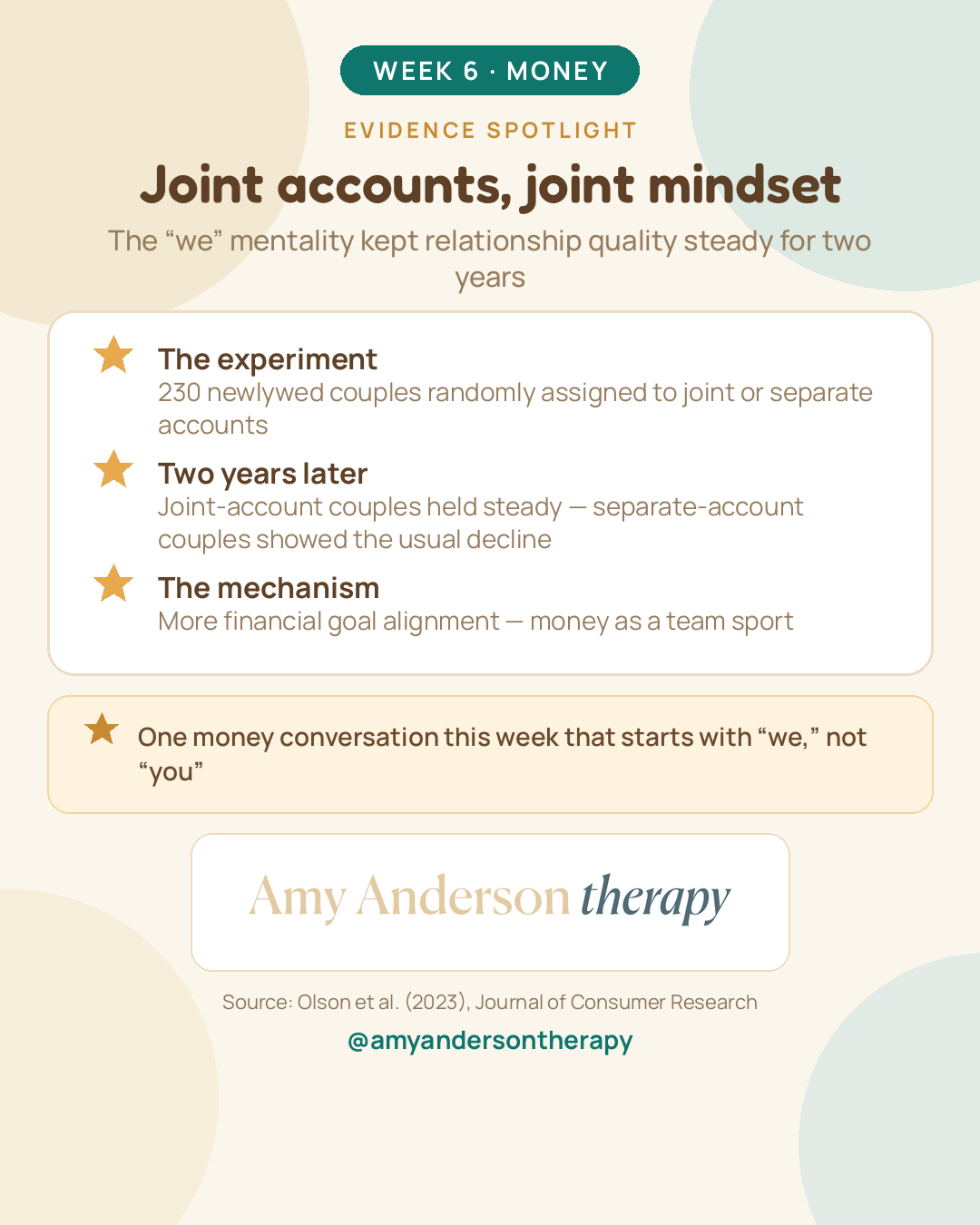
In a randomized experiment with 230 newlywed couples, joint bank accounts kept relationship quality steady over two years while separate accounts showed the usual decline — driven by more shared financial goals and a “we” mentality (Olson et al., 2023, Journal of Consumer Research).
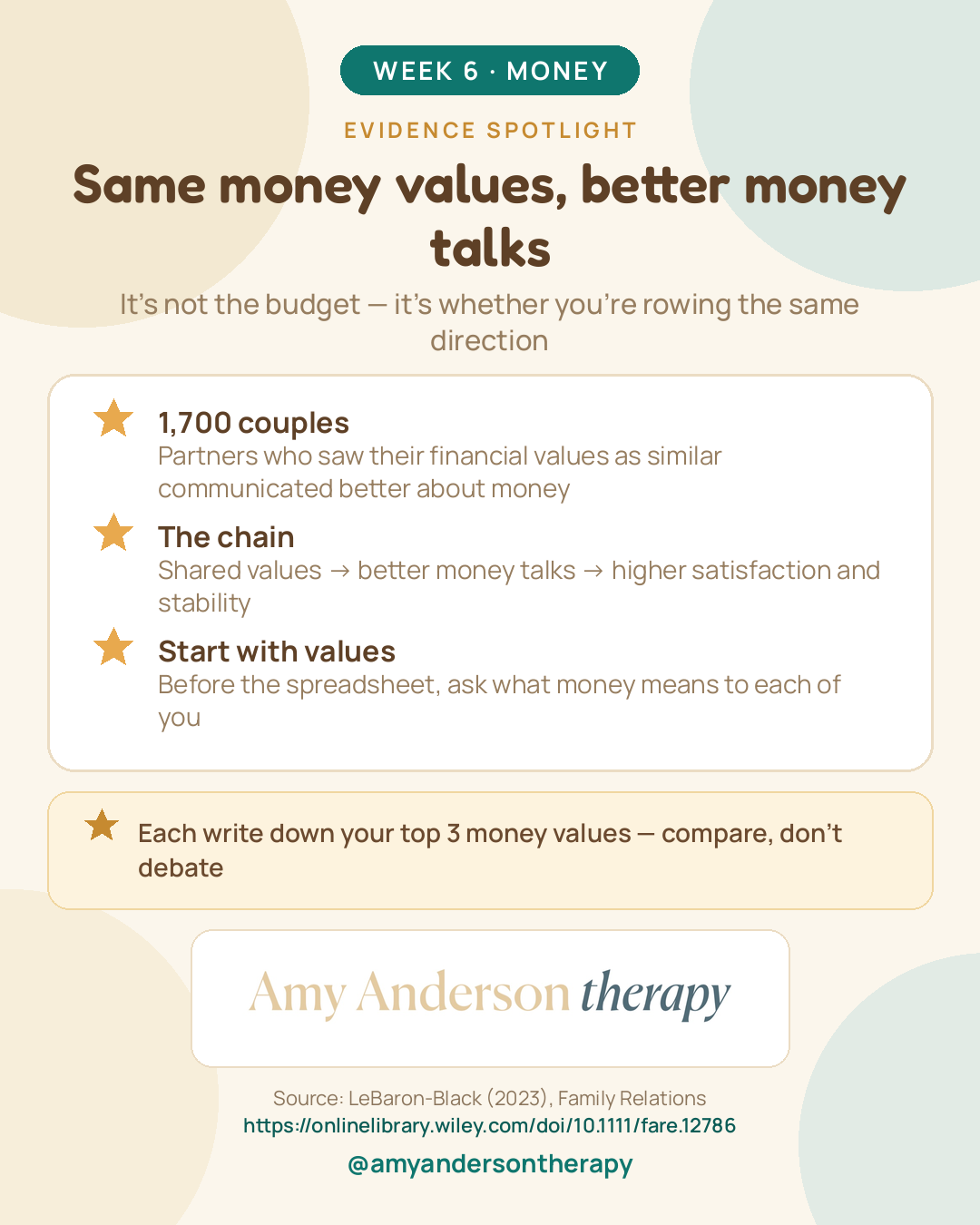
In 1,700 newlywed couples, partners who saw their financial values as similar communicated better about money — and that communication linked to higher satisfaction and stability (LeBaron-Black, 2023, Family Relations).
Full references live in your course research companion. These aren’t here to impress you — they’re here so you know this isn’t just my opinion. Alignment beats accounting.
Go Deeper
From Amy’s blog — the free posts this week builds on:
Why We Fight Over Money—and Why It Never Gets Resolved — https://amyandersontherapy.com/blogamys-anecdotes-advice/b1gu2baz4rhcwxpia9scm6f5a5qqsk
4 Ways Money Management and Mental Health Impact Each Other — https://amyandersontherapy.com/blogamys-anecdotes-advice/4-ways-money-management-and-mental-health-impact-each-other
The blogs diagnose the money fight. This week, you built the system under it. Next week: the strong one — over-functioning, and what holding everything is costing you.
Your Homework This Week
Read the lesson and listen to the voice note (20 min). Read top to bottom, play the 2-minute voice note, and name your money meaning out loud: “For me, money is ___.”
Run the Money Meaning Inventory (20 min). Solo first (10 min — no peeking), then share (10 min). End with one shared money value statement, written down and posted where you’ll see it.
Hold your first 20-Minute Money Meeting (20 min). Download the 20-Minute Money Meeting handout, pick a day, set the timer: one decision, one appreciation, one check-in date. End on time even if nothing resolves.
Draft your capacity-based roles (25 min, bonus). List every money task; assign by actual capacity, not ideology. If one person holds everything, design one accommodation (autopay, shared dashboard).
Companion workbook: complete the Week 6 worksheets (15 min) — the money meaning inventory and the money thought-record, before your check-in.
Small things, often. One contained money conversation this week teaches both nervous systems that money talks are survivable.
Week 6 of 16 · Too Busy or Too Broke for Trauma Therapy · © Amy Anderson, LCSW. This material is psychoeducational and is not a substitute for therapy, diagnosis, or treatment.