

The Strong One:
Over-Functioning &
the Cost of
Holding Everything
Week 7
Too Busy or Too Broke for Trauma Therapy: A 16-Week Trauma-Informed Course for Couples & Individuals · Amy Anderson, LCSW
Welcome to Week 7
Someone in this relationship is doing too much. Managing. Smoothing. Preventing. Anticipating every need, absorbing every tension, keeping the whole machine running — and calling it love.
If that’s you: I see you. You’re the one who remembers the appointments, regulates the room, soothes the partner, manages the family logistics — then lies awake wondering why nobody notices you’re drowning. You’re “the strong one.” The reliable one. The one who doesn’t need anything.
This week we name what’s actually happening. And what it’s costing.
One honest note up front: you’ll see the word “codependency” in this lesson because it’s the word most people search for — the word that brought many of you here. But here’s what I owe you: “codependency” as a clinical concept has almost no recent peer-reviewed couples research behind it. It’s a pop-psychology label — evocative, widely used, empirically thin. What does have evidence behind it is differentiation of self (holding onto who you are while staying close to someone) and the patterns I’ll describe as over-functioning and compulsive caregiving. That’s the language this week uses, because that’s where the research lives. The experience is real. We’re just naming it more precisely.
“What this is: Psychoeducation — evidence-informed information, frameworks, and practice exercises to help you understand your relationship patterns and build skills. It is not psychotherapy, couples therapy, or a clinical relationship. Nothing here diagnoses or treats a mental health condition. If you need clinical support — especially around trauma, addiction, or safety — work with a licensed professional in your state.
If you’re in crisis: call or text 988 (US Suicide & Crisis Lifeline) · National Domestic Violence Hotline: 1-800-799-7233 or text START to 88788.
Who this week is not for (yet): If there is ongoing physical violence, coercion, or fear in your relationship — or an undisclosed affair or active addiction without outside support — pause here and reach out for individual support first. Stabilization comes before coursework. That’s not failure. That’s sequencing.”
The lesson
Over-functioning: a brilliant survival strategy
Let’s start with respect. Over-functioners don’t get enough of it.
Over-functioning — doing more than your share, managing other people’s emotions, preventing problems before they happen — is not a character flaw. It’s a survival strategy. And it was brilliant. If you grew up in a home where the adults were unpredictable, overwhelmed, or checked out, somebody had to be the steady one. That was you. You learned to read the room before you could read a book. You learned that being needed was safer than needing. You learned that control — of the schedule, the emotions, the outcomes — was how you stayed safe.
That strategy got you here. It made you competent, reliable, the person everyone counts on. High achievers are often professional over-functioners — it’s practically in the job description.
The problem isn’t that it was wrong. The problem: the strategy didn’t retire when the emergency ended. You’re still running wartime operations in peacetime. And now it’s bankrupting you.
Caregiving vs. caretaking: love or management?
Here’s the distinction that changes everything:
Caregiving is love. You do something for your partner because you want to, you have the capacity, and you’d be fine if they did it differently or not at all. It energizes — or at least doesn’t deplete you. No strings.
Caretaking is management. You do it because if you don’t, you’re anxious. You’re preventing their discomfort, managing their emotions, earning your place. It depletes you. And it has strings — invisible ones: I did all this, so you owe me calm / gratitude / not leaving.
Caretaking looks like love. Attentive, generous, tireless. But the engine is different. Caregiving runs on fullness. Caretaking runs on fear — fear that if you stop, everything falls apart, including your worth in the relationship.
The test is simple and brutal: how do you feel when they don’t notice? Caregiving doesn’t need applause. Caretaking is devastated by the lack of it — because the applause was the paycheck. Run this diagnostic silently, mid-week, no journal required. That sting is data, not guilt — your fastest read on whether the engine running you is fullness or fear.
The caretaker’s hidden half
There’s a framework from Inner Bonding work (Margaret Paul) that goes one layer deeper on caretaking — uncomfortable in the useful way. It says caretaking isn’t just generosity gone overboard. It’s covert control: managing, pleasing, over-giving to get the love and approval you don’t believe you’d receive just for being you. The belief underneath is shame-based — some version of I’m not enough as I am, so I have to earn my place.
The same framework names the mirror image: the taker, who controls overtly — blame, criticism, anger, withdrawal — to get taken care of. Same wound, opposite strategy. And the part couples miss: the roles aren’t fixed. You can be the caretaker emotionally and the taker financially. The over-functioner at home, the checked-out one about the budget. The question isn’t “which one am I” — it’s “which role am I playing in this domain, and what am I trying to get without asking for it directly?” Don’t use these as labels for each other — use them as flashlights for yourself.
The resentment math
Over-functioning creates a ledger. Nobody means to start one. It starts anyway:
I handle the bills, the kids’ schedules, your mother’s feelings, the vacation planning, the emotional labor of every hard conversation — and you… what? Exist?
Resentment is the interest on unpaid labor. And here’s the cruel part: the over-functioner usually never asked. They just did — because doing felt safer than asking, because asking felt like burdening, because needing felt dangerous. Then they resent the partner for not volunteering — while the partner had no idea there was a ledger at all.
Meanwhile, the under-functioning partner isn’t necessarily lazy or checked out. Often they’ve been trained out of functioning: every time they tried, the over-functioner redid it, corrected it, or sighed audibly. Why bother doing the thing when doing it wrong gets you managed — and doing nothing gets you also managed, but with less effort? Under-functioning is frequently a learned position in the dance, not a character trait.
That’s the loop: one over-functions, the other under-functions, the over-functioner resents, the under-functioner withdraws, the over-functioner takes on more to compensate. Around and around. Sound familiar? It’s the pursue–withdraw dance from Week 5 wearing an apron.
What it’s costing you
Let’s be honest about the bill, because over-functioners are excellent at ignoring it:
Your body. The tension. The exhaustion that sleep doesn’t fix. The jaw, the stomach — Week 1’s nervous-system signs, all of them. You can’t run a second full-time job (managing everyone’s inner life) on top of your actual life without a physiological cost.
Your resentment. Which leaks. In the sighs, the sharp tone, the martyr moments. Your partner feels it even when you don’t say it — and it poisons the very connection you’re working so hard to protect.
Your identity. When was the last time you wanted something just because you wanted it? Over-functioners lose the thread of their own desires. Everything gets filtered through everyone else first.
Your partner’s growth. Hard to hear: your over-functioning is preventing your partner from developing. You can’t rescue someone into competence. Every problem you prevent is a rep they don’t get.
The relationship itself. A relationship where one person does everything isn’t intimate — it’s a management structure. Intimacy requires two whole people. Over-functioning keeps you half a person: the competent half, with the needy half locked in the basement.
Differentiation: the actual goal
Remember the evidence note from the intro: the researched concept here is differentiation of self — the capacity to hold onto your own sense of self while staying close to someone. To have your own feelings, needs, opinions without either fusing with your partner or cutting them off.
Differentiation is the opposite of over-functioning. The over-functioner fuses: your discomfort is my emergency, your problem is my job, your mood is my weather. Differentiation says: I love you, I’m close to you, and I am still a separate person with my own needs.
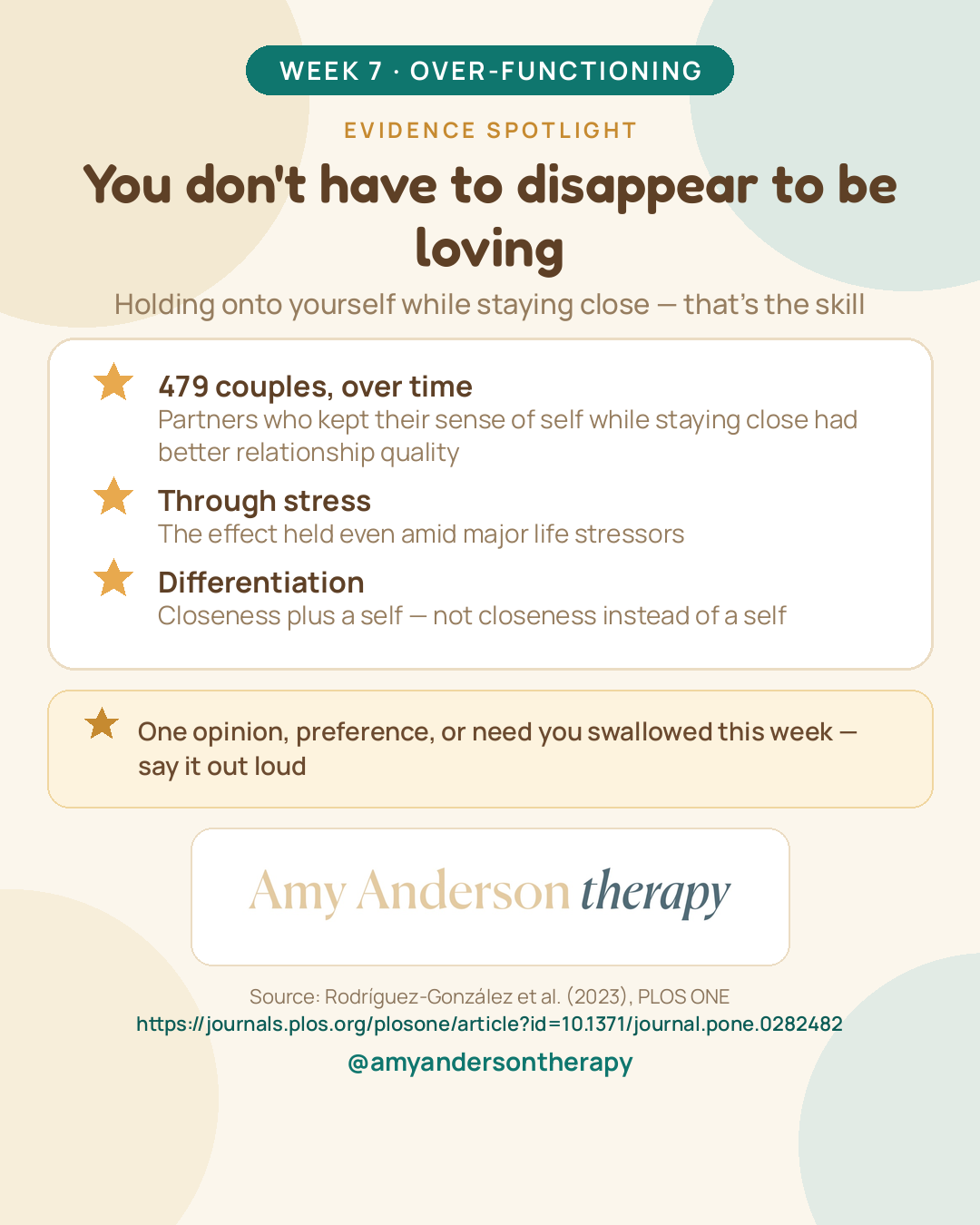
And here’s what the research found: in 479 couples followed over time, partners with higher differentiation had better relationship quality and stability — even through stressful life events. You don’t have to disappear to be loving. In fact, disappearing is what breaks it.
What recovery actually looks like, in plain terms: not becoming selfish — becoming honest. Doing things from fullness instead of fear. Letting your partner have their feelings without making them your emergency. Asking for what you need before resentment writes the invoice. That’s the whole week in one paragraph.
The step-down protocol: how to stop without everything collapsing
The over-functioner’s deepest fear: if I stop doing everything, the whole thing falls apart — and then I’ll know I was only loved for what I do.
So we don’t stop everything. We step down — one piece at a time, with a protocol:
Name what you’re carrying. The Invisible Load Audit (Exercise 1) makes the invisible visible — to you and your partner. You can’t step down from what you haven’t named. If you’re ambivalent about releasing something, run a quick decisional balance (borrowed from Motivational Interviewing): what do I get from carrying this — and what does it cost me? Ambivalence is normal; the over-functioning once kept you safe. Naming both sides honestly is what lets you choose instead of just white-knuckling.
Pick ONE thing to release. Not the most important thing. Not everything. One thing. The thing whose release would give you the most relief with the least actual consequence.
Hand it over cleanly — no booby traps. “I’d like you to own the kids’ dentist appointments” — and then don’t remind, check, redo, or sigh when it’s done differently. A handoff with surveillance isn’t a handoff.
Tolerate the discomfort. This is the hard part. Your nervous system will scream that something terrible is happening. Nothing terrible is happening. You’re just not managing. Sit with it. Breathe through it. It passes.
Let the wobble happen. Things will be done worse, later, or differently than you’d do them. That’s not failure — that’s your partner learning, and you learning that imperfect doesn’t mean catastrophic.
And for the under-functioning partner — the step-up protocol, without shame:
Receive the handoff as trust, not criticism. Your partner handing you something isn’t an attack. It’s them saying I believe you can do this — maybe for the first time in a while.
Do it your way. Not their way. Your way. “Done differently” is still done.
Expect awkwardness. You’ve been out of practice. Awkward is fine. Avoided is not.
Name the pattern if it helps. “I think I stopped trying because you always redid it. I’m going to try again.” That sentence alone can reset years of dynamic.
The skill underneath the step-down: opposite action + willingness
The step-down protocol runs on three borrowed skills — DBT and ACT, translated for the strong one:
Opposite action (DBT-informed). The urge says: do it, fix it, smooth it, remind them. Opposite action says: do the reverse of the urge, all the way — don’t remind, don’t check, don’t redo. Not halfway. The urge is the old survival strategy talking; obeying it halfway just teaches your nervous system the strategy still runs you.
Defusion for the catastrophic thought (ACT-inspired). When you step down, your brain will serve the thought: if I don’t do it, everything falls apart. Don’t argue with it. Prefix it: “I’m having the thought that if I don’t do it, everything falls apart.” It’s a thought, not a weather report. Loud doesn’t mean true.
Willingness (ACT). The discomfort of not managing — the itch, the dread, the guilt — is the price of admission, not a signal to stop. Willingness is deciding to have the feeling without obeying it: “I feel awful not reminding them, and I’m not reminding them.” Both true. That’s the rep that rewires it.
The strong one’s two-minute sit. Before the audit — or before any handoff conversation — sit down, feet on the floor, one hand on your chest. Breathe. Silently: “I don’t have to earn rest. I don’t have to earn love. I can put one thing down.” Two minutes. The over-functioner’s nervous system treats stillness as danger; this is exposure to the unfamiliar sensation of not managing. Eyes open or closed, your choice — if it spikes you, shorten it to 30 seconds. The point isn’t calm. It’s practicing not doing, on purpose. Try it right now, before you read on — the rest of the lesson will land differently in a body that just practiced not managing.
And here’s the reframe that undoes the strong one’s deepest lie: “What is the bravest thing you’ve ever said?” asked the boy. “Help,” said the horse — Charlie Mackesy, saying out loud what the strong one was never allowed to believe. The bravest move was never holding it together. It was asking for help — out loud, to another person — instead of paddling frantically underneath a calm surface. Everybody’s paddling. You’re allowed to say so.
The Boundary Sentence
Boundaries are not threats. They’re not ultimatums. They’re information about what you can sustain — and they’re how a relationship survives the strong one’s exhaustion.
There’s a concept from Relational Life Therapy — an approach I’ve trained in — that belongs here: loving truth-telling. The idea: honesty and kindness aren’t opposites; the most caring thing you can do is tell the truth in service of the relationship, with warmth in your voice and the relationship’s health as your motive. Not truth as a weapon (“I’m just being honest!”). Truth as care: I love you enough to tell you what’s actually happening, and I love us enough to say it kindly. The frame below is built for exactly that — firm and warm in the same sentence.
The frame:
“I love you, and I can’t keep doing ___. What I need instead is ___.”
Three parts, all load-bearing. “I love you” — this is not an attack, we’re on the same team. “I can’t keep doing ___” — specific, behavioral, no mind-reading. “What I need instead is ___” — a request, not just a complaint. Boundaries without the third part are just grievances with better grammar.
Examples:
“I love you, and I can’t keep managing your family’s holiday plans on top of everything else. What I need instead is for you to own that, start to finish.”
“I love you, and I can’t keep being the only one who notices when we’re disconnected. What I need instead is for you to tell me when something feels off, even if it’s clumsy.”
Practice it out loud before you need it. Boundaries set in green land. Boundaries blurted in yellow detonate.
Why it matters for trauma
Over-functioning is a trauma adaptation. The child who managed an unpredictable parent’s emotions grew into the adult who manages a partner’s. The nervous system learned: my safety depends on everyone else being okay. So you scan, you smooth, you prevent — not because you’re controlling, but because your body believes other people’s distress is your danger.
That’s why “just stop over-functioning” doesn’t work as advice. You’re asking someone to drop the strategy that kept them safe — their nervous system hears that as be unsafe now. The step-down has to be gradual, witnessed, and survivable. One piece at a time. Each successful release teaches the nervous system something it never learned in childhood: I stopped managing, and I was still okay. I stopped managing, and I was still loved.
There’s a second trauma thread: over-functioning is how many trauma survivors earn love. If you learned that love is conditional on usefulness — that you’re valued for what you do, not who you are — then stopping feels like risking abandonment. The differentiation research says the opposite: holding your self while staying close is what makes relationships last. You don’t have to disappear to be loved. You have to appear — as yourself, needs included.
Try this
Exercise 1 — The Invisible Load Audit
Purpose: make the invisible labor visible — to you and your partner — so redistribution is based on reality. Time: 35 minutes.
Together: Separately, each partner lists everything they manage — bills, appointments, emotional labor, family logistics, social planning, household systems, remembering, worrying, smoothing. The visible and the invisible. Then compare lists. The rules: no defending, no justifying, no “but I do X.” Just witnessing. Let the disparity land. Then redistribute one thing — by capacity, not by default (see Week 6’s capacity-based thinking). One thing. Clean handoff, no surveillance.
Solo version: Audit your own load — everything you carry across work, home, relationships, family. Circle what you’d stop carrying in a partnership. Then ask: what am I afraid would happen if I put one of these down? That’s the belief running the pattern. Write it out.
Why this works: the audit converts invisible labor into negotiable reality — and the no-defending rule is what makes it safe enough to tell the truth. The no-reminding week is the rep that teaches your nervous system your partner surviving without you is survivable.
How you’ll know it worked: one item got redistributed with a clean handoff — and you didn’t remind, check, or redo it for a full week. That’s the whole exercise.
Exercise 2 — The Boundary Sentence
Purpose: practice loving truth-telling — honest and kind in the same sentence. Time: 15 minutes.
Together: Each partner writes one Boundary Sentence using the frame: “I love you, and I can’t keep doing ___. What I need instead is ___.” Read them to each other — in green, not mid-conflict. The listener’s job: repeat back what they heard, no rebuttal. Then practice: say it out loud three times. It should feel awkward. Awkward means it’s new, not wrong.
If a boundary conversation starts escalating, use the Pause-and-Return Protocol from Week 1: name the state, separate 20–30 minutes to regulate (not ruminate), return at a set time, check states before resuming. Boundaries set in green land; boundaries blurted in yellow detonate.
Solo version: Write your Boundary Sentence for the relationship you’re in or the one you want. Then identify where over-functioning shows up in your dating life — the early over-texting, the over-planning, the auditioning. Write three early-warning signs you’ll watch for next time: “When I start ___, that’s my cue to pause.”
Why this works: the three-part frame makes honesty land as care, not attack — loving truth-telling is how boundaries survive the strong one’s exhaustion.
How you’ll know it worked: you said the sentence out loud three times without rushing, softening, or turning it into a joke. Awkward is fine. Clear is the goal.
Exercise 3 — The Caregiving Check (bonus)
Purpose: track whether your giving runs on fullness or fear — data, not judgment. Time: one week.
Together & Solo: For one week, when you do something for your partner (or someone you’re dating), silently ask: Am I doing this from fullness or from fear? Keep a private tally — no judgment, just data. At week’s end, notice the ratio. You’re not trying to be perfect. You’re trying to see the pattern clearly enough to choose differently.
Why this works: you can’t choose differently until you can see the pattern — a silent week-long tally makes the engine visible without turning it into a trial.
How you’ll know it worked: at week’s end you can name your ratio — and you caught one fullness-or-fear moment in real time.
Reflect
Your 20-minute weekly check-in ritual — the only “homework” in this course: 5 minutes on a states check (green/yellow/red — separately, then compare if you’re a couple) · 10 minutes on this week’s exercise · 5 minutes on the reflection prompt below. Same day, same time, every week. The ritual is the practice.
Journal on this — a few honest lines, not an essay:
“Being ‘the strong one’ protected me from ___. What it’s costing me now is ___. Letting go of one piece would look like ___.”
Then: If you weren’t earning love by being useful — who would you get to be?
And the grief this week is for the years the strong one cost you: What did being “the reliable one” take that you’ll never get back? The rest you didn’t take. The softness you never allowed. The needs you filed under “later” until later never came. Grieve it honestly — not to wallow, but because ungrieved years keep charging interest. The step-down isn’t just a skills exercise. It’s you finally putting down a job you were hired for as a child and never got to quit.
Evidence spotlight
In 479 couples followed over time, partners who could hold onto their own sense of self while staying close — what researchers call differentiation of self — had better relationship quality and stability, even through stressful life events (Rodríguez-González et al., 2023, PLoS ONE).
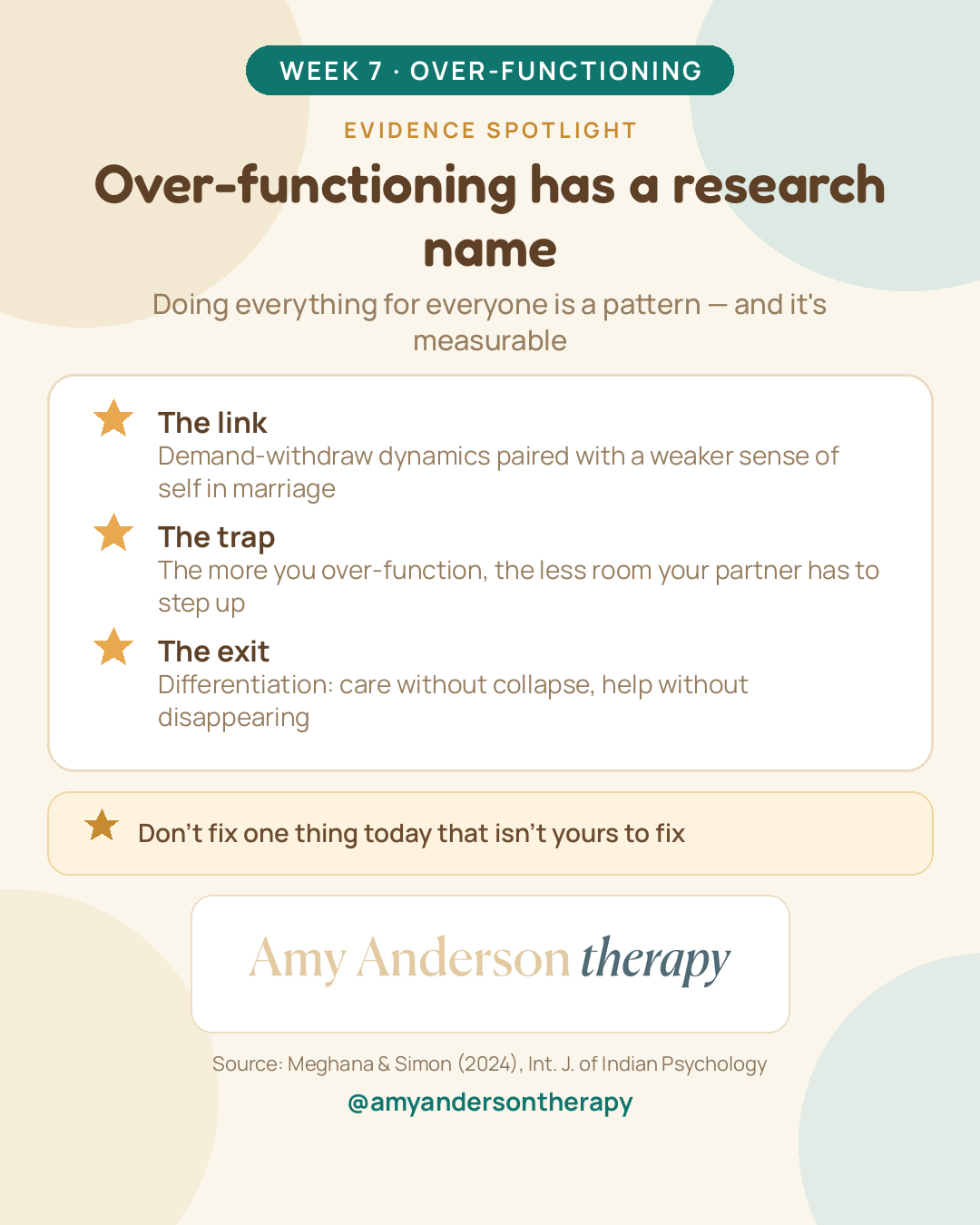
In a related finding, demand–withdraw communication patterns were linked to lower differentiation — pursuing-withdrawing dynamics and anxious/avoidant attachment went together with a weaker sense of self in the marriage (Meghana & Simon, 2024). The dance from Week 5 and the disappearing act from this week are the same problem wearing different clothes.
Full references live in your course research companion. These aren’t here to impress you — they’re here so you know this isn’t just my opinion. An honest footnote: “codependency” itself has almost no recent peer-reviewed couples research as a construct — this week draws on differentiation and compulsive-caregiving evidence instead. You don’t have to disappear to be loving.
Go deeper
From Amy’s blog — the free posts this week builds on:
Codependency in Professional Couples: The Hidden Cost of Being “The Strong One” → https://amyandersontherapy.com/blogamys-anecdotes-advice/codependency-in-professional-couples-the-hidden-cost-of-being-the-strong-one
Codependency → https://amyandersontherapy.com/blogamys-anecdotes-advice/codependency
The Price of a False Peace: How Trauma Fuels People-Pleasing and Burnout → https://amyandersontherapy.com/blogamys-anecdotes-advice/the-price-of-a-false-peace-how-trauma-fuels-people-pleasing-and-burnout
Let’s Ditch the Control Freak Label and Heal Your Trauma, Instead → https://amyandersontherapy.com/blogamys-anecdotes-advice/lets-ditch-the-control-freak-label-and-heal-your-trauma-instead
The blogs name the strong one. This week, you started setting them down — one piece at a time. Next week: different operating systems — ADHD, neurodivergence, and the translator your relationship’s been missing.
Your homework this week
Read the lesson and listen to the voice note (20 min). Read top to bottom, play the 2-minute voice note, and run the diagnostic silently: “Am I doing this from fullness or fear?” — pick one example each.
Run the Invisible Load Audit (35 min, together or solo). Download the Invisible Load Audit handout. List everything (20 min), compare with no defending (15 min), then redistribute exactly one item — clean handoff, no surveillance.
Practice the Boundary Sentence (15 min). Download the Boundary Sentence handout. Write one sentence in the frame, read it aloud three times. Awkward is fine. Clear is the goal.
Step down one piece this week (daily, 30 seconds each). The opposite-action rep: when the urge to remind, check, or redo arrives, don’t. Say it to yourself instead: “I’m having the thought that if I don’t do it, everything falls apart.” Note what happens.
Companion workbook: complete the Week 7 worksheets (15 min) — the audit page and the boundary-sentence practice, before your check-in.
Small things, often. One clean handoff, one un-reminded week — that’s the whole assignment working.
Week 7 of 16 · Too Busy or Too Broke for Trauma Therapy · © Amy Anderson, LCSW. This material is psychoeducational and is not a substitute for therapy, diagnosis, or treatment.