
Week 8 — Different Operating Systems:
ADHD, Neurodivergence & Love
Week 8
Too Busy or Too Broke for Trauma Therapy: A 16-Week Trauma-Informed Course for Couples & Individuals · Amy Anderson, LCSW
“What this is: Psychoeducation — evidence-informed information, frameworks, and practice exercises to help you understand your relationship patterns and build skills. It is not psychotherapy, couples therapy, or a clinical relationship. Nothing here diagnoses or treats a mental health condition, and nothing here diagnoses ADHD, autism, or any neurodevelopmental condition. If you need clinical support — especially around trauma, addiction, or safety — work with a licensed professional in your state.
If you’re in crisis: call or text 988 (US Suicide & Crisis Lifeline) · National Domestic Violence Hotline: 1-800-799-7233 or text START to 88788.
Who this week is not for (yet): If there is ongoing physical violence, coercion, or fear in your relationship — or an undisclosed affair or active addiction without outside support — pause here and reach out for individual support first. Stabilization comes before coursework. That’s not failure. That’s sequencing.”
Welcome to Week 8
“He forgot our anniversary again. He says he loves me. How can both be true?”
“She says I never listen. I’m listening so hard my brain hurts. Why can’t she see that?”
If one or both of you is neurodivergent — ADHD, autistic, or running a trauma-shaped nervous system — you’ve probably had some version of this fight. Hear this first: your relationship isn’t broken. It’s running two different operating systems with no translator.
This week is the translator.
One important frame before we start: this week offers explanations that lead to solutions, not excuses. Understanding how your partner’s brain works doesn’t mean everything gets a pass. It means you stop fighting the neurology and start designing around it. That’s the difference between a relationship that grinds you down and one that works for both operating systems.
The lesson
Two operating systems, one relationship
Think of it like this: one of you runs iOS, the other runs Android. Both legitimate. Both fully functional. Neither “broken.” But the apps don’t transfer cleanly, the chargers don’t fit — and if you keep insisting the other system should just work like yours, you’ll both end up furious at a phone doing exactly what it was designed to do.
ADHD brains and autistic brains — and trauma-shaped nervous systems, which borrow features from both — process the world differently in ways that land directly in relationships:
Time. Time blindness is real: “I’ll be ready in five minutes” is sincere — and also fiction. The ADHD partner isn’t lying; their brain genuinely doesn’t track time passing. Meanwhile the other partner experiences every late arrival as you don’t respect my time — which reads as you don’t respect me.
Attention. The ADHD partner can hyperfocus for six hours on a work project and forget a conversation from this morning. Not selective caring — dopamine-gated attention. But to the partner it looks exactly like: you care about work more than me.
Rejection sensitivity. Many ADHDers experience rejection-sensitive dysphoria — criticism, perceived disapproval, even a neutral facial expression lands like a gut punch. So the partner’s mild “hey, you forgot the thing” detonates a shame spiral. The partner ends up walking on eggshells. Honest feedback becomes impossible.
Sensory needs. The autistic partner who needs the bedroom dark, quiet, and textureless isn’t being difficult — their nervous system is. But when sensory needs collide with a partner’s need for closeness (cuddling, talking in bed, background music), both people feel rejected by the other’s neurology.
Shutdown vs. meltdown. Under overwhelm, some brains shut down (freeze, go silent, disappear inward) and others meltdown (flood, escalate, can’t stop talking). Put a shutdown brain and a meltdown brain in one conflict and you’ve got the pursue–withdraw dance from Week 5 with a neurological engine.
Emotional regulation. ADHD affects the brain’s braking system — emotions arrive bigger, faster, and take longer to clear. The partner experiences this as volatility or “overreacting.” The ADHDer experiences it as I feel things at volume 11 and I can’t find the dial.
None of these are moral failures. They’re wiring. And wiring doesn’t respond to willpower, lectures, or “just try harder.” It responds to design.
The stories couples tell (and why they’re wrong)
Every neurodivergent couple develops narratives — the stories they tell about what the friction means. Three show up constantly:
You don’t care. The forgotten task, the missed cue, the anniversary — read as evidence of not caring. But caring was never the problem. The executive function required to demonstrate caring on schedule was the problem. The love is real. The reminder system is not.
You’re doing it on purpose. Weaponized incompetence gets thrown around a lot, and sometimes it’s real — but far more often, genuine neurological limitation is being read as intentional. Nobody chooses time blindness. Assuming malice where there’s neurology poisons everything.
If you loved me, you’d just change. The “fix” narrative — the most corrosive of the three, because it frames neurology as a character defect that love should cure. Love doesn’t rewire brains. Love designs around brains.
The reframe I give every couple: replace “you don’t care” with “your brain works differently, and we need a system.” That one sentence — sincerely believed by both people — changes the entire temperature of the relationship. The problem stops being you and starts being the missing system.
Accommodation vs. management: the line that matters
This is the distinction that makes or breaks neurodivergent relationships:
Accommodation is healthy. Designing the environment so both brains can succeed: shared calendars, visual reminders, agreed check-in times, sensory-friendly spaces, permission to pause. Accommodation says: your brain is legitimate, and we’ll build for it. Co-designed, mutual, dignity-preserving.
Management is corrosive. One partner becoming the other’s executive function: reminding, nagging, checking, correcting, hovering. Management says: your brain is a problem I have to solve. It breeds resentment in the manager and shame in the managed — and quietly destroys attraction, because nobody desires their project manager.
The line between them: who designed it, and does it preserve dignity? An accommodation the ADHD partner helped create (“yes, please put it on the shared calendar — that helps me”) is support. The same reminder imposed unilaterally (“I put it on your calendar because you can’t be trusted”) is management. Same action, opposite meaning. Co-design is everything.
And a hard truth for the non-ADHD partner: you cannot outsource your anxiety to their compliance. If your sense of safety requires your partner to never forget anything, that’s not a system problem — that’s an anxiety problem wearing a relationship costume. Accommodation reduces friction. It doesn’t eliminate uncertainty. Some of this work is yours.
The OS Manual: documenting how your brain works
This week’s centerpiece: each partner writes their Operating System Manual — a plain-language document of how their brain actually operates, especially under stress. Not a diagnosis. Not an excuse. A user guide.
The template:
“When I’m overwhelmed, my brain does ___. What helps most is ___. What makes it worse is ___.”
A few honest examples:
“When I’m overwhelmed, my brain goes silent and I can’t find words. What helps most is 20 minutes alone with no talking. What makes it worse is being followed and asked ‘what’s wrong’ on repeat.”
“When I’m overwhelmed, my brain speeds up and I talk in circles. What helps most is you saying ‘I hear you, let’s pause and come back at 7.’ What makes it worse is silence — silence reads as abandonment to me.”
“My brain doesn’t register time passing. What helps most is external structure — alarms, shared calendars, you texting ‘leaving in 10.’ What makes it worse is relying on me to ‘just remember.’”
“Fluorescent lights and background noise drain me fast. What helps most is low-stimulation spaces for hard conversations. What makes it worse is trying to talk through dinner in a loud restaurant.”
Trade manuals. Read your partner’s like sacred text — because it is. This is the document you consult instead of diagnosing each other mid-fight. When friction starts, the question isn’t “what’s wrong with you.” It’s “what does the manual say?” Why it works: a manual you both wrote in green carries consent — consulting it mid-friction lands as teamwork, not diagnosis. Real-time diagnosis lands as attack, and attack shuts down the very nervous system you’re trying to reach.
Your manual is also what Gottman researchers call a love map — the detailed inner map of your partner’s world. For neurodivergent couples, the map has extra terrain: sensory thresholds, time patterns, shutdown cues. One finding from the PTSD-and-couples research worth knowing: an overwhelmed nervous system can get over-stimulated by multiple bids — three loving gestures in a row can flood instead of soothe. So read the manual before you bid: one clear, well-timed bid beats five rapid-fire ones. Quality of turning toward beats quantity.
“Be curious” — two words that are the entire instruction manual for love maps. Curiosity turns “you’re doing it wrong” into “tell me what this is like for you.” When your partner’s wiring mystifies you, curiosity is the bridge.
The “fix vs. love” conversation
Many neurodivergent partners carry a quiet, devastating question: do you love me, or do you love the fixed version of me?
If you’ve ever thought — or said — “why can’t you just ___” (remember, focus, calm down, be on time, listen better), your partner heard: the real you isn’t enough. Even when you meant it as problem-solving. Especially then.
So have the conversation explicitly. The framework:
Name what you love about how their brain works. Not despite the neurology — with it. The creativity, the intensity, the pattern-seeing, the deep focus, the honesty. Start here. Mean it.
Name the friction honestly. “When X happens, I feel Y” — the impact is real and you’re allowed to say so. Loving someone doesn’t mean pretending the friction doesn’t exist.
Ask, don’t prescribe. “What would help?” instead of “Here’s what you should do.” Co-design, always.
Say the thing. “I love you — not a fixed version of you. I want to build systems with you, not for you.” Say it out loud. Some partners have waited years to hear it.
Building your two agreements
The final move this week: pick two friction points — the ones that generate the most recurring conflict — and design an accommodation together for each. The rules:
Both partners co-design. No unilateral systems.
It must honor both nervous systems, not just one. An accommodation that solves the ADHD partner's problem by exhausting the other partner isn't a solution — it's a transfer.
Write it down. Vague agreements evaporate. Written ones get followed.
Build in a review date. "We'll try this for two weeks and revisit." Systems are experiments, not verdicts.
Examples: forgotten tasks → shared digital list with phone alarms, reviewed together Sunday nights. Sensory overload at bedtime → 30 minutes of separate wind-down, then together time in a low-stimulation bedroom. Rejection-sensitivity spirals → agreed script: "I'm giving feedback on the task, not on you. You're safe."
If feedback triggers a shame spiral: pause the design conversation. The spiral is the nervous system, not the truth about you. Regulate first (Week 1 tools), then return. And a standing rule for all feedback in this relationship: it's about the task, never the person. "The bill was late" is feedback. "You're irresponsible" is the critic talking.
Shame-spiral first aid (DBT-informed)
When the spiral starts — hot face, the "I'm a terrible partner" cascade — run this sequence:
Opposite action to shame. Shame's urge is to hide, collapse, or attack. The opposite: stay visible. Say it out loud — "I'm in a shame spiral right now, and I need a minute." Naming it to your partner is the opposite of what shame wants, which is exactly why it works. Self-compassion isn't softness here — it's the deliberate opposite of the shame reflex.
Check the facts — both directions. ADHD partner: the story is "I'm a failure as a partner." The facts: you forgot a task; your brain drops balls it never meant to drop; you're here doing this work. Non-ADHD partner: the story is "they don't care." The facts: caring was never the deficit — the reminder system was. Run the check before anyone speaks from the story.
The 3-minute breathing space (mindfulness). Minute one: notice — what's happening in your body right now, no fixing. Minute two: gather — bring attention to the breath, in and out, eyes open or closed, your choice. Minute three: expand — widen attention back to the room, your partner, the conversation. Three minutes, then re-enter. It's a pause with a shape — and it beats the spiral every time.
Why it matters for trauma
ADHD, autism, and trauma-shaped nervous systems overlap heavily — and they interact. Trauma can mimic ADHD (hypervigilance looks like distractibility; dissociation looks like inattention), ADHD creates trauma (years of being told you’re lazy, careless, “too much”), and many couples are navigating both at once without knowing which is which.
Here’s what matters for this course: you don’t have to sort the neurology from the history to do this work. Whether the time blindness is ADHD or a dissociative freeze response, the accommodation is the same: external structure, co-designed. Whether the shutdown is autistic overwhelm or a trauma freeze, the response is the same: space, no pursuit, a set return time. The OS Manual works regardless of the label — because it’s built on observed reality, not diagnosis.
And the trauma thread underneath: many neurodivergent people carry an internalized story of being a burden — research found exactly this, with ADHD adults describing misunderstood intentions and a deep-seated sense of burdening their partners. If that’s you: the accommodation isn’t charity. It’s not your partner “putting up with” you. It’s two people designing a relationship that fits both brains. You are not a burden. You are an operating system that needs the right setup — same as everyone.
Try this
Exercise 1 — Write Your OS Manuals
Purpose: create the user guide your partner consults instead of diagnosing you mid-fight. Time: 40 minutes.
Together: Each partner completes the template — honestly, specifically:
“When I’m overwhelmed, my brain does ___. What helps most is ___. What makes it worse is ___.”
Add: time patterns (“I lose track of time when ___”), sensory needs (“I need ___ to feel okay in shared spaces”), and communication needs (“When I’m upset, I need you to ___ / not ___”). Trade manuals. Read them fully before responding. From now on, mid-friction, consult the manual instead of diagnosing each other.
Solo version: Write your OS manual as something you’d share with a future partner — clear, kind, unapologetic. Then note what you’d need them to understand: “The thing I’d need a partner to get about my brain is ___.” Knowing your own manual before you hand it to someone is the whole game.
Why this works: a manual you both wrote in green carries consent — consulting it mid-friction lands as teamwork, not diagnosis. Real-time diagnosis lands as attack, and attack shuts down the very nervous system you’re trying to reach.
How you’ll know it worked: mid-friction this week, one of you said “check the manual” — or caught yourself diagnosing and switched to consulting it instead.
Exercise 2 — The Accommodation Agreement
Purpose: co-design one dignity-preserving system for your biggest recurring friction. Time: 30 minutes.
Together: Pick one friction point — the one that sparks the most recurring conflict (forgotten tasks, sensory overload at bedtime, time blindness around plans). Design an accommodation together that honors both nervous systems. Co-designed, written down, with a two-week review date. Remember the line: accommodation preserves dignity; management doesn’t. If it starts feeling like surveillance, redesign it.
If the design conversation gets heated, run the Pause-and-Return Protocol from Week 1: name the state, separate 20–30 minutes to regulate (not ruminate), return at a set time, check states before resuming. You’re designing a system, not litigating a character.
Solo version: Design one self-accommodation for your biggest daily friction point — the thing your brain fights you on most. Externalize it: alarms, visual cues, body doubling, a checklist on the fridge. Test it for a week. Notice what changes when you stop relying on willpower and start relying on design.
Why this works: co-designed, written-down systems get followed — and honoring both nervous systems means the solution doesn’t just transfer the burden from one partner to the other.
How you’ll know it worked: the agreement is written down with a review date — and it still feels like support, not surveillance, two weeks in.
Exercise 3 — The “Fix vs. Love” Dialogue (bonus)
Purpose: say the unsaid thing — love for the person, honesty about the friction. Time: 20 minutes.
Together: Using the four-step framework from the lesson — (1) name what you love about how their brain works, (2) name the friction honestly, (3) ask “what would help?”, (4) say “I love you, not a fixed version of you” — have the conversation. Take turns. Use the Gottman-Rapoport speaker-listener structure: the speaker talks, the listener paraphrases back what they heard — no rebuttals, no corrections — until the speaker feels heard. Then switch. Slow down until both brains are actually in the room. This one’s tender; do it in green, unhurried.
Solo version: Journal the question: “Where in my life have I felt loved only conditionally — only when performing, achieving, or masking? What would it mean to be loved as I am?” Sit with it. That’s the wound this week’s work is really about.
Why this works: saying “I love you, not a fixed version of you” out loud answers the question your partner has been carrying silently — and naming the friction honestly keeps love from requiring pretending.
How you’ll know it worked: both partners said the sentence out loud — and one friction point now has an agreed, co-designed plan for handling it together.
Guided practice — Bids don’t always look like bids
Gottman’s research on “turning toward” — noticing and responding to your partner’s small bids for connection — gets interesting with different operating systems, because bids don’t always look like bids. The ADHD partner’s bid might be a 20-minute infodump about their hyperfocus topic — that’s not “talking at you,” that’s “come into my world.” The autistic partner’s bid might be parallel play — sitting near you, doing their own thing — that’s not distance, that’s closeness in their language. The trauma-shaped partner’s bid might be simply staying in the room during a hard conversation. This week’s practice: catch one bid this week that you would have missed last week, and turn toward it. Name it out loud: “That was a bid. I’m turning toward it.” Corny. Rewiring.
Why this works: operating systems hide their bids — catching one you would have missed teaches both brains that turning toward is safe here.
How you’ll know it worked: you caught one hidden bid this week and named it out loud: “That was a bid. I’m turning toward it.”
Reflect
Your 20-minute weekly check-in ritual — the only “homework” in this course: 5 minutes on a states check (green/yellow/red — separately, then compare if you’re a couple) · 10 minutes on this week’s exercise · 5 minutes on the reflection prompt below. Same day, same time, every week. The ritual is the practice.
Journal on this — a few honest lines, not an essay:
“The thing I most want my partner to understand about my brain — not fix, just understand — is ___. The thing I’m willing to understand about theirs is ___.”
Then: What system — not what personality change — would make your biggest recurring fight 50% easier?
And grief, because this week carries a heavy one: What did years of being misunderstood cost you? The “lazy,” the “careless,” the “too much” — from teachers, parents, partners, yourself. If you’re the ADHD partner: grieve the kid who was punished for neurology. If you’re the partner: grieve the years you spent reading neurology as not-caring, and what that misreading did to both of you. Grief here isn’t blame — it’s the clearing where the translator finally gets to work.
Evidence spotlight
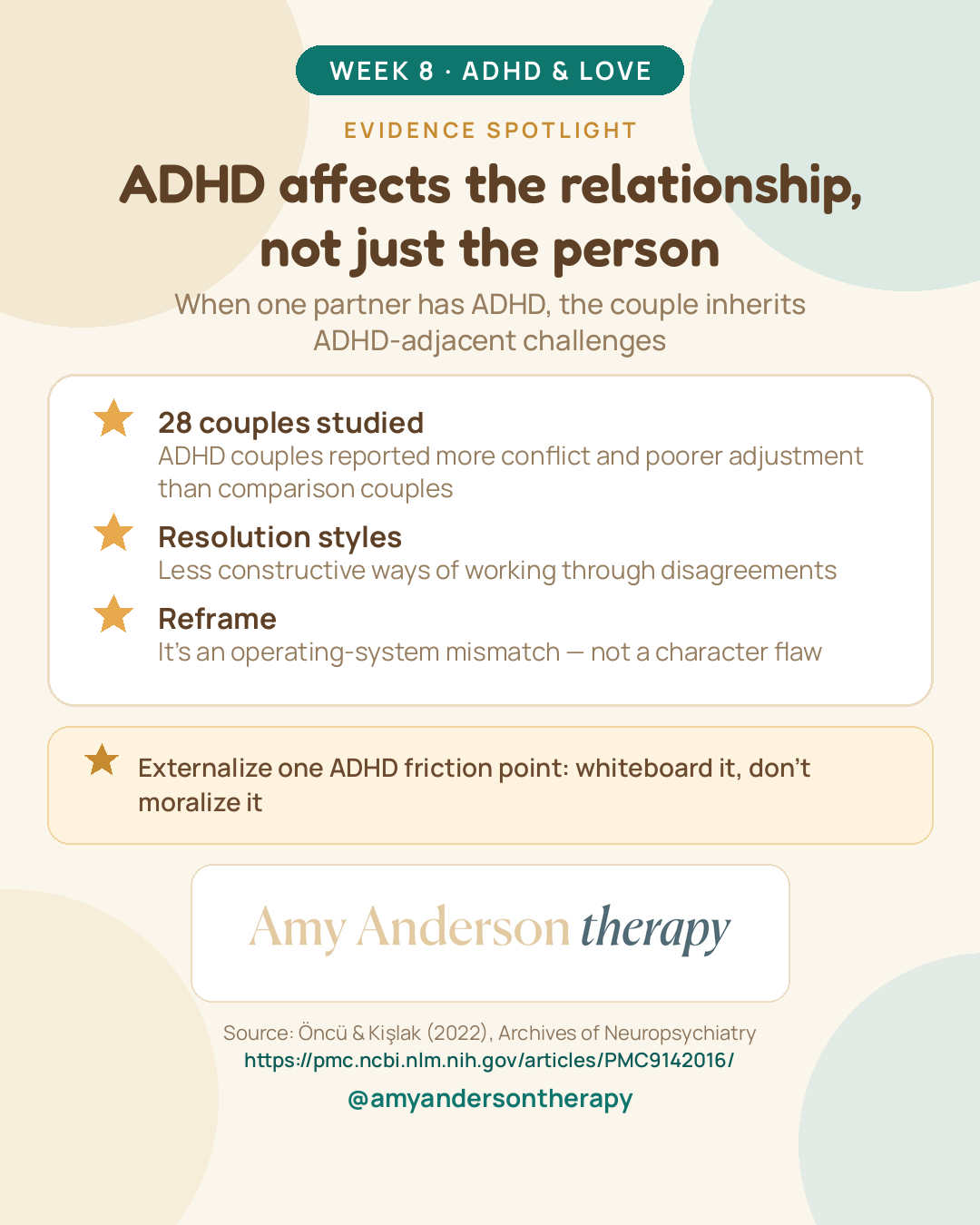
In 28 married couples where one partner had diagnosed ADHD vs. 28 comparison couples, the ADHD couples reported more marital conflict, poorer marital adjustment, and less constructive ways of resolving disagreements (Öncü & Kişlak, 2022, Archives of Neuropsychiatry).
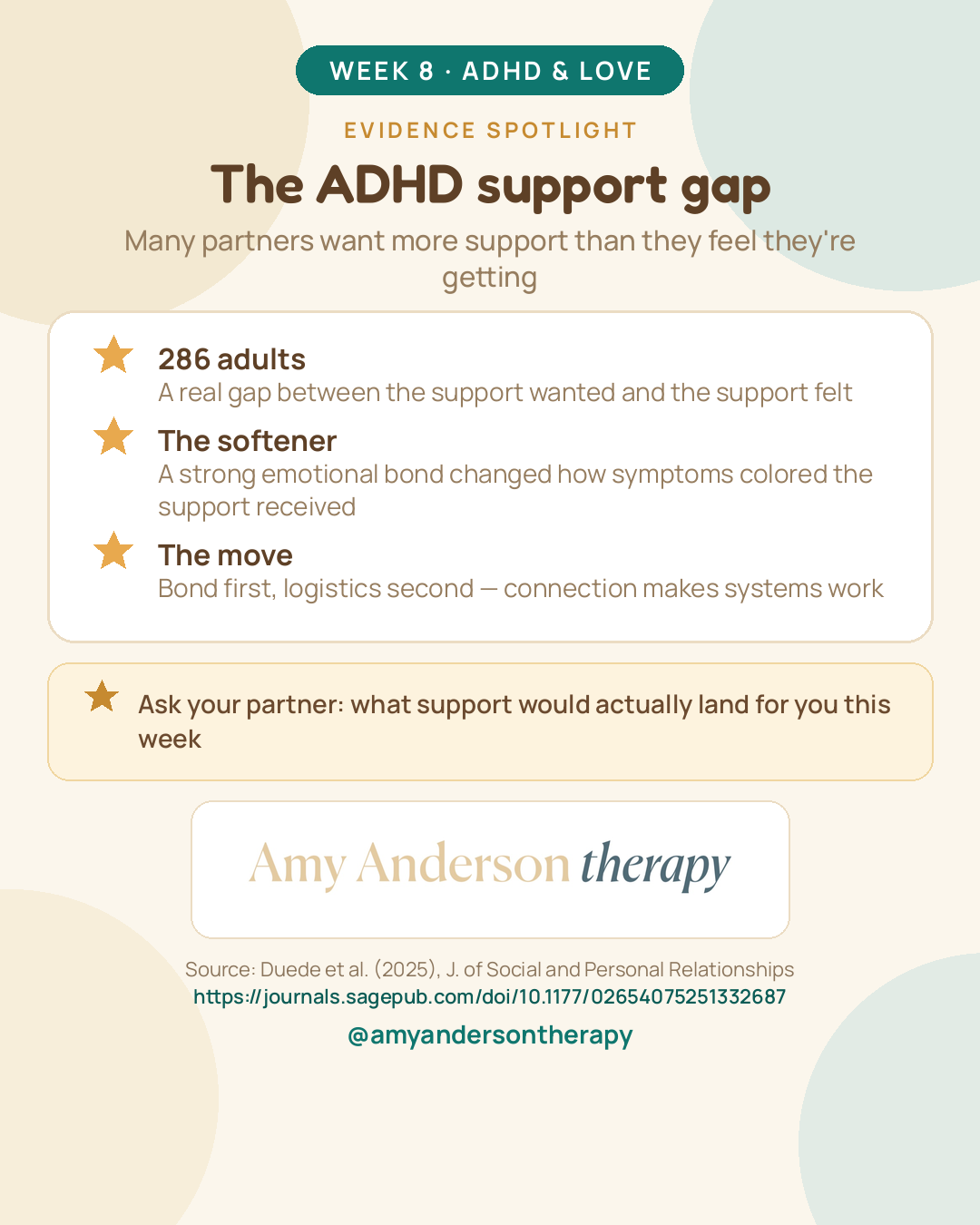
The hopeful thread: among 286 adults with ADHD in relationships, many wanted more support than they felt they got — a “support gap” — but a strong emotional bond softened how symptoms colored their view of the support they received (Duede et al., 2025, Journal of Social and Personal Relationships). The neurology is real; so is the buffer.
Full references live in your course research companion. These aren’t here to impress you — they’re here so you know this isn’t just my opinion.
Go deeper
From Amy’s blog — the free posts this week builds on:
ADD/ADHD in High-Achieving Couples: When Success Masks Executive Function Burnout
Three Predictable Narratives for Those Impacted by ADHD in Long-Term Committed Relationships
ADHD vs. Emotional Neglect: Why Conversations Go Sideways in Neurodiverse Couples
Neurocomplex Families: How to Support Neurodivergent Adults, Couples, and Kids
The blogs explain the neurology. This week, you wrote the manual. That closes Phase 2 — patterns named, mapped, and interrupted. Next week, Phase 3 begins: repair. The anatomy of trust ruptures, and how they actually heal.
Your homework this week
Short on time? Do items 1–2 — the manuals are the week. The rest is there when you have the bandwidth.
Read the lesson and listen to the voice note (20 min). Read top to bottom, play the 2-minute voice note, and name your operating system out loud: “My brain does ___ when overwhelmed.”
Write your OS Manuals (40 min). Download the OS Manuals handout. Each partner completes the template (20 min each), then trade and read fully before responding. No diagnosis mid-fight from here on — “check the manual” instead.
Co-design one accommodation agreement (30 min). Pick your biggest recurring friction point. Co-design one system that honors both nervous systems, write it down, and set a two-week review date.
Catch one hidden bid this week (ongoing). Notice a bid you’d have missed last week — the infodump, the parallel play, the staying in the room — and turn toward it. Say it out loud: “That was a bid.”
Companion workbook: complete the Week 8 worksheets (15 min) — the OS manual draft and the accommodation-agreement template, before your check-in.
Small things, often. One manual written, one system co-designed, one bid caught — that’s the whole assignment working.
Week 8 of 16 · Too Busy or Too Broke for Trauma Therapy · © Amy Anderson, LCSW. This material is psychoeducational and is not a substitute for therapy, diagnosis, or treatment.