
Week 9 — The Anatomy of Repair: Trust Ruptures & How They Actually Heal
Week 9
Too Busy or Too Broke for Trauma Therapy: A 16-Week Trauma-Informed Course for Couples & Individuals · Amy Anderson, LCSW
“What this is: Psychoeducation — evidence-informed information, frameworks, and practice exercises to help you understand your relationship patterns and build skills. It is not psychotherapy, couples therapy, or a clinical relationship. Nothing here diagnoses or treats a mental health condition. If you need clinical support — especially around trauma, addiction, or safety — work with a licensed professional in your state.
If you’re in crisis: call or text 988 (US Suicide & Crisis Lifeline) · National Domestic Violence Hotline: 1-800-799-7233 or text START to 88788.
Who this week is not for (yet): If there is ongoing physical violence, coercion, or fear in your relationship — or an active addiction or undisclosed affair without outside support — pause here and reach out for individual support first. This week’s repair work needs a foundation of basic safety. That’s not failure. That’s sequencing.”
Welcome to Week 9
Welcome to Phase 3 — Repair & Intimacy. The patterns are named. Now comes the harder, braver work: fixing what's actually broken.
Quick honesty up front: nobody likes this phase. Naming patterns was intellectual. Repair is personal. It asks the person who caused harm to sit in the fire of accountability, and the person who was hurt to risk trusting again — both without a guarantee. There's no version of this that's comfortable. But there is a version that's structured, honest, and actually works. That's this week.
The lesson
What “I’m sorry” gets wrong
Most of us were taught that repair looks like this: something bad happens, someone apologizes, everyone moves on. The apology is the period at the end of the sentence.
That’s not repair. That’s a wish.
Real repair is a process, not an event. Researchers who studied 16 couples that healed meaningfully found that trust wasn’t restored by a single apology — it was re-established as a two-way, reciprocal process over time (Fife et al., 2023). The apology is the starting line, not the finish line.
High achievers especially want the apology to “close the ticket.” Say the words, feel the relief, move on to the next thing. Trauma doesn’t close tickets. A traumatized nervous system keeps a ledger — and it doesn’t accept “I’m sorry” as payment. It accepts changed behavior, delivered repeatedly, over time.
A rupture vs. a pattern of ruptures
Before we touch the how, we need the what. Not all breaks are the same.
A rupture is a single event. It’s out of character. It gets named, owned, repaired — and it doesn’t happen again. The relationship has a scar, but the scar holds.
A pattern of ruptures is the same break, repeating. The relapse again. The lie again — or a new lie in the same shape. Each incident re-opens the last one, so you’re never repairing just this week’s event. You’re repairing the whole stack.
Here’s the discernment that matters: if the latest incident is one of many, you don’t get to repair just the latest incident. You have to name the pattern. Remember: the pattern is the problem, not either person. Trying to fix the dent while the car is still being crashed doesn’t work — and your partner knows it, even if they can’t articulate why your apology about Tuesday feels hollow.
Three questions to tell which you’re dealing with:
Has this — or something shaped exactly like this — happened before?
Was it addressed and then repeated anyway?
Does your body react to the anticipation, not just the event — the dread before the late night out, the stomach drop when the phone lights up?
Three yeses? You’re working with a pattern. The repair still follows the same four steps — but step three, changed behavior, has to address the pattern, not just the episode. (If the pattern involves addiction, this week’s work sits alongside professional support — not instead of it.)
The four-part repair process
Every real repair — the kind that actually restores trust — moves through four parts. Skip one and the whole thing wobbles.
Acknowledgment. Name what happened. Facts only, no spin, no minimizing, no "it wasn't that bad." The repairer owns the story accurately before anything else gets said. This is harder than it sounds — because the moment you add the spin, the injured partner's nervous system hears: they're still managing the story, not telling the truth.
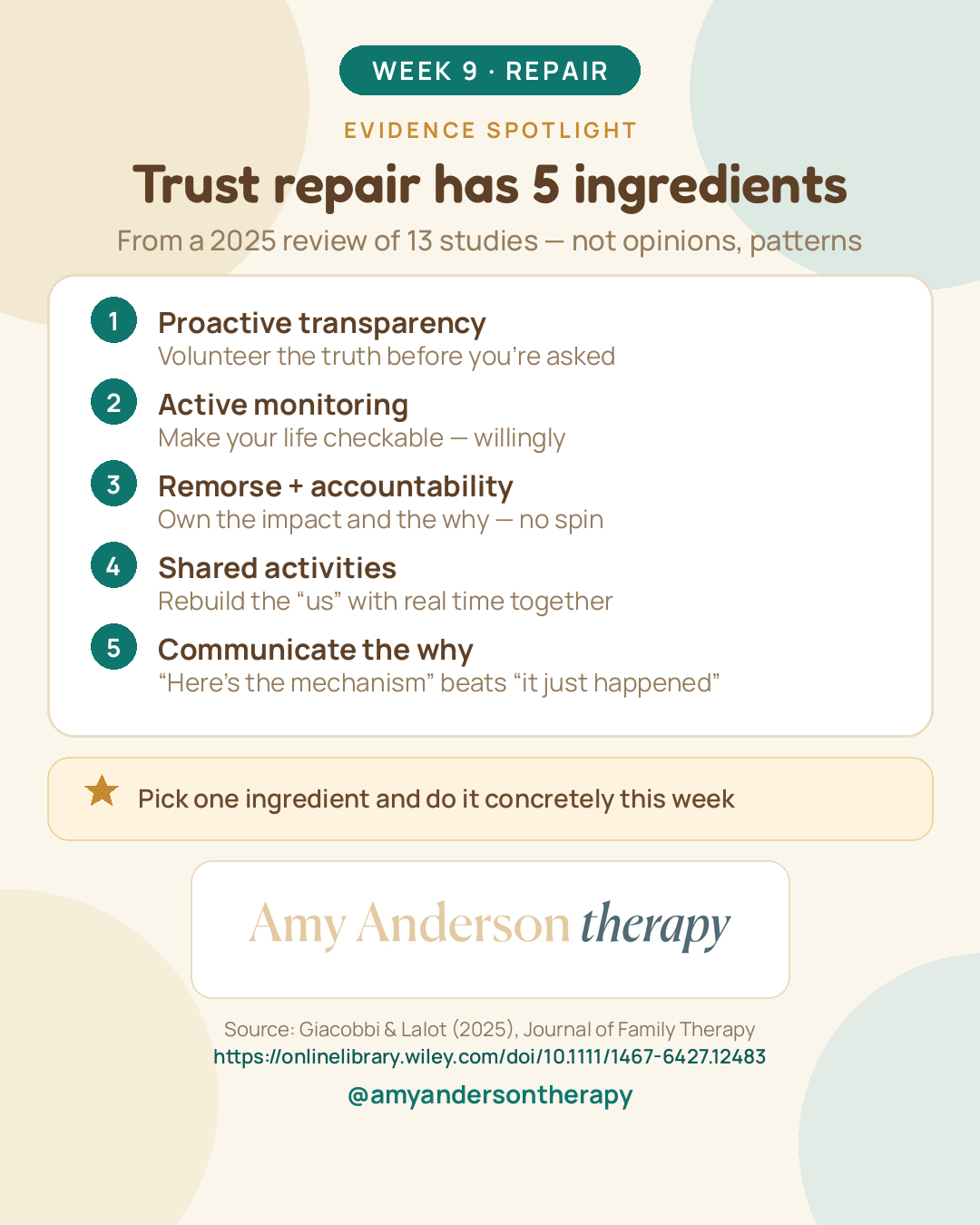
Accountability. This is the part most people skip straight past, and it's the part that matters most. Accountability has two halves: the impact ("here's what I understand this cost you") and the why ("here's my honest understanding of why I did it"). A 2025 review of 13 trust-repair studies found five recurring ingredients, and two of them live right here: remorse and accountability, and clearly communicating why the betrayal happened (Giacobbi & Lalot, 2025). The "why" isn't an excuse — it's the difference between "it just happened" (terrifying, because it could happen again at any time) and "here's the mechanism, and here's how I'm dismantling it" (something you can actually trust).
One more requirement for the repairer, borrowed from ACT: willingness. Owning harm feels awful — the heat in your face, the shame crawling up your spine, the urge to defend or rush to "okay, are we good now?" Willingness is the decision to have those feelings without obeying them: to stay in the chair, stay in the truth, and let the discomfort be the price of admission instead of the reason to leave. You don't have to like the feeling. You have to be willing to feel it while you do the work.
There's a line in Charlie Mackesy's book that belongs taped to the repair chair: "When have you been at your strongest?" asked the boy. "When I have dared to show my weakness." Sitting in that chair, undefended, willing to feel the heat in your face without leaving — that is exactly the kind of strong.
3. Changed behavior. Concrete. Dated. Observable. Not "I'll do better" — what exactly, by when, and how will they know. "I'll be home by 7 on weeknights, phone on the counter during dinner, and I'll text if I'm running late — starting tonight." Vague promises are where repair goes to die.
4. Check-ins over time. Trust is rebuilt in installments. The repairer's job is to keep showing up to the check-in — weekly at first — without resentment, without "are we still talking about this?" Yes. You're still talking about this. That's the job. The check-in is where the injured partner gets to say "this week felt safer" or "this week didn't," and the repairer gets to hear it without defending. That's how the ledger gets rewritten.
And one more truth, from my blog: if someone promises to resolve complex trauma in six sessions, keep walking. Trust isn't a quick fix. It's repetition.
The horse in Charlie Mackesy's book gives the repairer their whole job description in five words: "You fell — but I've got you." Not "you fell, here's my analysis of why." I've got you. That's the check-in, every week: I'm still here, I've still got you.
SLOW DOWN: the window-of-tolerance checkpoint
Repair conversations are the highest-activation conversations a couple can have. So before we go further — a mandatory checkpoint.
Signs you're outside your window of tolerance: heart pounding, or you can't feel your heartbeat at all · thoughts racing or totally blank · rehearsing counterarguments while your partner is still talking · tears you can't stop, or a flat numbness · the urge to leave, attack, or shut down completely.
If that's you right now: stop reading the script section. Use the Pause-and-Return Protocol from Week 1 — name it ("I'm in yellow"), separate for 20–30 minutes, regulate (walk, breathe, cold water — don't rehearse your points), return at a set time, and check states before resuming. If you can't get back to green within a day or two of trying, this repair needs a professional in the room with you. That's not a failure of the process — it's information about the size of the rupture.
Do not attempt a repair conversation yet if: you're currently activated · the rupture happened less than 72 hours ago and nobody can think straight · there's an active addiction without outside support · there's an undisclosed or ongoing betrayal (that's Week 10's territory, with its own safety rules) · there's violence, coercion, or fear in the relationship. Write down what you'd want to say, put it somewhere safe, and come back to this week's exercises when the conditions are right — or bring the blueprint to a professional.
The Repair Blueprint
This is the paid-lesson tool the blogs don't give you: a step-by-step template for one specific rupture. Print it, copy it into a doc, write it by hand — whatever you'll actually use.
THE REPAIR BLUEPRINT
Rupture (facts only): What happened, in plain sentences. No adjectives, no mind-reading, no "always/never."
Impact statement (injured partner): What it cost me — practically, emotionally, in the body. "When X happened, I felt ___, and what I made it mean was ___."
Accountability statement (repairer): What I did, why I understand I did it, and what I understand it cost you. No "but." No "you also."
Changed behavior plan: 2–3 concrete, observable changes with dates. What / by when / how you'll know.
Check-in schedule: Day, time, 10 minutes, weekly for the next month. (This becomes Exercise 2.)
The trigger underneath (Gottman's "enduring vulnerability" question): What old wound did this rupture touch? Gottman's aftermath-of-a-fight work asks each partner to name the deeper history the conflict activated — because most ruptures are bigger than the incident. "You forgot to call" lands harder when it touches "nobody ever showed up for me." Naming the older wound isn't excusing the rupture; it's explaining the size of the reaction, so the repair can address the real injury.
The structured conversation. Set it up to succeed: both regulated (green — check first), a scheduled time (never ambushed after a hard day), 30–45 minutes max, and the Pause-and-Return Protocol loaded and agreed upon in advance.
The injured partner reads their impact statement. The repairer listens — fully, no interrupting — then reflects back what they heard before responding: "What I heard is ___." Only then: acknowledgment, accountability statement, changed behavior plan. The repairer's only job in the first pass is to show the injured partner they were truly heard. Defending, explaining, or "but you—" ends the conversation. You can pause and try again another day. (This conversation borrows the skeleton of Gottman's "Aftermath of a Fight or Regrettable Incident" exercise — his structured format for processing a specific fight — adapted here for any rupture.)
The repair killers: the Four Horsemen — and their antidotes
Gottman research names four patterns that rot relationships from the inside — the “Four Horsemen” — and they don’t show up during the good times. They show up mid-repair, right when it matters most. Here’s each one, translated for this week’s work, with the Gottmans’ own antidote (I’m trained in the Gottman Method through Level 3 — these are taught the way I was taught them, in plain language, with credit where it’s due):
Criticism → the gentle startup. Criticism attacks character: “You never think about anyone but yourself.” A gentle startup leads with I, the specific situation, and the positive need: “I’m still hurting about Tuesday, and I need to understand what happened.” Same truth — but delivered in a way the other person can actually hear. In repair, criticism tries to sneak into the impact statement. Keep the impact about what happened and what it cost, not about who they are as a person.
Contempt → a culture of appreciation. Eye-rolls, mockery, disgust, the sarcastic sigh — contempt is the single most corrosive thing that can enter a repair conversation. The Gottmans’ antidote is building a culture of appreciation: deliberately, daily, catching what your partner does right. Contempt says “I’m above you.” Appreciation says “I see you trying.” Only one of those heals anything.
Defensiveness → taking responsibility. The repairer’s default move: deflection, counterattack, “well, you also—” Every defensive sentence deletes a sentence of accountability. The antidote is owning even the smallest true piece: “You’re right — I did minimize it, and I see why that landed badly.” Owning 10% of the truth is infinitely more repairing than defending 100% of your innocence.
Stonewalling → self-soothe, then re-engage. The blank stare, the monosyllables, the shutdown. Flooded nervous systems do this involuntarily (Week 1’s map explains why) — but involuntary or not, the antidote is the same: physiologically self-soothe, then re-engage. That’s exactly what the Pause-and-Return Protocol is. The pause is legitimate. The return is mandatory — which is why you set the return time before you separate.
The Weekly Trust Check-In
Ten minutes. Same day each week. Two questions, each partner answers both:
What built trust this week?
What dented it?
Rules: the listener reflects, doesn't defend. Nothing new and huge gets introduced in minute nine — if something big surfaces, it goes on the blueprint for a full conversation later. End with one specific appreciation. That's it. Boring, repeatable — and quietly the most powerful habit in this phase. Small things, often: that's the whole mechanism.
Run one DBT-informed skill inside this check-in: check the facts. When the injured partner's "dented it" answer is "I still don't trust you," slow down and separate what actually happened this week from what the alarm is predicting. Facts: did the repairer show up to the check-in? Follow through on the plan? Offer the transparency they promised? If the facts show follow-through and the feeling hasn't caught up — that's not a failed repair. That's a ledger that needs more entries. The body keeps receipts — so give it good ones. The feeling gets to exist. It just doesn't get to be the verdict. Try saying both out loud: "The facts this week were ___. What I'm feeling is ___."
One more Gottman concept to train here: repair attempts. In Gottman's research, a repair attempt is any small move one partner makes mid-tension to stop the spiral — a softer tone, a hand on the arm, a "we're on the same side here" — and what predicts whether couples make it isn't avoiding conflict; it's whether the other partner notices and accepts the attempt. This check-in trains exactly that muscle: hearing the other's reach instead of letting the alarm override it. When you reflect instead of defend, you're accepting the repair attempt. That's the mechanism.
Why it matters for trauma
Trauma trains the nervous system to keep a ledger — and to distrust inconsistency more than bad news. A partner who is warm on Monday and cold on Thursday is harder on a traumatized system than a partner who is consistently distant, because unpredictability is what the alarm was built to detect. This is why the check-in matters more than the grand gesture: repetition is what rewrites the ledger.
There's a second trap: shame. For the repairer, real accountability can feel like annihilation — the nervous system reads "I did something harmful" as "I am harmful" and slams into shutdown. That's why the script exists. Structure holds what shame wants to flee. If you're the repairer and accountability makes you want to disappear: that's the shame talking, not the truth. Stay in the structure.
And for the injured partner: your hypervigilance isn't the enemy of repair — it's data. "I don't believe you yet" isn't a verdict on the relationship. It's your system saying show me, repeatedly, over time. That's exactly what the four-part process is built to do.
Try this
Exercise 1 — Together: The Repair Blueprint
Purpose: run one complete repair — acknowledgment through check-ins — on a small rupture, to learn the skill. Time: 30–45 minutes for the conversation (plus writing time).
Why this works: structure holds what shame wants to flee. For the injured partner, an accurate, spin-free acknowledgment is the first data point that reality-testing can be trusted here. For the repairer, the script makes accountability survivable — four defined steps instead of an open-ended punishment. Starting on a 4-out-of-10 is deliberate: you're training both nervous systems on light weight before the heavy lift.
Choose one rupture — and start small, not with the biggest one. A repair conversation is a skill; learn it on a 4-out-of-10 before you take it to the 9.
Each partner fills out their half of the blueprint: facts, impact, what's needed. Then have the structured conversation using the script above. Non-negotiables: both green before you start, 45 minutes max, Pause-and-Return Protocol active and agreed upon. If either of you hits yellow or red, you pause — that's the protocol working, not the conversation failing. And remember Amy's rule: a pause without a return time is stonewalling with better branding. Set the return time before you separate.
Solo version: Complete the full blueprint for a past rupture — write both sides, as honestly as you can. Then write the accountability statement you needed to hear — the one nobody ever said. Read it aloud to yourself. Notice what your body does with it. (Grief is a common response. So is relief. Both are information.)
How you'll know it worked: the check-in got scheduled (day, time, recurring) before you closed the conversation — and the injured partner felt heard without having to fight to be heard. The scheduled check-in is the proof the repair is real.
Your homework this week
1. Run one full repair — small. Print the Repair Blueprint and work it end to end on a 4-out-of-10 rupture, not the biggest one. Writing time plus a 30–45 minute structured conversation. Both green first, Pause-and-Return Protocol on standby. Schedule the recurring check-in before you close the conversation — that’s the proof it was real.
2. Hold your first weekly trust check-in — 10 minutes. Same day each week, recurring: “What built trust this week? What dented it?” Listener reflects, doesn’t defend. End with one specific appreciation. When the urge to skip hits, remember: showing up to this check-in is opposite action — the streak is the repair.
3. Run the “Not Yet” check before any repair talk — 5 minutes. Regulated? Recent? Undisclosed? Motive — getting or giving? Any red flag means: write it down, put it somewhere safe, and reschedule — or bring it to a professional. Discernment counts as doing the work.
4. Companion workbook: complete the Week 9 worksheets — the full-lesson versions of the exercises above, with the reflection prompts built in (30 minutes, then stop).
5. One ingredient, concretely. From the five-ingredients list above, pick one trust-repair ingredient and do it observably this week — proactive transparency, active monitoring, accountability, a shared activity, or communicating the why. Changed behavior is dated and visible, not vibes.
Week 9 of 16 · Too Busy or Too Broke for Trauma Therapy · © Amy Anderson, LCSW. This material is psychoeducational and is not a substitute for therapy, diagnosis, or treatment.