

The Map: How Trauma Moves Through Relationships
Week 1
Every couple has a third party in their relationship. This isn’t a thrupple or an extra lover…. Something quieter and harder to name: the collective nervous system — yours, your partner's, and what happens when they join forces.
This week, we name it by understanding it. Before patterns, repair, desire, money, or anything charged in the weeks ahead — we build the understanding of your collective nervous system dance pattern via map. You can't navigate territory you haven't charted. And most couples are trying to fix their relationship while completely lost about what's actually happening in their bodies.
One rule for the whole course, starting now: we do this work regulated, not activated. If anything in a lesson spikes you, pause - regulate and return when recalibrated. There's a protocol for that below. Not optional equipment — the whole vehicle of our work requires regulation for you to be able to retain the content of the course.
As Charlie Mackesy put it: "Isn't it odd. We can only see our outsides, but nearly everything happens on the inside."
This course lives on the inside — the states, the stories, the alarm. That's where the relationship actually happens.
“What this course is: Psychoeducation — evidence-informed information, frameworks, and practice exercises to help you understand your relationship with self in relation to others. We will review patterns and build skills. It is not psychotherapy, couples therapy, or a clinical relationship. Nothing here diagnoses or treats a mental health condition. If you need clinical support — especially around trauma, addiction, or safety — work with a licensed professional in your state.
If you’re in crisis: call or text 988 (US Suicide & Crisis Lifeline).
National Domestic Violence Hotline:
1-800-799-7233 or text START to 88788.
Who this week is not for (yet): If there is ongoing physical violence, coercion, or fear in your relationship — or an undisclosed affair or active addiction without outside support — pause here and reach out for individual support first. Stabilization comes before coursework. That’s not failure. That’s sequencing.”
The Lesson
Trauma doesn't stay in one person
Here's the thing nobody tells you: trauma isn't just something that happened to you, back then. It's something that happens between you, right now.
Over the 22+ years I have worked with humans, I have found remarkable resiliency and self-sacrificing strategies that allow humans to rise in their professional, personal, and relational accolades. Our greatest military personal, medical doctors, fiercest litigators, and founders are the hardest working, highest achieving individuals out there, however many of them had underlying symptoms of PTSD, OCD, ADHD, Perfectionism, and Autism secondary to their early upbringing and genetics. I attribute these dynamics to relationships and attachment.
This is why I teach relational health to all my individuals, couples, and families I work with. Your loved one’s stress lives in your body as well. Your shutdown lives in theirs.
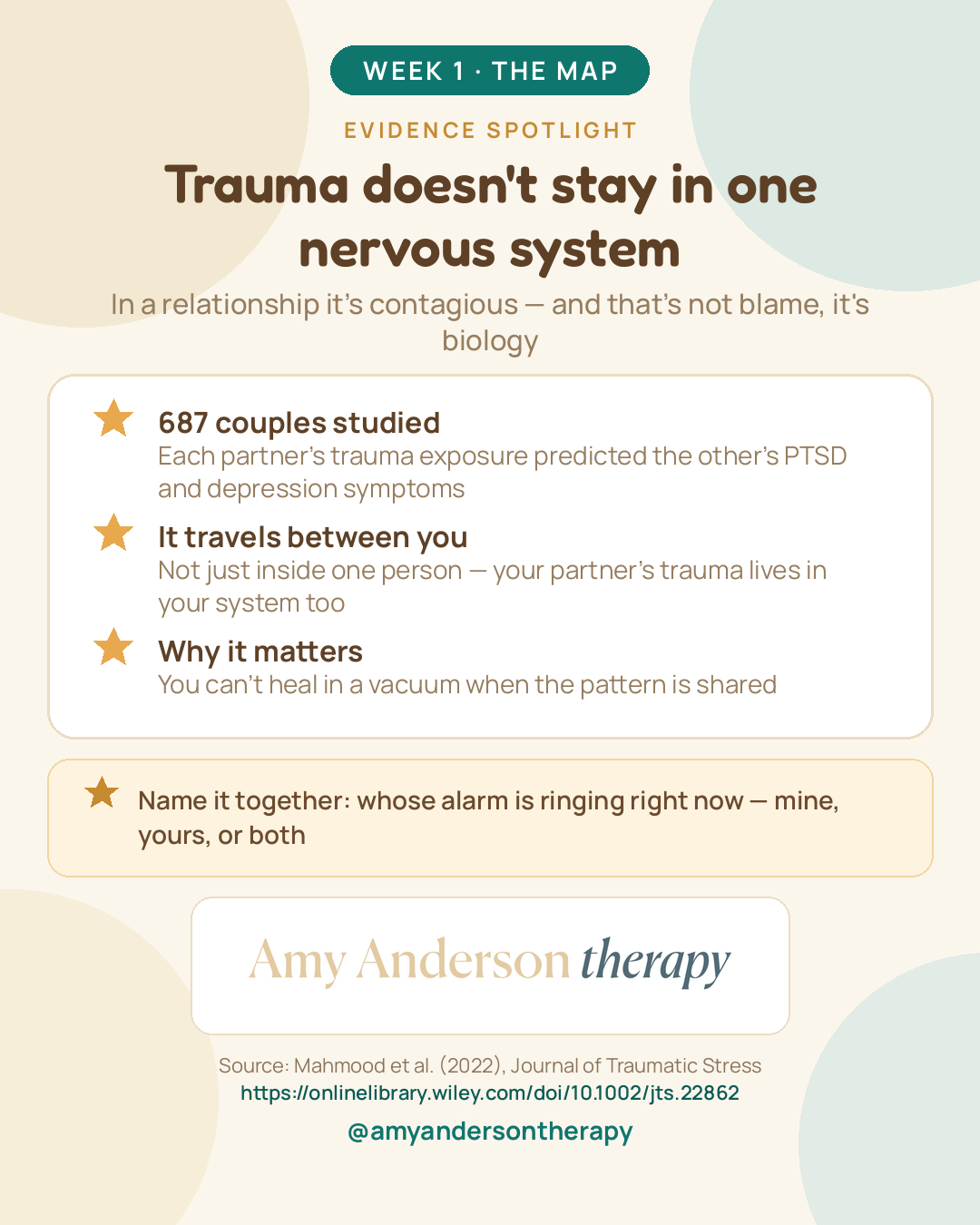
Researchers studied hundreds of couples and found that each partner's trauma exposure predicted the other partner's PTSD and depression symptoms. (Read my full blog: PTSD Doesn't Live in One Person)
Not just their own — their partner's.
Trauma moves through a relationship like weather moves through a house with the windows open.
"PTSD is a relationship diagnosis wearing an individual costume."
Which is why this course runs on one operating rule: the pattern is the problem, not anyone person. Two good people, one inherited weather system. You're not each other's enemy — you're both getting rained on and just want to learn how not to be wet and cold.
When we say "trauma-informed relationship course," we don't necessarily just mean a course about your childhood. We mean a course about what your relational history is doing to your partnership today — in real time. In your chest, your jaw, your gut, mid-argument about the intimacy, finances, or the dishes.
The 7 Signs Your Nervous System Is Running The Show
High achievers (my highly over generalization of those who are impacted by CPTSD, ADHD, Autism,OCD, Perfectionism) are world-class at overriding their inner child needs due to a sincere and honest fear of being abandoned or rejected by others. Push through exhaustion. Numb out discomfort. Avoid any type of feelings that distract from masking. Call it discipline? Your nervous system keeps receipts anyway. The signs my clients miss most:
The shutdown. You go blank mid-conversation. Not calm — gone. Words stop landing. You nod while feeling nothing. Not you "being difficult." Your system pulling the emergency brake.
The scan. Always half-listening for the next problem — your partner's tone, a delayed text back, a sigh that might mean something. Hypervigilance dressed up as "just being attentive."
The tension you live in. Jaw clenched. Shoulders up by your ears. Stomach in a permanent knot. Braced so long you think this is just how a body feels.
The exhaustion that sleep doesn't fix. Tired in a way weekends don't touch. Not a productivity problem. A nervous system that hasn't stood down in years.
The over-functioning. You manage everything — the calendar, the emotions, the conflict — because stillness feels dangerous. Control is your regulation strategy.
The numb scroll. Hours disappear into your phone. You feel nothing about it. Dissociation with a touchscreen.
The snap. Tiny things detonate you — a tone, a mess, a question asked the wrong way — and the reaction is ten sizes too big for the moment. Not about the dishes. Old alarm, new trigger.
The body keeps receipts — so give it good ones.
Starting this week, you write better ones.
None of these are character flaws.
They're states of being. Your nervous system has three basic gears that we need to understand to map out:
Green — regulated. You can think, feel, and connect at the same time. Curiosity is available. Humor is available. Your partner is a person, not a threat.
Yellow — activated. Fight-or-flight. Heart rate up, jaw tight, thoughts racing. Everything your partner says sounds like an attack — because your system is listening for attacks.
Red — shut down. Freeze or collapse. Numb, foggy, checked out. Can't access your words or your feelings. You're not ignoring your partner — you're offline.
Here's what matters for your relationship: you cannot have a productive conversation from Yellow or Red.
Not "it's harder."
You cannot.
The part of your brain that does empathy, compassion, patience, perspective-taking, and repair goes dim when survival mode takes over. Every fight that ever went in circles? Somebody was in Yellow or Red the whole time, and nobody named it.
The Story is not the State
Your nervous system doesn't just send signals — it writes stories. Mid-Yellow, the story sounds like: they don't care about me, this will never change, I'm too much.
CBT calls these distortions:
catastrophizing (this will never change)
mind-reading (they don't care)
all-or-nothing (I'm too much / they're never there for me)
The distortion itself isn't the problem. Believing it mid-flood is.
This week's practice: when you catch a story running in Yellow, name the distortion out loud.
"That's catastrophizing."
"That's mind-reading."
You don't have to fix the thought or argue with it. Naming it puts a crack between the state and the story. That crack is where Green gets back in.
Building your personal map
Generic advice fails because your nervous system isn't generic. Your Yellow doesn't look like your partner's Yellow. Your Red doesn't look like mine. So this week, you build your map — the specific, map of your bodily signs that reflect your emotions for yourself and others, recognizable signs of each state, in your words. Draw us the map for others to know you!
The single most useful thing you'll make in this entire course. Everything later — the repair scripts, the de-escalation tools, the desire work — depends on knowing which state you're in.
The ARC of this course: preparation, experience, integration
One more thing about how this course is built — the structure is doing work too.
Three movements:
preparation (Weeks 1–4: safety, mapping, understanding)
the work itself (Weeks 5–12: patterns, repair, intimacy)
integration (Weeks 13–16: becoming, maintenance, what's next)
That three-part arc mirrors a framework I use in my psychedelic-assisted therapy practice nothing deep happens without preparation first, and nothing deep lasts without integration after. The insight isn't the change. Preparation makes the work possible; integration makes it actually stick. You'll feel the arc as you go — and by Week 16, you'll understand exactly why it was built this way slowly, over time, with practice and integration.
The framework — prepare, do the work, integrate — belongs to everyone.
"If someone promises to resolve complex trauma in six sessions, keep walking."
Quick fixes don't touch this.
The nervous system needs repetition over time to learn emotional safety.
Why it matters for trauma
Trauma trains the nervous system to treat the present like the past. A partner's neutral face reads as rejection. A delayed reply reads as abandonment. A normal disagreement reads as danger. The alarm is real — it's just answering an old emergency.
Couples get stuck here because they argue about the content (the dishes, the money, the tone) while the actual problem is the state (Yellow, Red, and nobody regulated enough to notice). You can't think your way out of a body in survival mode. Notice the state first. Regulate second. Then talk.
One more finding worth sitting with: in a study of 199 veteran couples, partners who disagreed about how severe the trauma symptoms were had lower relationship satisfaction — above and beyond the actual severity of the symptoms. Being on the same page about what's happening matters as much as what's happening.
When couples face trauma together, "the partner stopped being collateral damage and became a participant in recovery." If your partner has PTSD and you're "fine," you're not fine — you're "the unmeasured second patient."
This course is, in large part, a 16-week project of getting on the same page.
Try this First
One thing today:
Exercise 1 — the safety inventory. Everything else in this course sits on top of it. The rest can wait. Whatever you do, do this first.
Exercise 1 — Together & Solo: The Safety Inventory
Purpose: build your regulation infrastructure before you need it. Time: 10 minutes.
Do this first. Everything else in the course requires it.
Write down — on paper, on your phone, somewhere you'll actually find it:
3 people you can reach when the work gets hard (name + how to contact them)
2 practices that reliably settle your body (walk, breath, music, cold water on your face — yours, not the internet's)
1 professional resource — your therapist, a crisis line, a support group. If you don't have one, write down 988.
Put it on the fridge. Screenshot it. This isn't homework — it's infrastructure.
Why this works: under threat, your prefrontal cortex — the part that plans and remembers — goes dim. A written list is an external brain for Yellow-you. You don't have to think your way to your resources; you just have to find them.
Bonus — your calm place (2 minutes). A stabilization skill from EMDR therapy- Phase 2 resourcing — settling the system, not processing trauma: close your eyes and picture a place where you've felt completely calm — real or imagined.
Notice what you see, hear, smell, feel there.
Give it a one-word name ("dock," "kitchen," "pines").
Write the word on your inventory. When you're rattled this week, visit it for 60 seconds -90 possibly just the image, just the feeling. No digging, no processing, no trauma material. Just a place your nervous system recognizes as safe and can be a place you return to yourself at anytime.
How you'll know it worked: you can lay hands on this list — or the calm-place word — within 30 seconds, without thinking, the next time you're activated. If you have to search for it, it's not a solid infrastructure yet.
Exercise 2 — Together: Name the Third Party In The Room
Purpose: practice naming body states out loud with a witness. Time: 15 minutes together.
Sit together, regulated (Green — not mid-conflict, not after a hard day). Each partner answers, out loud:
"One physical sensation I notice in my body when a fight starts escalating is ___."
Tight chest. Hot face. Numb hands. Stomach drop. Just naming. No fixing, no explaining, no "well you do X so I feel Y." The only job is to witness each other's map. End by telling your partner one thing from their answer you want to remember.
Solo version: Journal the same question for your last three conflicts. What sensation showed up each time? Look for the repeat — that's your Yellow.
Why this works: naming a body state is affect labeling — and research shows it measurably quiets the brain's alarm center. You're not analyzing. You're down-regulating with a sentence.
How you'll know it worked: you named one physical sensation of your Yellow while it was happening this week — even once. Naming it mid-activation is the whole skill.
Exercise 3 — The Pause-and-Return Protocol
Purpose: install the single most-used skill in this course. Time: 10 minutes to learn and rehearse.
Learn this now. You'll use it every week of this course and, ideally, for the rest of your relationship.
The Pause-and-Return Protocol → pause-and-return-protocol.pdf
Flooding First Aid: Physiological Soothing → experiential-physiological-soothing.pdf (the "regulate" half of the protocol, step by step: slow exhale, unclench, temperature, movement, and the full 20-minute wait)
What does this Pause and Return Protocol look like in real practice?
When either partner notices Yellow or Red — in themselves or each other — either person can call it: Name it. "I'm in Yellow right now." Or: "I think we're both activated. I want to pause."
Separate briefly. 20–30 minutes minimum. Not as punishment — as physiology reset that is rooted in science and effective communication. Gottman's research on flooding found it takes a minimum of 20 minutes for stress hormones to clear enough for Green to be possible.
That's the science behind the timer. Regulate, don't ruminate. Walk, breathe, cold water, music. Do NOT rehearse your argument points with your AI bot. That's just fighting alone.
Return at a set time. "Let's come back at 7:30 and try this again." The return time is sacred — pausing without a return time is just stonewalling with better branding.
Check states before resuming. "Where are you — Green, Yellow, Red?" If anyone's still Yellow or Red, extend the pause. No shame in it. Write your version of the script somewhere visible. Practice it once this week when you're not fighting, so it's available when you are.
Solo version: The protocol works with anyone you argue with — friends, family, roommates, coworkers, or clients. The script is the same; you just name it to yourself first ("I'm in Yellow, I need 25 minutes") and then say it out loud to the other person. Practice it once this week in one non-romantic relationship. The skill transfers. How you'll know it worked: you've said the pause script out loud once while calm — and you know where each of you goes during the pause. Rehearsed Green means available in Yellow.
Guided practice — Body scan:
We need to meet your nervous system (5 minutes)
Read the script below aloud slowly, in your own voice. Do it lying down or seated, somewhere you won't be interrupted.
Find a comfortable position and let your eyes close, or soften your gaze downward. You don't need to change anything about your breathing.
Just notice it. In... and out. Bring your attention to the top of your head. Notice any tension in your scalp, your forehead. See if you can let it soften, even one percent. No forcing. Just inviting. Move down to your eyes, your jaw.
High achievers hold entire meetings in their jaw. Let your teeth part slightly. Let your tongue drop from the roof of your mouth. Notice your throat, your shoulders. Are they up near your ears? Let them drop. Feel the weight of your arms.
Bring attention to your chest. Is it tight, open, heavy, buzzy? Don't judge it — just name it silently. Tight. Heavy. Okay. Move to your stomach. This is where a lot of us hold the alarm. Notice what's there. Breathe into it, not to fix it — just to keep it company.
Notice your hands. Warm, cold, clenched, numb? Let them be whatever they are. Move down through your hips, your legs, all the way to your feet. Feel the surface beneath you holding your weight. You don't have to hold yourself up right now.
Now ask your body one question, and just listen for whatever comes:
What state am I in right now — Green, Yellow, or Red?
Don't argue with the answer. Whatever you found — that's data, not a verdict. Take one more slow breath. When you're ready, open your eyes. Welcome to your map. Why this works: sensing your own body — interoception — is the skill every later week depends on. Noticing without fixing builds the observer muscle that lets you catch Yellow before it runs the fight.
How you'll know it worked: you finished with one honest answer to "what state am I in right now" — even if the answer was "I don't know yet." Noticing is the practice.
Reflect Your 20-minute weekly check-in ritual — the only "homework" in this course: 5 minutes on a states check (Green/Yellow/Red — separately, then compare if you're a couple) ·
10 minutes on this week's exercise
5 minutes on the reflection prompt below.
Same day, same time, every week. The ritual is the practice.
Journal on this — a few honest lines, not an essay:
"When I'm in survival mode, the story I tell myself about my partner is ___.
The story my body is actually telling is ___."
Then answer one more:
What's one sensation from your map you want your partner (or future partner) to recognize as "I'm not okay right now, and it's not about you"?
And one more — a grief seed for the weeks ahead:
One thing I'm grieving — the relationship I wished for, the childhood I didn't get, or the years I spent in survival mode — is ___.
Naming it doesn't fix it. It just stops it from driving your nervous system in the dark. Grief isn't linear, and it isn't a problem to solve. This week, you just name it.
And a last word for the whole sixteen weeks, from Charlie Mackesy's horse:
"Asking for help isn't giving up. It's refusing to give up."
This course is a form of asking — for better tools, a steadier partnership, a different story. That was never giving up. It was the opposite.
Evidence spotlight In 687 couples, each partner's trauma exposure predicted the other partner's PTSD and depression symptoms — trauma doesn't stay in one person; it moves through the relationship (Mahmood et al., 2022, Journal of Traumatic Stress).
In 199 veteran couples, simply disagreeing about how severe the PTSD symptoms were predicted lower relationship satisfaction — above and beyond the symptoms themselves (Grubbs et al., 2025, Family Process).
Being on the same page about what's happening matters as much as what's happening. Full references live in your course research companion. These aren't here to impress you — they're here so you know this isn't just my opinion.
Go deeper From Amy's blog — the free posts this week builds on:
How to Know If You Need Trauma Therapy: 7 Nervous System Signs High Achievers Miss
Why Trauma Shows Up Stronger in High-Performing Relationships
Trauma Therapy vs. High-Performance Coaching: What the Research Actually Says
The blogs tell you the signs exist. This week, you build your map so you can interact with others the best way for your regulation.
Next week: two nervous systems, one relationship — co-regulation, and what to actually do when you're both in Yellow.
Your homework this week
Do Exercise 1 today (10 minutes). Build your safety inventory — 3 people, 2 practices, 1 professional resource. Put it somewhere you can reach in 30 seconds. No other homework exists until this one does.
Download the handout and rehearse the protocol (10 minutes). Get The Pause-and-Return Protocol [blocked] and say the pause script out loud once while calm. Agree where each of you goes during a pause.
Do the 5-minute body scan once — today or tomorrow. End with one honest answer to "what state am I in right now?"
Catch one Yellow mid-week. Name one physical sensation of your Yellow while it's happening — and name one distortion out loud ("that's catastrophizing") when a story runs hot.
Hold your 20-minute weekly check-in ritual. Same day, same time: 5 minutes on a states check, 10 on this week's exercise, 5 on the reflection prompt.
Companion workbook: complete the Week 1 worksheets — your map, your states, your first grief seed.
Week 1 of 16 · Too Busy or Too Broke for Trauma Therapy · © Amy Anderson, LCSW.
This material is psychoeducational and is not a substitute for therapy, diagnosis, or treatment.