

The Dance:
Pursue,
Withdraw,
or the
Tango
Week 5
You've mapped your nervous system. Green, yellow, red — yours & your partners if you are
Now we zoom out. Because conflict in a relationship isn't just two nervous systems colliding. It's a dance. Same steps. Same music. Same ending. Every time.
Here's the thing about dances: once you learn the choreography, you can step off the floor. But first you have to see it. Most couples can replay their last fight in detail — who said what, who was wrong — but they've never once noticed they're running the exact same five-minute loop they've run a hundred times.
This week, we make the invisible visible.
“What this course is: Psychoeducation — evidence-informed information, frameworks, and practice exercises to help you understand your relationship with self in relation to others. We will review patterns and build skills. It is not psychotherapy, couples therapy, or a clinical relationship. Nothing here diagnoses or treats a mental health condition. If you need clinical support — especially around trauma, addiction, or safety — work with a licensed professional in your state.
If you’re in crisis: call or text 988 (US Suicide & Crisis Lifeline).
National Domestic Violence Hotline:
1-800-799-7233 or text START to 88788.
Who this week is not for (yet): If there is ongoing physical violence, coercion, or fear in your relationship — or an undisclosed affair or active addiction without outside support — pause here and reach out for individual support first. Stabilization comes before coursework. That’s not failure. That’s sequencing.”
The Lesson
Every Couple Has a Dance. Yours Probably Goes Like This.
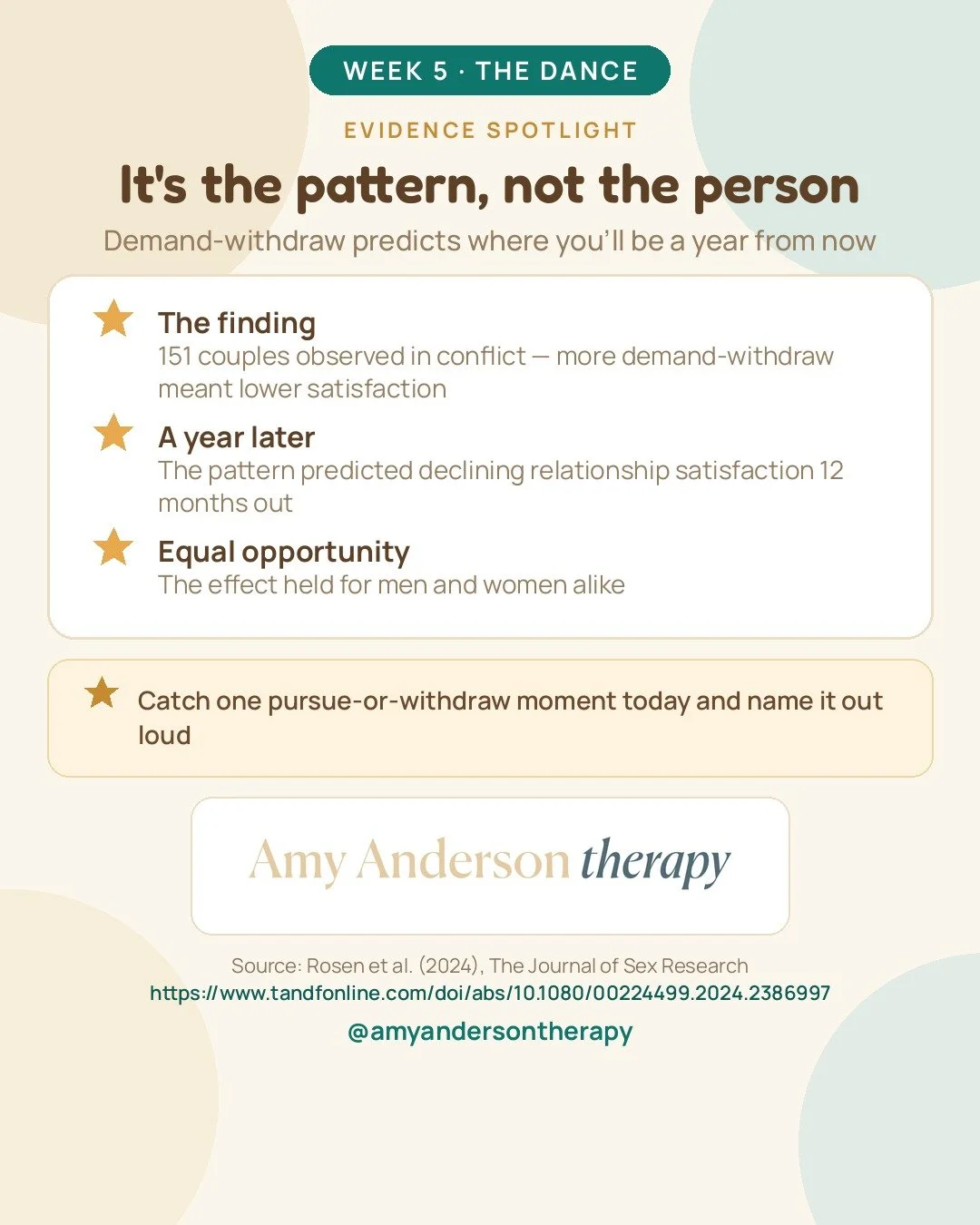
The most common conflict pattern in couples — especially trauma-affected couples — is demand–withdraw. In plain English: pursue–withdraw. One partner moves toward when upset.
The other moves away. The pursuer gets louder. The withdrawer gets quieter.
Both end up feeling abandoned.
It goes something like this:
The trigger. A tone. A forgotten errand. A delayed text. Or something big. Size barely matters.
The pursue move. One partner feels the disconnection and reaches — harder questions, raised voice, following the other person into the next room, the "we need to talk about this RIGHT NOW" energy. Underneath: I need you to come back. I'm scared we're not okay.
The withdraw move. The other partner feels the pressure rising and protects — goes quiet, leaves the room, changes the subject, suddenly has urgent emails. Underneath: I'm drowning. If I stay in this, I'll say something I can't take back. I need air.
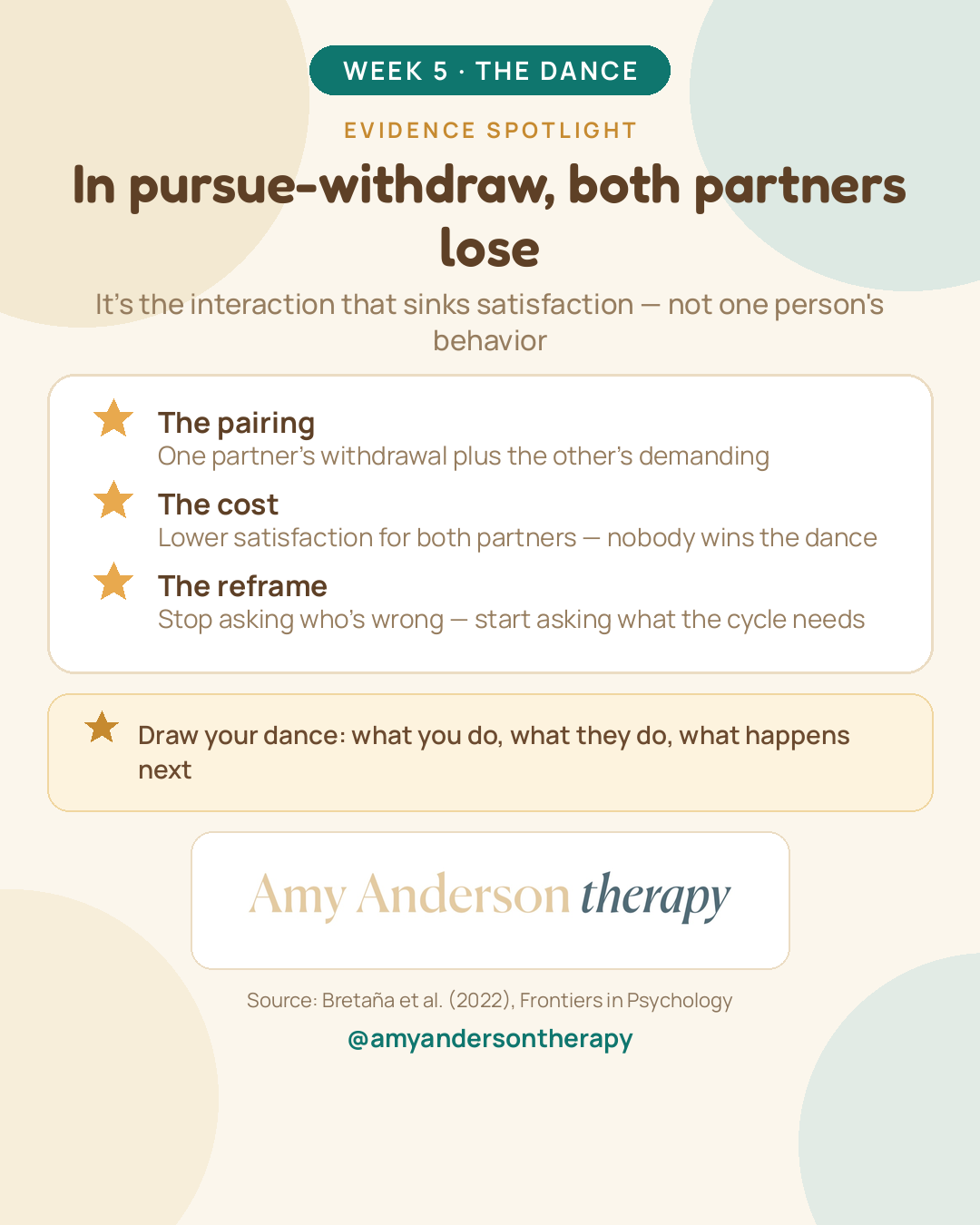
The escalation. The pursuer reads the withdrawal as indifference and pushes harder. The withdrawer reads the pushing as attack and shuts down further. Each person's protective move is the other person's trigger.
The emotional shutdown. Somebody leaves. Somebody slams a door — literal or emotional. Somebody sleeps on the couch. The fight ends without resolution. Nothing decided except that both people feel worse.
Gottman's Horsemen, in dance form. Escalation is where the Four Horsemen ride in — criticism ("you never"), defensiveness, contempt, and stonewalling — the patterns Gottman's research ties to conversations that go nowhere.
The antidotes live in this week's toolkit: the softened startup below (gentle, over criticism), taking responsibility for your part (over defensiveness), the pre-agreed repair attempt you're about to name together (over contempt), and physiological self-soothing instead of silent stonewalling (over stonewalling). You don't memorize these mid-fight. You recognize them when you're green — and interrupt them there.
Four Horsemen with their Anecdotes
Sound familiar? It should. This pattern shows up in couples everywhere — and the roles aren't as gendered as the old stereotypes said. Either partner can pursue. Either can withdraw.
Plenty of couples switch depending on the topic.
The pattern is the issue. Not either person.
What the Pursuer Actually Wants
Pursuers get a bad rap.
Controlling. Dramatic.
"Too much."
Let me translate — I sit across from pursuers every week:
The pursuer is not trying to control. The pursuer is trying to reconnect.
Pursuing is a proximity strategy. When the relationship feels shaky, the pursuer moves toward — because somewhere in their history, moving toward is what kept connection alive. The texting, the questions, the need to resolve it now — that's not manipulation. That's a nervous system that learned: if you don't grab connection fast, it disappears.
Pursuers are asking one question, over and over, in different costumes: Are we okay?
The tragedy: pursuing causes the thing it fears. The harder you pursue, the harder your partner withdraws. Which confirms connection is slipping. Which makes you pursue harder. The loop feeds itself.
What the withdrawer actually does
Withdrawers get a bad rap too. Cold. Avoidant. "Checked out." Indifferent. Translation time again:
The withdrawer is not indifferent. The withdrawer is overwhelmed.
Withdrawing is a self-protection strategy. When conflict escalates, the withdrawer's nervous system floods — heart rate up, thinking narrowing, the red-zone shutdown you mapped in Week 1 — and leaving is how they keep from doing damage. Many withdrawers grew up in homes where conflict was dangerous: yelling that escalated, silence that punished, adults who exploded. They learned the safest seat in a fight is outside the room.
Withdrawers are asking one question too, usually silently: Can I get out of here without everything getting worse?
And their tragedy mirrors the pursuer's: withdrawing causes the abandonment it fears. The partner reads the silence as "you don't care," pursues harder, and the withdrawer's exit confirms it — see? Conflict is dangerous. I was right to leave.
Why trauma makes the dance faster and meaner
In couples without significant trauma history, this dance still happens — it's a human pattern. But trauma puts it on a hair trigger.
Remember Week 1: trauma trains the nervous system to treat the present like the past. A pursuer with attachment wounds hears their partner's silence not as "I need a minute" but as "I'm leaving you." A withdrawer with conflict trauma hears their partner's raised voice not as "I'm upset" but as "danger, evacuate." The alarm is real. It's just answering an old emergency.
That's why the same fight can feel existential. You're not arguing about the tone of a text. You're arguing about whether you're safe and loved — and neither of you can say that out loud in the moment, because the dance has you.
When trauma runs the dance: control, compliance, and edicts
Trauma tends to polarize how a partner runs conflict — either hyper-controlling (every complaint becomes an edict, every preference a demand) or overly compliant (agreeing to everything to dodge the explosion, then quietly resenting it). Check your dance for both poles. The pursuer's "we need to talk about this RIGHT NOW" can be a complaint dressed as an edict. The withdrawer's instant "fine, whatever you want" can be compliance dressed as peace. Neither pole is the person — it's the trauma running the role. Naming which one you default to under threat ("I go controlling" / "I go compliant") gives you the same power as naming the cycle: now it's visible. Visible things can change.
What does this Pause and Return Protocol look like in real practice?
When either partner notices Yellow or Red — in themselves or each other — either person can call it: Name it. "I'm in Yellow right now." Or: "I think we're both activated. I want to pause."
Separate briefly. 20–30 minutes minimum. Not as punishment — as physiology reset that is rooted in science and effective communication. Gottman's research on flooding found it takes a minimum of 20 minutes for stress hormones to clear enough for Green to be possible.
That's the science behind the timer. Regulate, don't ruminate. Walk, breathe, cold water, music. Do NOT rehearse your argument points with your AI bot. That's just fighting alone.
Return at a set time. "Let's come back at 7:30 and try this again." The return time is sacred — pausing without a return time is just stonewalling with better branding.
Check states before resuming. "Where are you — Green, Yellow, Red?" If anyone's still Yellow or Red, extend the pause. No shame in it. Write your version of the script somewhere visible. Practice it once this week when you're not fighting, so it's available when you are.
Solo version: The protocol works with anyone you argue with — friends, family, roommates, coworkers, or clients. The script is the same; you just name it to yourself first ("I'm in Yellow, I need 25 minutes") and then say it out loud to the other person. Practice it once this week in one non-romantic relationship. The skill transfers. How you'll know it worked: you've said the pause script out loud once while calm — and you know where each of you goes during the pause. Rehearsed Green means available in Yellow.
Guided practice — Body scan:
We need to meet your nervous system (5 minutes)
Read the script below aloud slowly, in your own voice. Do it lying down or seated, somewhere you won't be interrupted.
Find a comfortable position and let your eyes close, or soften your gaze downward. You don't need to change anything about your breathing.
Just notice it. In... and out. Bring your attention to the top of your head. Notice any tension in your scalp, your forehead. See if you can let it soften, even one percent. No forcing. Just inviting. Move down to your eyes, your jaw.
High achievers hold entire meetings in their jaw. Let your teeth part slightly. Let your tongue drop from the roof of your mouth. Notice your throat, your shoulders. Are they up near your ears? Let them drop. Feel the weight of your arms.
Bring attention to your chest. Is it tight, open, heavy, buzzy? Don't judge it — just name it silently. Tight. Heavy. Okay. Move to your stomach. This is where a lot of us hold the alarm. Notice what's there. Breathe into it, not to fix it — just to keep it company.
Notice your hands. Warm, cold, clenched, numb? Let them be whatever they are. Move down through your hips, your legs, all the way to your feet. Feel the surface beneath you holding your weight. You don't have to hold yourself up right now.
Now ask your body one question, and just listen for whatever comes:
What state am I in right now — Green, Yellow, or Red?
Don't argue with the answer. Whatever you found — that's data, not a verdict. Take one more slow breath. When you're ready, open your eyes. Welcome to your map. Why this works: sensing your own body — interoception — is the skill every later week depends on. Noticing without fixing builds the observer muscle that lets you catch Yellow before it runs the fight.
How you'll know it worked: you finished with one honest answer to "what state am I in right now" — even if the answer was "I don't know yet." Noticing is the practice.
Reflect Your 20-minute weekly check-in ritual — the only "homework" in this course: 5 minutes on a states check (Green/Yellow/Red — separately, then compare if you're a couple) ·
10 minutes on this week's exercise
5 minutes on the reflection prompt below.
Same day, same time, every week. The ritual is the practice.
Journal on this — a few honest lines, not an essay:
"When I'm in survival mode, the story I tell myself about my partner is ___.
The story my body is actually telling is ___."
Then answer one more:
What's one sensation from your map you want your partner (or future partner) to recognize as "I'm not okay right now, and it's not about you"?
And one more — a grief seed for the weeks ahead:
One thing I'm grieving — the relationship I wished for, the childhood I didn't get, or the years I spent in survival mode — is ___.
Naming it doesn't fix it. It just stops it from driving your nervous system in the dark. Grief isn't linear, and it isn't a problem to solve. This week, you just name it.
And a last word for the whole sixteen weeks, from Charlie Mackesy's horse:
"Asking for help isn't giving up. It's refusing to give up."
This course is a form of asking — for better tools, a steadier partnership, a different story. That was never giving up. It was the opposite.
Evidence spotlight In 687 couples, each partner's trauma exposure predicted the other partner's PTSD and depression symptoms — trauma doesn't stay in one person; it moves through the relationship (Mahmood et al., 2022, Journal of Traumatic Stress).
In 199 veteran couples, simply disagreeing about how severe the PTSD symptoms were predicted lower relationship satisfaction — above and beyond the symptoms themselves (Grubbs et al., 2025, Family Process).
Being on the same page about what's happening matters as much as what's happening. Full references live in your course research companion. These aren't here to impress you — they're here so you know this isn't just my opinion.
Go deeper From Amy's blog — the free posts this week builds on:
How to Know If You Need Trauma Therapy: 7 Nervous System Signs High Achievers Miss
Why Trauma Shows Up Stronger in High-Performing Relationships
Trauma Therapy vs. High-Performance Coaching: What the Research Actually Says
The blogs tell you the signs exist. This week, you build your map so you can interact with others the best way for your regulation.
Next week: two nervous systems, one relationship — co-regulation, and what to actually do when you're both in Yellow.
Your homework this week
Do Exercise 1 today (10 minutes). Build your safety inventory — 3 people, 2 practices, 1 professional resource. Put it somewhere you can reach in 30 seconds. No other homework exists until this one does.
Download the handout and rehearse the protocol (10 minutes). Get The Pause-and-Return Protocol [blocked] and say the pause script out loud once while calm. Agree where each of you goes during a pause.
Do the 5-minute body scan once — today or tomorrow. End with one honest answer to "what state am I in right now?"
Catch one Yellow mid-week. Name one physical sensation of your Yellow while it's happening — and name one distortion out loud ("that's catastrophizing") when a story runs hot.
Hold your 20-minute weekly check-in ritual. Same day, same time: 5 minutes on a states check, 10 on this week's exercise, 5 on the reflection prompt.
Companion workbook: complete the Week 1 worksheets — your map, your states, your first grief seed.
Week 1 of 16 · Too Busy or Too Broke for Trauma Therapy · © Amy Anderson, LCSW.
This material is psychoeducational and is not a substitute for therapy, diagnosis, or treatment.